

Our partner for world banknotes research

| Wojcicki Polish Auction House > Special Auction I | Auction date: 23 May 2026 |
| Lot number: 59 Price realized: 22,651 EUR (Approx. 26,271 USD) Note: Prices do not include buyer's fees. | |
| Lot description: John III Sobieski, Medal Grzymułtowski treaty with Russia 1686 Very rare medal of John III Sobieski in fire gilded bronze, minted on the occasion of signing a treaty with Russia. The medal was ordered by Pope Innocent XI and made by Giovanni Battista Guglielmada, an artist who worked for the needs of the papal court for about twenty years, signed I•B•G•F• in exerque. On the presented medal, the artist clearly honored John III Sobieski, to whom he dedicated the entire obverse, and on the reverse, he presented a scepter to John III Sobieski standing with Zofia Alekseevna Romanova, regent of Russia. The previously mentioned couple steps on the crescent moon symbolizing Turkey. Obverse scratched. Obverse: bust of the King, the Royal head decorated with a crown is seen from the side IO III DACICVS TVRC TART POLON REX MAX (John III of Wallachia, Turkish, Tatar, Polish King, the most dignified) Reverse: The King of Poland and Sophia Alekseevna Romanova, Regent of Russia, standing, holding hands and trampling the crescent with their feet, in the episode DECENNALIA AVG (The Tenth Year of the King's Reign) PAX FVNDATA CUM MOSCHIS (Peace with Moscow established) Fire gilded bronze, diameter 65 mm, weight 109.29 g Bardzo rzadki medal Jana III Sobieskiego w BRĄZIE ZŁOCONYM OGNIOWO, wybity z okazji podpisania traktatu z Rosją. Medal, zamówiony przez papieża Innocentego XI, a wykonany przez Giovanniego Battistę Guglielmadę, artystę który przez około dwadzieścia lat tworzył na potrzeby dworu papieskiego, sygnowany w odcinku I•B•G•F•. Na prezentowanym medalu artysta uhonorował zdecydowanie Jana III Sobieskiego, któremu poświęcił cały awers, a na rewersie stojącemu Janowi III Sobieskiemu wraz z Zofią Aleksiejewną Romanową, regentką Rosji, wręczył berło. Wspomniana wcześniej para, zgodnie depcze półksiężyc symbolizujący Turcję. Delikatnie przetarte tło na awersie oraz zadrapanie. Prezencja ogólna znakomita. Medal zakupiony przez Lecha Kokocińskiego na aukcji w 2010 roku, opisany wówczas błędnie jako kopia. Jedyny znany, bity egzemplarz, ZŁOCONY grubo ogniowo! OGROMNA RZADKOŚĆ! Egzemplarz z unikatowej 'Kolekcji medali lwowskich i galicyjskich' Lecha Kokocińskiego, Honorowego Prezesa Polskiego Towarzystwa Numizmatycznego. Awers: popiersie Króla, głowa Królewska koroną ozdobiona z boku jest widziana IO III DACICVS TVRC TART POLON REX MAX (Jan III Wołoski, Turecki, Tatarski, Polski Król najdostojniejszy) Rewers: Król Polski i Zofia Aleksiejewna Romanowa, regentka Rosji, stojąc, trzymają się za ręce i nogami depczą półksiężyc, w odcinku DECENNALIA AVG (Dziesiąty rok panowania Króla) PAX FVNDATA CUM MOSCHIS (Pokój z Moskwą ugruntowany) Brąz złocony ogniowo, średnica 65 mm, waga 109.29 g Edward Raczyński przy tej pozycji pisze tak: 'Medal niniejszy bity został z powodu zawartego z Rossyą traktatu, który zamienił zawieszenie broni przez Jana Kazimierza w roku 1664 podpisane, na wieczysty (jak w ten czas mniemano) związek. Układ ten podpisali imieniem Jana III Grzymułtowski Wojewoda Poznański i Ogiński Kanclerz Wielki X. Litewskiego; ze strony zaś Rossyi Kniaź Galiczyn, który pod niedołężnem panowaniem Cara Iwana, i w czasie małoletności Piotra I sterem rządu w Rossyi kierował. Uciążliwe warunki, jakie w tem zdarzeniu przyjęli kommissarze Polscy, dowodzą w mniemaniu naszem słabość charakteru Jana III. Ten Monarcha ujęty prośbami Innocentego XI Papieża i Leopolda Cesarza, odstąpił krajów Zadnieprskich, Smoleńska i Kijowa Rossyi, w celu wciągnienia jej do ligi Chrześciańskiej przeciw Turkom i Tatarom. Tym sposobem poświęcił Jan III bezpośrednie dobro kraju swego polityce obcych mocarstw. Autor tego medalu w napisie jego naśladować chciał podobno medale dawnych Rzymskich Cesarzów, którym, jak wiadomo, przydomki dawano od zwycięst odniesionych lub zawojowanych krajów; tak i tu czytamy słowa Dacius, Turcicus, Tartaricus dla tego, że Król Jan był wtargnął do Wołoskiej ziemi i że po kilkakrotnie zgromił Turków i Tatarów.' Reference: Raczyński 241, Hutten-Czapski 2523 Grade: XF Starting price: 4820 EUR |  |
Match 1:
| Wojcicki Polish Auction House > Premium Auction 18 | Auction date: 26 September 2026 |
| Lot number: 365 Price realized: 23,419 EUR (Approx. 26,704 USD) Note: Prices do not include buyer's fees. | |
| Lot description: John III Sobieski, Medal Grzymułtowski treaty with Russia 1686 - VERY RARE, SILVER, ex. Potocki Very rare medal of John III Sobieski in SILVER, minted on the occasion of signing a treaty with Russia. The medal was ordered by Pope Innocent XI and made by Giovanni Battista Guglielmada, an artist who worked for the needs of the papal court for about twenty years. On the presented medal, the artist clearly honored John III Sobieski, to whom he dedicated the entire obverse, and on the reverse, he presented a scepter to John III Sobieski standing with Zofia Alekseevna Romanova, regent of Russia. The previously mentioned couple steps on the crescent moon symbolizing Turkey. Medal signed I•B•G•F• in exerque. Obverse: bust of the King, the Royal head decorated with a crown is seen from the side IO III DACICVS TVRC TART POLON REX MAX (John III of Wallachia, Turkish, Tatar, Polish King, the most dignified) Reverse: The King of Poland and Sophia Alekseevna Romanova, Regent of Russia, standing, holding hands and trampling the crescent with their feet, in the episode DECENNALIA AVG (The Tenth Year of the King's Reign) PAX FVNDATA CUM MOSCHIS (Peace with Moscow established) SILVER, diameter 65 mm, weight 142.04 g Edward Raczyński writes about this item: 'This medal was minted due to the treaty concluded with Russia, which changed the armistice signed by John Casimir in 1664 into a perpetual (as it was believed at that time) union. This treaty was signed under the name of John III Grzymułtowski Voivode of Posen and Ogiński, Grand Chancellor of the Tenth of Lithuania, and on the part of Russia, Prince Galiczyn, who was in charge of the government in Russia during the infirm rule of Tsar Ivan and during the minority of Peter I. The onerous conditions adopted by the Polish commissars in this event prove, in our opinion, weakness of the character of John III. This Monarch, persuaded by the requests of Pope Innocent XI and Leopold the Emperor, ceded the Trans-Dnieper countries, Smolensk and Kiev, to Russia in order to include it in the Christian league against the Turks and Tatars. In this way, John III devoted the immediate good of his country to the policies of foreign powers. In its inscription, the author of this medal apparently wanted to imitate the medals of old Roman Emperors, who, as we know, were nicknamed after victories won or conquered countries; so here we read the words Dacius, Turcicus, Tartaricus because King John invaded Wallachia and defeated the Turks and Tartars several times. Niezwykle rzadki medal Jana III Sobieskiego w SREBRZE, wybity z okazji podpisania traktatu z Rosją. Medal, zamówiony przez papieża Innocentego XI, a wykonany przez Giovanniego Battistę Guglielmadę, artystę który przez około dwadzieścia lat tworzył na potrzeby dworu papieskiego. Na prezentowanym medalu artysta uhonorował zdecydowanie Jana III Sobieskiego, któremu poświęcił cały awers, a na rewersie stojącemu Janowi III Sobieskiemu wraz z Zofią Aleksiejewną Romanową, regentką Rosji, wręczył berło. Wspomniana wcześniej para, zgodnie depcze półksiężyc symbolizujący Turcję. Medal sygnowany w odcinku I•B•G•F•. Rzadkość i zapotrzebowanie na tą pozycję doskonale obrazuje notowanie egzemplarza bitego w brązie złoconego ogniowo z naszej I Aukcji w Krakowie z notowaniem końcowym na poziomie 112 800 złotych. Oferowany numizmat to pozycja o klasę wyższą, jest to bicie w srebrze, na dodatek z wyśmienitą proweniencją z Kolekcji Potockich. Unikalna pozycja do wyspecjalizowanych zbiorów monet Polski Królewskiej. Awers: popiersie Króla, głowa Królewska koroną ozdobiona z boku jest widziana IO III DACICVS TVRC TART POLON REX MAX (Jan III Wołoski, Turecki, Tatarski, Polski Król najdostojniejszy) Rewers: Król Polski i Zofia Aleksiejewna Romanowa, regentka Rosji, stojąc, trzymają się za ręce i nogami depczą półksiężyc, w odcinku DECENNALIA AVG (Dziesiąty rok panowania Króla) PAX FVNDATA CUM MOSCHIS (Pokój z Moskwą ugruntowany) SREBRO, średnica 65 mm, waga 142.04 gReference: Hutten-Czapski 2523, Raczyński 241 Grade: XF Starting price: 7026 EUR | 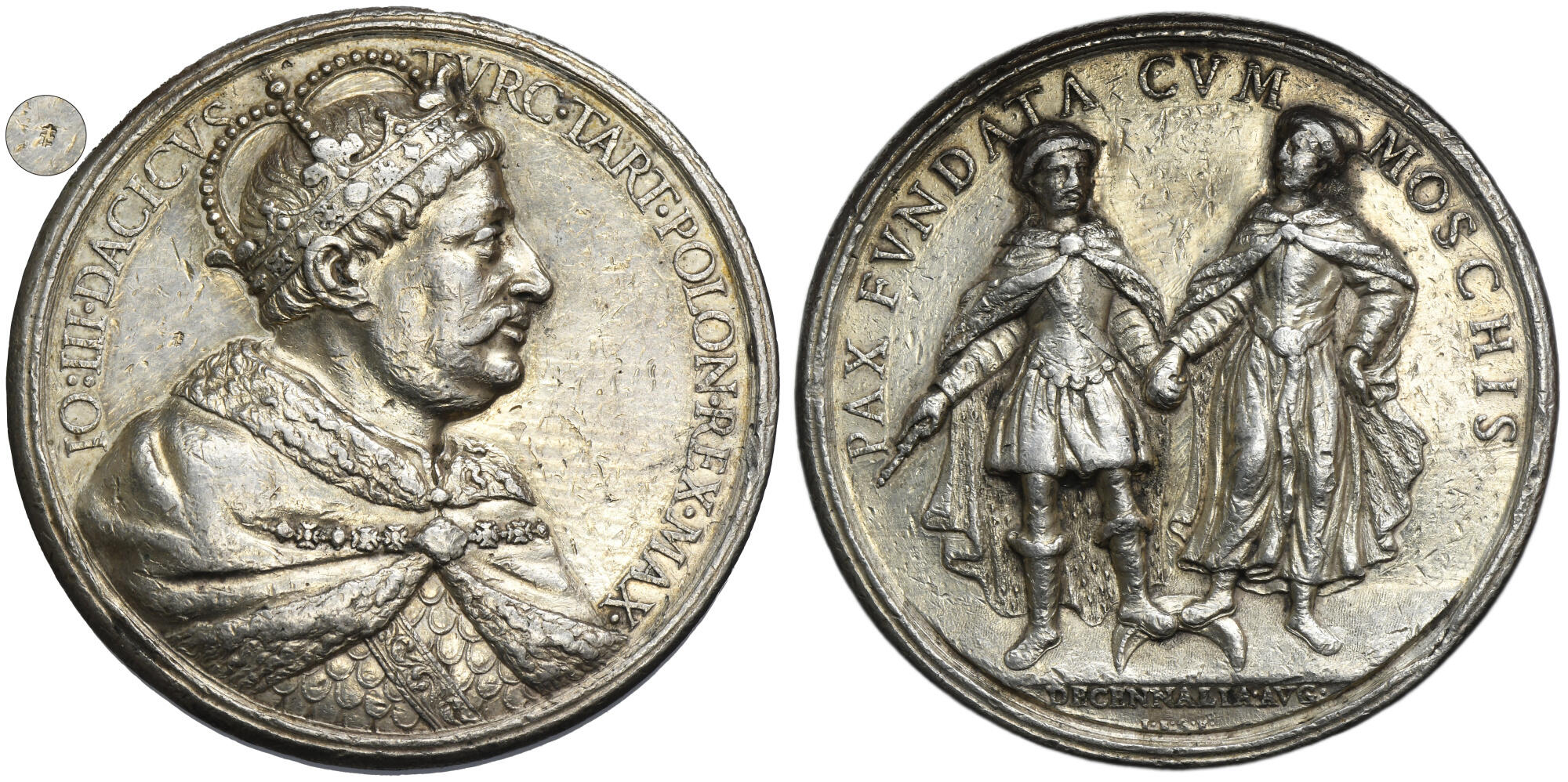 |
Match 2:
| Wojcicki Polish Auction House > Premium Auction 18 | Auction date: 26 September 2026 |
| Lot number: 366 Price realized: 2,810 EUR (Approx. 3,204 USD) Note: Prices do not include buyer's fees. | |
| Lot description: John III Sobieski, Medal Johannes Hevelius Danzig 1687 - SILVER A very rare and impressive posthumous medal of Johannes Hevelius (1611–1687), one of the most outstanding astronomers of the 17th century, struck in 1687 to commemorate his death. Johannes Hevelius, who spent his entire life in Gdańsk (Danzig), was one of the leading European scholars of his time. From his private observatory he conducted systematic astronomical observations, studied the Moon and comets, and compiled catalogues of stars. His monumental Selenographia of 1647 was one of the most important works in the history of lunar studies. Hevelius also held public offices in Gdańsk, serving first as a juror and later as a city councillor. The medal is the work of Arvid Karlsteen (1647–1718), a distinguished Swedish medallist active in Stockholm, whose signature appears beneath the astronomer's bust. The medal was issued during the reign of King John III Sobieski (1674–1696), who was an important patron of Hevelius and supported his scientific work. The relationship between the astronomer and the monarch is particularly reflected in Hevelius's naming of the constellation Scutum Sobiescianum ("Sobieski's Shield") in honour of the King and his victory at Vienna in 1683. The symbolism of the reverse is particularly noteworthy. An eagle soaring high above the earth and looking towards the rays of the sun forms an allegorical reference to Hevelius's astronomical pursuits and his ability to perceive what remained beyond the reach of others. The composition is complemented by the Latin motto IN SVMMIS CERNIT ACVTE, approximately meaning: "In the heights, he sees keenly." The medal also emphasizes the remarkable coincidence of the astronomer's dates – Hevelius died on 28 January 1687, on the very day of his 76th birthday. Attractive state of preservation. Original lustre remains visible, with the surfaces covered by a light, natural patina. A very rare medal with exceptional iconography, commemorating one of the most distinguished figures of science associated with Gdańsk and the 17th-century Polish-Lithuanian Commonwealth. Obverse: bust of Johannes Hevelius with long hair, wearing a robe, facing three-quarters left; below, the signature KARLSTEEN. IOHANNES HEVELIVS DANTISCA CONSVL Reverse: an eagle soaring high above a landscape, facing the rays of the sun descending from above; in the exergue Nat Ao 1611 Die 28 Jan Mort ipso natali Die 1687 IN SVMMIS CERNIT ACVTE Silver, diameter 45 mm, weight 46.06 g Ceniony medal pośmiertny Jana Heweliusza (1611–1687), jednego z najwybitniejszych astronomów XVII wieku, wybity w 1687 roku dla uczczenia jego pamięci. Jan Heweliusz, związany przez całe życie z Gdańskiem, należał do najważniejszych uczonych europejskich swojej epoki. Prowadził we własnym obserwatorium systematyczne obserwacje astronomiczne, zajmował się kartografią Księżyca, kometami oraz katalogowaniem gwiazd. Jego monumentalna Selenographia z 1647 roku należała do najważniejszych dzieł w historii badań Księżyca. Heweliusz pełnił również funkcje publiczne w Gdańsku, będąc ławnikiem, a następnie rajcą miejskim. Medal został wybity w okresie panowania Jana III Sobieskiego (1674–1696), który był ważnym mecenasem Heweliusza i wspierał jego działalność naukową. Relacja astronoma z monarchą znalazła szczególny wyraz w nazwaniu przez Heweliusza jednego z opisanych przez siebie gwiazdozbiorów Scutum Sobiescianum („Tarcza Sobieskiego"), na cześć króla i jego zwycięstwa pod Wiedniem w 1683 roku. Medal jest dziełem Arvida Karlsteena (1647–1718), wybitnego szwedzkiego medaliera działającego w Sztokholmie, którego sygnatura została umieszczona pod popiersiem astronoma. Szczególnie interesująca jest symbolika rewersu. Orzeł wznoszący się wysoko ponad ziemią i spoglądający ku promieniom słońca stanowi alegoryczne odniesienie do astronomicznych zainteresowań Heweliusza oraz jego zdolności dostrzegania tego, co dla innych pozostawało niedostępne. Kompozycję dopełnia łacińska dewiza IN SVMMIS CERNIT ACVTE, w przybliżeniu: „Na wysokościach widzi przenikliwie". Medal podkreśla również niezwykłą zbieżność dat życia astronoma, Heweliusz zmarł 28 stycznia 1687 roku, dokładnie w dniu swoich 76. urodzin. Ładny stan zachowania. Zachowany połysk, powierzchnia pokryta lekką, naturalną patyną. Bardzo rzadki medal o wyjątkowej ikonografii, upamiętniający jedną z najwybitniejszych postaci nauki związanych z Gdańskiem i Rzeczpospolitą XVII wieku. Srebro, średnica 45 mm, waga 46.06 gReference: Raczyński 255, Hutten-Czapski 3900 (R4) Grade: XF- Starting price: 1406 EUR | 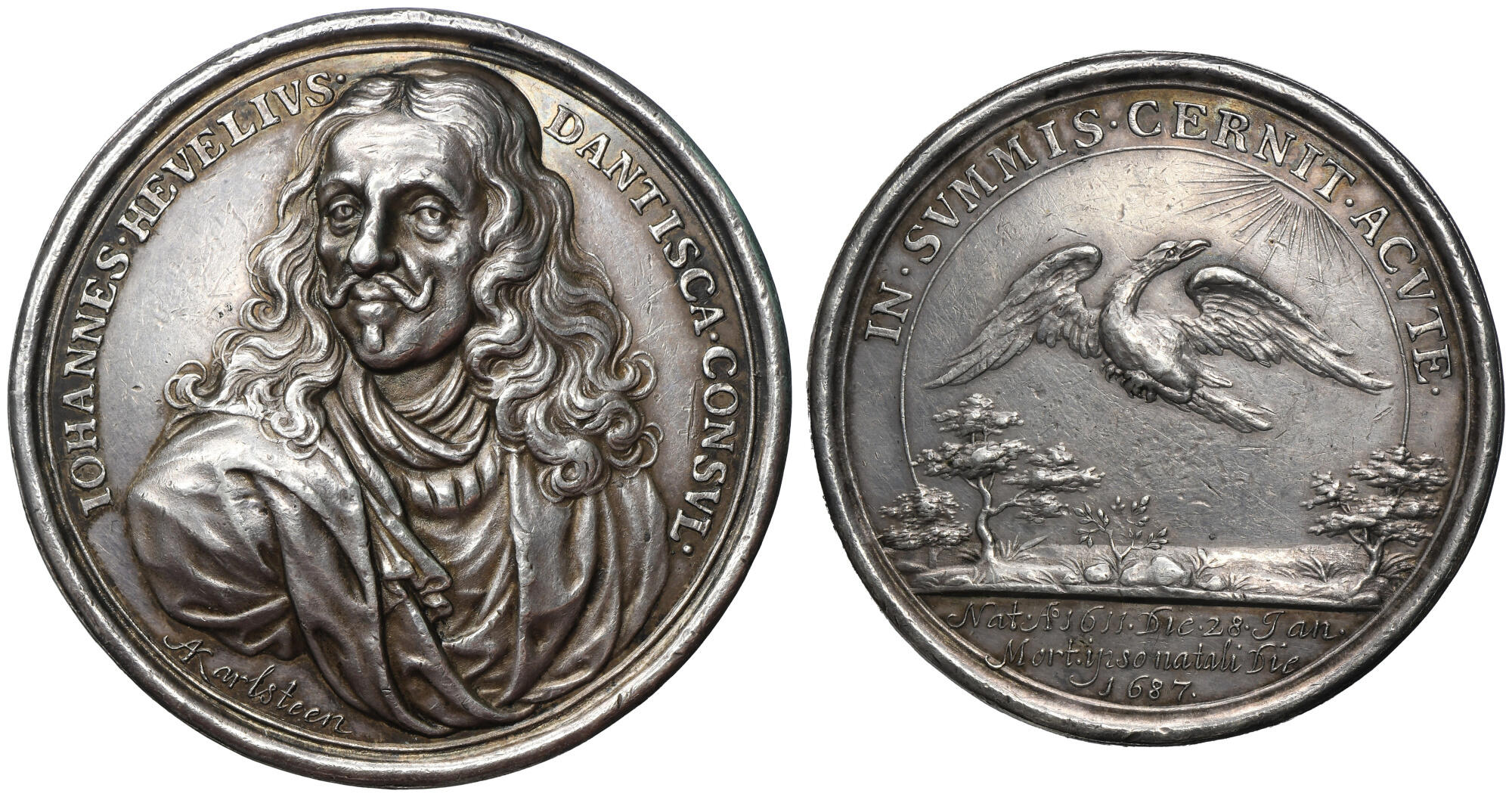 |
Match 3:
| Wojcicki Polish Auction House > Special Auction I | Auction date: 23 May 2026 |
| Lot number: 129 Price realized: 916 EUR (Approx. 1,062 USD) Note: Prices do not include buyer's fees. | |
| Lot description: Galicia, Token for the Coronation of the Image of the Virgin Mary at the Dominican Monastery in Lviv 1751 Veru rare issue minted on the occasion of the coronation of the image of the Virgin Mary in the Dominican Monastery in Lviv, which took place on July 2, 1751. The painting was crowned by Father Mikołaj Ignacy Wyżycki, based on permission issued by Pope Benedict XIV (1740-1758). The coronation was funded by the Potocki family: Ignacy, the starost of Kołomyja, and Mikołaj, the starost of Kaniv. Token from the unique "Collection of Lviv and Galician Medals" of Lech Kokociński, Honorary President of the Polish Numismatic Society. Obverse: under the crown on the sides, the date of which is 17-51, an inscription in five lines BENED:XIV:CORON / IMAg:B:V:MARIA: / LEOP APUD P.P. / ORD:PRÆD: / 9.IVLII Reverse: under the crown, on the cartouche, the Pilawa coat of arms, banners in the background GLORIA DECUS CORONÆ Silver, diameter 24 mm, weight 2.75 g Bardzo rzadki żeton w SREBRZE wybity z okazji koronacji obrazu Matki Boskiej w Klasztorze Dominikanów we Lwowie, która miała miejsce 2 lipca 1751. Obraz koronował arcybiskup lwowski ks. Mikołaj Ignacy Wyżycki, w oparciu o pozwolenie wydane przez papieża Benedykta XIV (1740-1758). Fundatorami koronacji byli dwaj przedstawiciele rodu Potockich: Ignacy starosta kołomyjski i Mikołaj starosta kaniowski. Na tę okoliczność wybito specjalne żetony koronacyjne, jak również wydano liczne druki okolicznościowe i kazania, m.in. autorstwa Franciszka Koźlewskiego i Antoniego Bieykowskiego. Po II wojnie światowej, w 1946 roku, dominikanie opuszczający Lwów przewieźli cudowny obraz do Polski. Obecnie znajduje się on w kościele św. Mikołaja w Gdańsku. Egzemplarz z unikatowej 'Kolekcji medali lwowskich i galicyjskich' Lecha Kokocińskiego, Honorowego Prezesa Polskiego Towarzystwa Numizmatycznego. Wielka rzadkość, w oryginale nienotowana na rynku aukcyjnym. Awers: pod koroną z boków, której data 17-51, napis w pięciu wierszach BENED:XIV:CORON / IMAg:B:V:MARIA: / LEOP APUD P.P. / ORD:PRÆD: / 9.IVLII Rewers: pod koroną, na kartuszu, herb Pilawa, w tle sztandary GLORIA DECUS CORONÆ Srebro, średnica 24 mm, waga 2.75 g Zaprowadzenie religii chrześciańskiej w Polsce przypadło właśnie w czasie, w którym cześć N. Maryi Panny zaczęła na zachodzie wzrastać. Dlatego też zaszczepioną zaraz została w umysły ojców naszych już w X i XI wieku, czego dowodem pieśń Boga rodzico dziewico, przypisywana Ś. Wojciechowi i tyle świątyń pańskich w najodleglejszych wiekach chrześciaństwa w Polsce, pod tytułem N. Maryi Panny wzniesionych. Cześć takowa Matki Zbawiciela, powiększyła się jeszcze w XVII wieku, rozszerzana szczególniej przez zakon Ś. Dominika, i w tym czasie najuczeńsi ludzie nasi, jakoto: Abraham Bzowski, Szymon Starowoski, Stanisław Albert Radziwill i inni, mnóstwo dzieł ascetycznych ku chwale jej wydali. Najwyższego przecież szczytu doszło nabożeństwo i uwielbienie N. Maryi Panny wtenczas, gdy Jan Kazimierz znękany przeciwnościami siebie i naród bogobojnym umysłem w opiekę jej oddał i obraz jej w Lwowie królową polską koronował, i gdy dzielny Kordecki, przeor Paulinów częstochowskich, odparłszy od Jasnej góry Szwedów, w dziele swojem Nova Gigantomachia, ocalenie tej twierdzy jedynie N. Pannie Maryi przypisywał. Od tej chwili namnożyło się po różnych miejscach Korony i Litwy, kościołów z cudownemi obrazami N. Panny Maryi, i niebylo prawie kościółka, w którymby przynajmniej ołtarz jeden N. Pannie rożańcowej, lub szkaplernej niebył poświęcony. Nabożeństwa po kościołach rozpoczynały Godzinki o N. Pannie, kończyły koronki, a bractwa N. Panny rozciągały się nawet do szkół. Do miejsc, które cudownemi obrazami N. Panny słynęły, liczyć należy: Częstochowę, Sokal, Podkamień, Lwów, Leżajsk, Berdyczew, Latyczew, Przemyśl, Poczajów, Jarosław i Łask. Bite na cześć Matki Boskiej w wspomnionych dopiero miejscach numizmaty (No. 464 - 483), w niniejszym umieściliśmy artykule. (hrabia Edward Raczyński - 'Gabinet Medalów Polskich') Reference: Raczyński 469, Hutten-Czapski 4092 (R4) Grade: XF Starting price: 723 EUR |  |
Match 4:
| Wojcicki Polish Auction House > Special Auction I | Auction date: 23 May 2026 |
| Lot number: 121 Price realized: 964 EUR (Approx. 1,118 USD) Note: Prices do not include buyer's fees. | |
| Lot description: Galicia, Medal Agricultural and Industrial Exhibition in Zhovkva 1910 Rare silver issue minted on the occasion of the Agricultural and Industrial Exhibition in Zhovkva in 1910. The medal was made at the Szapiry factory in Lviv. Cleaned. Plugged. Medal from the unique "Collection of Lviv and Galician Medals" of Lech Kokociński, Honorary President of the Polish Numismatic Society. Obverse: woman sitting against the background of a factory, with chimneys pouring smoke, a sheaf of grain on the left, agricultural and craft tools, a cogwheel under her left hand and a wreath in her raised right hand Reverse: under the crown, the two-field coat of arms of Zhovkva, surrounded by a plant wreath WYSTAWA ROLNICZA i PRZEMYSŁOWA • ŻÓŁKIEW 1910 • Silver, diameter 51 mm, weight 40.10 g Rzadka emisja w SREBRZE, wybita z okazji Wystawy Rolniczej i Przemysłowej w Żółkwi w 1910 roku. Medal wykonany w Zakładach Szapiry G. Syn we Lwowie, sygnowany na rewersie. Czyszczony. Załatana dziurka. Egzemplarz z unikatowej 'Kolekcji medali lwowskich i galicyjskich' Lecha Kokocińskiego, Honorowego Prezesa Polskiego Towarzystwa Numizmatycznego. Awers: kobieta siedząca na tle fabryki, z kominami z których wylatuje dym, z lewej snop, narzędzia rolnicze i rzemieślnicze, z kołem zębatym pod lewą ręką i z wieńcem w prawej, podniesionej ręce Rewers: pod koroną dwupolowy herb Żółkwi, otoczony wieńcem roślinnym WYSTAWA ROLNICZA i PRZEMYSŁOWA • ŻÓŁKIEW 1910 • Srebro, średnica 51 mm, waga 40.10 g Reference: Przemysł-Sztuka-Polityka 426 (w brązie złoconym) Grade: VF+ Starting price: 241 EUR | 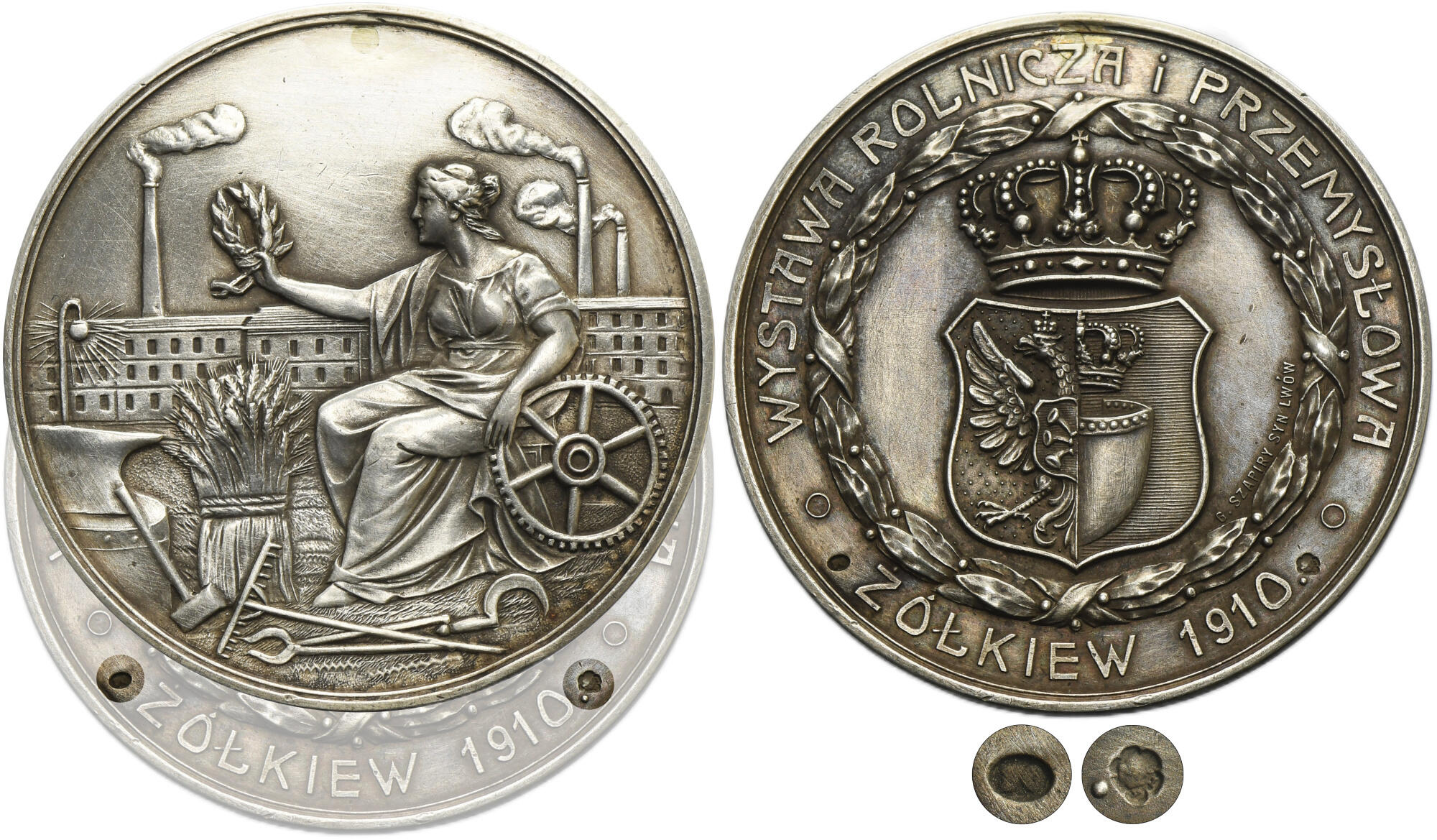 |
Match 5:
| Wojcicki Polish Auction House > Premium Auction 18 | Auction date: 26 September 2026 |
| Lot number: 374 Price realized: 1,030 EUR (Approx. 1,174 USD) Note: Prices do not include buyer's fees. | |
| Lot description: Poniatowski, Medal for the Granting of Rights to Dissidents 1768 Issued on the occasion of equal rights of dissidents with Catholics by Stanisław August Poniatowski, 1768. Medal by JL Oexlein, signed on the obverse. Smoothed background. An interesting addition to any collection of medals, especially from the period of Stanisław August Poniatowski. Obverse: bust of the king in armor and cloak three-quarters to the left, signature OEXLEIN on the shoulder. STANISL AVGVST DG REX POL MD LITHV Reverse: in the portico of the temple, Justitia and Pax kissing, above which the inscription CONCORDIA, in the section the inscription in three lines IVRA DISSIDENTIBVS / REDDITA / MDCCLXVIII Silver, diameter 38 mm, weight 21.93 g Edward Raczyński writes about this position as follows: 'From the time of their acceptance of the Christian faith, Poles not only staunchly but also zealously adhered to the Roman Catholic faith, and did not allow those who differed in their faith from the Roman Church to settle in their midst. Sometimes, in earlier centuries, private individuals and larger congregations came along who, having accepted teachings inconsistent with the Roman Church, undertook to express their own opinions and spread throughout the Polish lands. As we read, the sect of the Flagellants began to spread here, as Naruszewicz of Baszka proves, around the year 1261; which, however, is subject to doubt, because it is true that at that time this sect began and spread throughout the Italian lands, but the popes also successfully resisted it, and the rulers in their own lands did not tolerate it. I would therefore rather understand that this sect moved to Poland from Germany around the middle of the following century. where a terrible plague, called black, resurrected her. To suppress such and similar errors, the authority of the bishops was sufficient at that time. With the enlightenment and authority of the Roman See, they knew how to condemn and punish her even when necessary, without involving secular authority. An example of this involvement in Poland is found only in 1424, under Władysław Jagiełło. This monarch issued the sentence on the date in Wieluń, on Judica Sunday, that is, on the fifth Sunday of Lent, which imposes a heavy penalty on those who differ in faith from the Roman Church. But the date of this sentence itself reveals the motives for its making; for that same year, Žiška, the leader of the Hussites in Bohemia, died, and was succeeded by Prokop, against whom Sigismund the Emperor, even using the full might of his weapons, could achieve nothing. Therefore, King Jagiełło, fearing that these storms might reach Polish, a nation of one origin, with a very similar language and long-standing ties, attempted to prevent the misfortunes of his country with this verdict. In this verdict, he ordered special caution for those arriving from Bohemia to Poland, and recommended that Poles return to their homeland within a certain period of time under severe penalties. At the same time, he completely forbade the export of goods from Poland to Bohemia, namely lead, weapons, and food. The thought and motives of this law completely reveal all this. From that time on, for a hundred years and more, no laws punishing dissenters were passed by the secular authorities, convinced that judging what agrees with or contradicts the established religion in the country belonged to the bishops, its guardians. Only occasionally, more violent riots and religious disputes, initiated in various places, especially in Prussian cities, were prevented by sent commissions, court rulings, and local royal laws. For the spirit of proselytism, so often against the Church, The accusation against the Romans, far more powerfully animated those who intended to introduce, expand, and consolidate the changes occurring abroad in Poland. The leniency of Polish laws and the customs of the local inhabitants, which did not allow for the violent adaptation of laws to new dissenters, which a hundred years ago had been established against the Husssites, other specific events that would take a long time to enumerate, and finally, the insensitivity of many bishops, as long as it concerned only the teachings of the Church-all these factors combined to quickly and powerfully spread opinions opposed to the Roman Church. They were joined by very large and wealthy houses, such as the Górkas, Zborowskis, Ostrorógs, Zebrzydowskis, Stadnickis, and Gorajskis in Poland, the Radziwiłłs, Tyszkiewiczs, Chodkiewiczs, and Pacs in Lithuania. These, considering what the sovereign princes in Germany had done and what benefits they had derived from the change of religion, had similar laws. They appropriated sovereignty over their estates; therefore, they began to bring in clergy of their own faith, take away churches, encourage and lead their subjects to a similar faith, appropriate funds, and forbid the payment of eternally due tithes. This, along with the deprivation of jurisdiction, awakened the bishops, whom Cardinal Commando, even the nuncio in Poland at the time, openly supported in his letters to Rome, because, having grown cold in other matters, they insisted with the greatest fervor on their tithes. So, I say, the bishops began to complain, call for the defense of their rights, incite other Catholics, and King Sigismund Augustus himself, to shield them from such violent attacks. However, no bishop, no most zealous senator, or citizen participating in the debates, saw a difference of religion as any obstacle to the highest dignities and taking a seat in both the Senate and the Chamber of Deputies, although Those who differed from them in faith violently threatened to withhold the aid needed for the war, and demanded more and more prerogatives and freedom for themselves. Therefore, both the Senate and the Chamber of Deputies considered them not insignificant among themselves, and nothing harmful to them, nothing offensive to their civil rights, was decided. For the Constitution of Sigismund Augustus, issued in Kraków in 1550, could not have been considered strictly binding law, since the Catholics did not refer to it in so many subsequent adventures. Meanwhile, the Constitution promulgated at the Parczów Sejm in 1564 was the work of both Catholics and dissidents, of the twofold earlier confession, who, although hated each other in the fervor of those centuries, united with each other against Catholics, and with Catholics even against Aryans, neo-Baptists, Socinians, and the rabble of that foreign fugitives such as Bernardine Ochin, Faustus Socinus, and many others, whom both Catholics and former Protestants desired to expel from Poland and thus passed this law. This state of affairs remained when, during the interregnum following the death of Sigismund Augustus, these two parties clashed powerfully. While, to avoid major extremities, one party decided to establish a Catholic king, the other made an addition to the royal oath to ensure peace between the religious dissidents. The original meaning of the word dissidentes undoubtedly included Catholics, and meant that the king was to try to ensure that those who were arguing about faith lived in peace with each other, but soon after, through widespread use, the word began to mean those who differed in religion from Catholics. The return of many noble houses to the Roman Church weakened the dissident side. After all, they managed to maintain themselves in both the Senate and the Chamber of Deputies, and in distinguished offices, not only under Sigismund Augustus's closer successors, but even under Sigismund III, Władysław, and John Casimir. Although the former diligently tried to place anyone who wasn't Catholic in the Senate, he often abandoned this endeavor out of consideration for the great houses. At the Sejm of 1662, under King John Casimir, Bogusław Prince Radziwiłł was seen in the Chamber of Deputies, although he was still serving in Brandenburg at the time. I understand that more examples of this would be found in later times. There were apparently some plans to bar the path to honor for dissidents at the Treaty Sejm, due to the still-lingering hatred of the Saxons, especially the royal minister Flemming, but they settled for commonplace expressions that did them little harm. In 1718, at the Grodno Sejm, a deputy from the Wieluń region was barred from speaking in the Chamber of Deputies on religious grounds and dismissed from the proceedings. At the Convocation Sejm of 1733, a law was passed expelling all dissidents from the Senate and Chamber of Deputies in the future, and forbidding them from any dignities. Even elected dissidents were not admitted to the Chamber of Deputies at that same Sejm. I understand that this law, so offensive to dissidents, was passed partly to weaken the Saxon party, depriving it of the support of many sympathetic people who had close ties with the Saxons, and partly because the sad tragedy in Toruń, which occurred nine years earlier, was still fresh in the memory at that time. This opinion seems to be confirmed by the addition to this constitution, which, under the harshest penalties, forbade going to foreign powers, which was considered a great offense for Toruń at that time. These constitutions of the Convocation Sejm of 1733 (the original edition) were transformed and completely transferred to those found in the sixth volume of the constitutions; but the constitution against dissidents not only remained, but was also confirmed at the pacification sejm of 1735, and at the convocation sejm, and in the act of the general confederation of 1764, and by the pacta konserta of king stanisław august. The disappointed dissidents, in the hopes they had placed on the increased light and prosperity of their age, began to think of ways to regain their former national prerogatives and to remove the obstacles that blocked their path to national honors, and since they saw no way of obtaining this from their compatriots, they appealed to the powerful protection of the Russian Empress. After the interregnum ended and the king was universally recognized, Russian troops were withdrawn. The old policy of the Russian state compelled everyone to seize opportunities that would give this monarchy influence in Polish affairs. Moreover, the Empress believed that becoming the guardian of religion in Poland was a decent recompense for some of the wrongs done to her. She therefore eagerly seized this opportunity, and first, to test the inclinations of the minds, she ordered a motion to be made at the Sejm of 1766 by appointed officials to grant greater freedom to dissidents and restore some of their prerogatives. This motion was met with cries of utter disgust, not only from those entering the session but also from the arbitrators, and opposing opinions were met with applause, truly scandalous in such a solemn setting. Thus, a constitution was enacted, confirming all the rights against dissidents. When this failed, the dissidents, assured of the empress's effective assistance, plotted two confederations: a Crown confederation in Toruń and a Lithuanian confederation in Słuck. A certain coolness between the St. Petersburg and Warsaw courts revived the hopes of the more powerful lords, who proved to be the most opposed to King Stanisław. Thus, under the guise of patriotism, a confederation was formed, the so-called general confederation of the Crown and Lithuania, under the command of Prince Karol Radziwiłł, who had been deprived of the Vilnius voivodeship during the interregnum. A parliamentary session was held immediately, where, while greater sympathy was shown towards the dissidents, the Russian envoy, supported by the arms of his monarch, and by nature exceedingly violent, kidnapped two bishops of Kraków and Kiev, Hetman Rzewuski, an old man of great dignity and amiable to all, and his son, the starost of Dolina, then envoy, from Warsaw and ordered them to be taken to Russia, where they spent several years in exile. 'I have it from the lips of the most serious that the kidnapping of the bishop of Kiev, a lord of meager wealth, mediocre credit, and unfit for intrigue, resulted from an error-that is, an envoy issuing an order, or an officer receiving an order, when the real intention of the envoy was to send Bishop Wołłowicz of Lutsk to Russia. But this error, when it was known, was not corrected out of pride, premature shame, or fear of greater unrest. Indeed, to free Załuski would have presented a spectacle before the public eye that could have further outraged the minds. Taking Wołłowicz away would have been a repetition of the violence that the entire nation had complained about quite vigorously. Therefore, Załuski had to go into exile, unaware of the reason for his departure. The terrified parliamentary assembly saw no way to resist the open violence. Some remained gloomily silent, others complained about such an insult to national independence, but the power of Russia and the efforts of its minister brought matters to the desired end from the dissidents. These deliberations were transferred from the public assembly to a small number of delegates, whose task was to facilitate these matters with the Russian minister and the ministers of the Protestant powers, who had once been involved in concluding the Peace of Oliwa. The Russian minister made sure that the number of those opposed to Russia's plans did not outnumber the delegates elected. Thus, from this delegation, the dissidents received even more than they expected. They were granted access to all honors and dignities, to the possession of all kinds of royal estates, to full legislative power, and were granted great freedoms in the conduct of their rites and the construction of churches. Courts less suspect to them were established, and laws regulating their residence among other citizens, their trade, and their association with people of the same profession were abolished. In short, they were granted complete equality with Catholics. And although the Catholic religion was accorded a certain precedence and primacy, this was more a declaration of honor and a false title than a true elevation over other religions, except that it was guaranteed that the king would always be of the so-called Catholic, ruling religion. And this is precisely what the medal cited here calls consent, on the one hand, and on the other, rights restored to dissidents. I must admit, in praise of these dissidents, that they showed themselves far removed from the pride and violence of their ancestors two hundred years ago, who, like Catholics, shrank from remaining. The dissidents, endowed with such great prerogatives of our times, used them with great caution and moderation, which was not least contributed to by the serious complaints against the actions of this Sejm that arose soon after throughout Poland and Lithuania, and later by the confederations. The dissidents themselves determined the use of the granted prerogatives, renounced some very hateful ones, allowed others to be limited or modified, and indeed, by a separate act of the treaty with Russia concluded in 1775, March 15th, the Russian Empress allowed the nobility, Greeks, non-Uniates, and dissidents to be excluded from the Senate and from the ministries both in the Crown and in the Grand Duchy of Lithuania, while the number of dissident deputies was reduced to three, one from each province. By the same article, the judicium mixtum was abolished, referring cases to the assessory, but in dissident cases, there would be an equal number of Catholic and dissident assessors. They were not seen violently breaking into the Senate, they appeared rarely and in very small numbers in the Chamber of Deputies, and this as citizens participating together in the national debates, and not, as an example of the age of Sigismund Augustus, as dissidents forming a separate assembly, always ready to wrestle with the Catholics.' Emisja wybita z okazji zrównania w prawach dysydentów z katolikami przez Stanisława Augusta Poniatowskiego, 1768. Medal autorstwa J. L. Oexleina, sygnowany na awersie. Wygładzane tło. Ciekawe uzupełnienie każdego zbioru medali, szczególnie okresu Stanisława Augusta Poniatowskiego. Srebro, średnica 38 mm, waga 21.93 gReference: Raczyński 518, Hutten-Czapski 3099 (R2), Slg. Erlanger 2312 Grade: XF Starting price: 703 EUR | 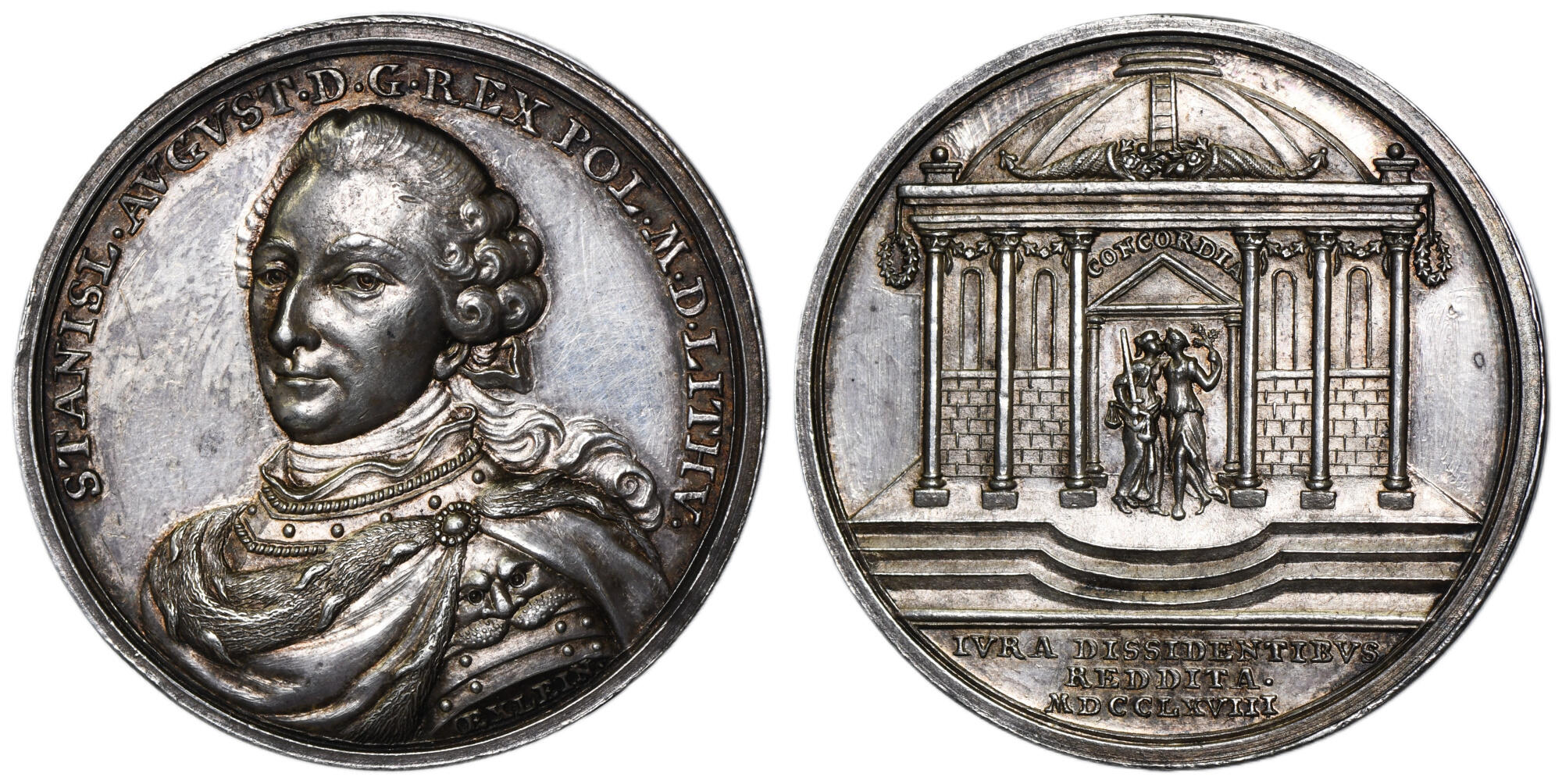 |
