

Our partner for world banknotes research

| Wojcicki Polish Auction House > Premium Auction 18 | Auction date: 26 September 2026 |
| Lot number: 14064 Price realized: 445 EUR (Approx. 507 USD) Note: Prices do not include buyer's fees. | Show similar lots on CoinArchives Find similar lots in upcoming auctions on  |
| Lot description: Greece, Corinthia, Corinth, Stater The Corinthian stater belongs to the most characteristic and recognizable coins of the ancient Greek world. The Pegasus and Athena type appeared in the coinage of Corinth towards the end of the 6th century BC and, over the following centuries, became the foundation of a monetary system whose influence extended far beyond Corinthia itself. The obverse depicts Pegasus flying left. The winged horse was closely associated with Corinth through the myth of Bellerophon. According to tradition, the hero captured and tamed Pegasus at the Peirene spring on Acrocorinth, using the golden bridle given to him by Athena. Pegasus consequently became one of the principal emblems of the city and the dominant motif on its silver staters. The reverse features the head of Athena wearing a Corinthian helmet. Behind the goddess appears a Chimera, the mythical creature slain by Bellerophon while riding Pegasus. Its presence is therefore more than merely an additional symbol: it perfectly complements the mythological programme of the coin, bringing together Athena, Pegasus and Bellerophon's legendary adversary. During the 4th century BC, Corinthian staters became one of the most important trade currencies of the western Greek world. Their distinctive design was adopted by numerous colonies and cities economically connected with Corinth, particularly in Akarnania, Epirus and the Ionian Islands. These mints retained the basic Pegasus–Athena scheme while introducing their own letters and additional symbols. These coins also acquired particular importance in Sicily. Their substantial presence there during the 4th century BC is associated, among other factors, with the expedition of Timoleon, who was sent from Corinth to Sicily in 344/343 BC to support Syracuse. In the following decades, Corinthian-type staters circulated extensively throughout the western Greek world. The present specimen, dated to c. 345–307 BC, belongs to the period when this monetary system was at its height. The Chimera behind Athena provides a particularly interesting complement to the iconography, directly evoking the myth of Bellerophon and Pegasus so deeply rooted in Corinthian tradition. Ex. WCN, e-Auction 547, Lot 360096. Greece, Corinthia, Corinth, Stater 345-307 BC Obverse: Pegasos flying left Reverse: head of Athena in a Corinthian helmet facing right, left, Chimera behind her Diameter 22 mm, weight 8.36 g Stater Koryntu należy do najbardziej charakterystycznych i rozpoznawalnych monet świata greckiego. Typ z Pegazem i Ateną pojawił się w mennictwie miasta pod koniec VI wieku p.n.e. i przez kolejne stulecia stał się podstawą systemu monetarnego, którego oddziaływanie wykroczyło daleko poza samą Koryntię. Na awersie przedstawiono Pegaza lecącego w lewo. Skrzydlaty koń był szczególnie silnie związany z tradycją Koryntu poprzez mit o Bellerofoncie. Według tradycji heros schwytał i okiełznał Pegaza przy źródle Peirene na Akrokoryncie, korzystając ze złotego wędzidła otrzymanego od Ateny. Właśnie dlatego Pegaz stał się jednym z najważniejszych symboli miasta i dominującym motywem jego srebrnych staterów. Rewers przedstawia głowę Ateny w hełmie korynckim, będącą drugim podstawowym elementem tej ikonografii. Za głową bogini umieszczono Chimerę, mitycznego potwora pokonanego przez Bellerofonta podczas lotu na Pegazie. Jej obecność nie jest więc jedynie znakiem dodatkowym, lecz doskonale uzupełnia mitologiczny program monety, łącząc w jednym typie Atenę, Pegaza oraz przeciwnika Bellerofonta. W IV wieku p.n.e. statery korynckie stały się jednym z najważniejszych pieniądzy handlowych zachodniej części świata greckiego. Ich charakterystyczny typ był naśladowany przez liczne kolonie i miasta związane gospodarczo z Koryntem, szczególnie w Akarnanii, Epirze i na wyspach Morza Jońskiego. Poszczególne ośrodki zachowywały podstawowy schemat Pegaz–Atena, wprowadzając własne oznaczenia i symbole. Szczególne znaczenie monety te uzyskały również na Sycylii. Ich liczny napływ w IV wieku p.n.e. wiązany jest m.in. z działalnością Timoleona, wysłanego z Koryntu na Sycylię w 344/343 p.n.e. w celu wsparcia Syrakuz. W następnych dekadach typ koryncki był szeroko obecny w obiegu zachodniego świata greckiego. Prezentowany egzemplarz, datowany na ok. 345–307 p.n.e., pochodzi z okresu największego rozpowszechnienia tego systemu monetarnego. Chimera umieszczona za głową Ateny stanowi szczególnie interesujące dopełnienie ikonografii, bezpośrednio odwołując się do mitu Bellerofonta i Pegaza, tak silnie zakorzenionego w tradycji Koryntu. Ex. WCN, e-Aukcja 547, Lot 360096. Grecja, Koryntia, Korynt, Stater 345-307 pne Awers: Pegaz z rozpostartymi skrzydłami lecący w lewo Rewers: głowa Ateny w hełmie korynckim w prawo, po lewo, za nią Chimera Średnica 22 mm, waga 8.36 gReference: Calciati 428 Grade: VF+ Greece Corinthia Corinth Stater Starting price: 282 EUR | 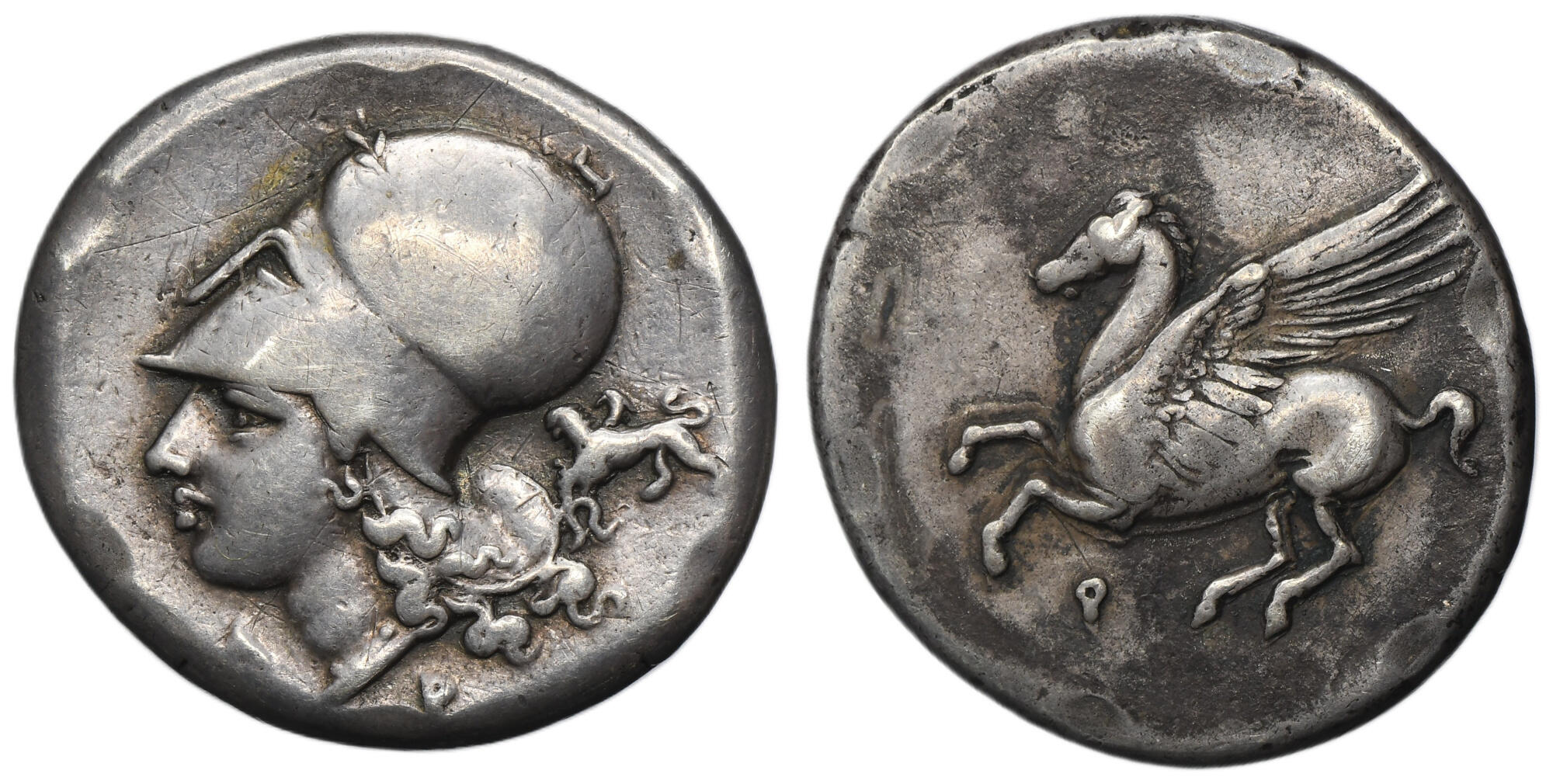 |
