

Our partner for world banknotes research

| Wojcicki Polish Auction House > Premium Auction 18 | Auction date: 26 September 2026 |
| Lot number: 14062 Price realized: 632 EUR (Approx. 721 USD) Note: Prices do not include buyer's fees. | Show similar lots on CoinArchives Find similar lots in upcoming auctions on  |
| Lot description: Greece, Akarnania, Thyrreium, StaterThe stater of Thyrreion belongs to the characteristic group of Corinthian-type staters, widely circulated throughout western Greece during the 4th and 3rd centuries BC. Thyrreion was one of the important centres of Akarnania, a region maintaining extensive commercial contacts with Corinth and the cities of the Ionian Sea. The obverse depicts Pegasus flying left, with the letter P below. The reverse features the head of Athena wearing a Corinthian helmet, also facing left. The type directly follows the famous staters of Corinth, whose iconography and weight standard were adopted by numerous mints throughout the western Greek world. Pegasus and Athena form a coherent iconographic programme associated with the myth of Bellerophon. According to tradition, Athena helped the hero tame Pegasus by providing him with a golden bridle. Owing to the widespread popularity of Corinthian coinage, the combination of these two images became one of the most recognizable monetary types of ancient Greece. The issues of Thyrreion testify to the importance of the Corinthian monetary standard in Akarnania. The use of the familiar Pegasus and Athena type facilitated the acceptance of these coins in interregional trade, while local letters and symbols served to distinguish individual issues. The present specimen, dated to c. 320–280 BC, belongs to the Early Hellenistic period, when the cities of western Greece continued to employ traditional Corinthian imagery while adapting it to their own local coinage. Ex. Artemide Aste, e-Auction 59, Lot 185. Greece Akarnania, Thyrreium, Stater 320-280 BC Obverse: pegasus flying left, letter P below it Reverse: head of Athena in Corinthian helmet left Diameter 23 mm, weight 8.37 gStater Thyrreion należy do charakterystycznej grupy staterów typu korynckiego, szeroko rozpowszechnionych w zachodniej Grecji w IV i III wieku p.n.e. Thyrreion było jednym z ważniejszych ośrodków Akarnanii, regionu pozostającego w intensywnych kontaktach gospodarczych z Koryntem i miastami położonymi nad Morzem Jońskim. Na awersie przedstawiono Pegaza lecącego w lewo, pod którym znajduje się litera P. Rewers zajmuje głowa Ateny w hełmie korynckim, również zwrócona w lewo. Typ ten bezpośrednio nawiązuje do słynnych staterów Koryntu, których ikonografia i standard wagowy zostały przejęte przez liczne ośrodki zachodniej części świata greckiego. Pegaz i Atena tworzą spójny program ikonograficzny związany z mitem o Bellerofoncie. Według tradycji Atena pomogła herosowi okiełznać Pegaza, przekazując mu złote wędzidło. Dzięki ogromnej popularności monet Koryntu zestawienie tych dwóch przedstawień stało się jednym z najbardziej rozpoznawalnych typów monetarnych starożytnej Grecji. Emisje Thyrreion są świadectwem znaczenia korynckiego standardu monetarnego w Akarnanii. Posługiwanie się dobrze znanym typem Pegaza i Ateny sprzyjało akceptacji monet w handlu międzyregionalnym, jednocześnie lokalne oznaczenia i symbole pozwalały identyfikować poszczególne emisje. Prezentowany egzemplarz, datowany na ok. 320–280 p.n.e., pochodzi z okresu wczesnohellenistycznego, kiedy miasta zachodniej Grecji nadal wykorzystywały tradycyjną ikonografię koryncką, dostosowując ją do własnego mennictwa. Ex. Artemide Aste, e-Auction 59, Lot 185. Grecja Akarnania, Thyrreium, Stater 320-280 pne Awers: pegaz lecący w lewo, pod nim litera P Rewers: głowa Ateny w korynckim hełmie w lewo Średnica 23 mm, waga 8.37 g Reference: Calciati 5, HGC 4, 919 Grade: XF Starting price: 282 EUR | 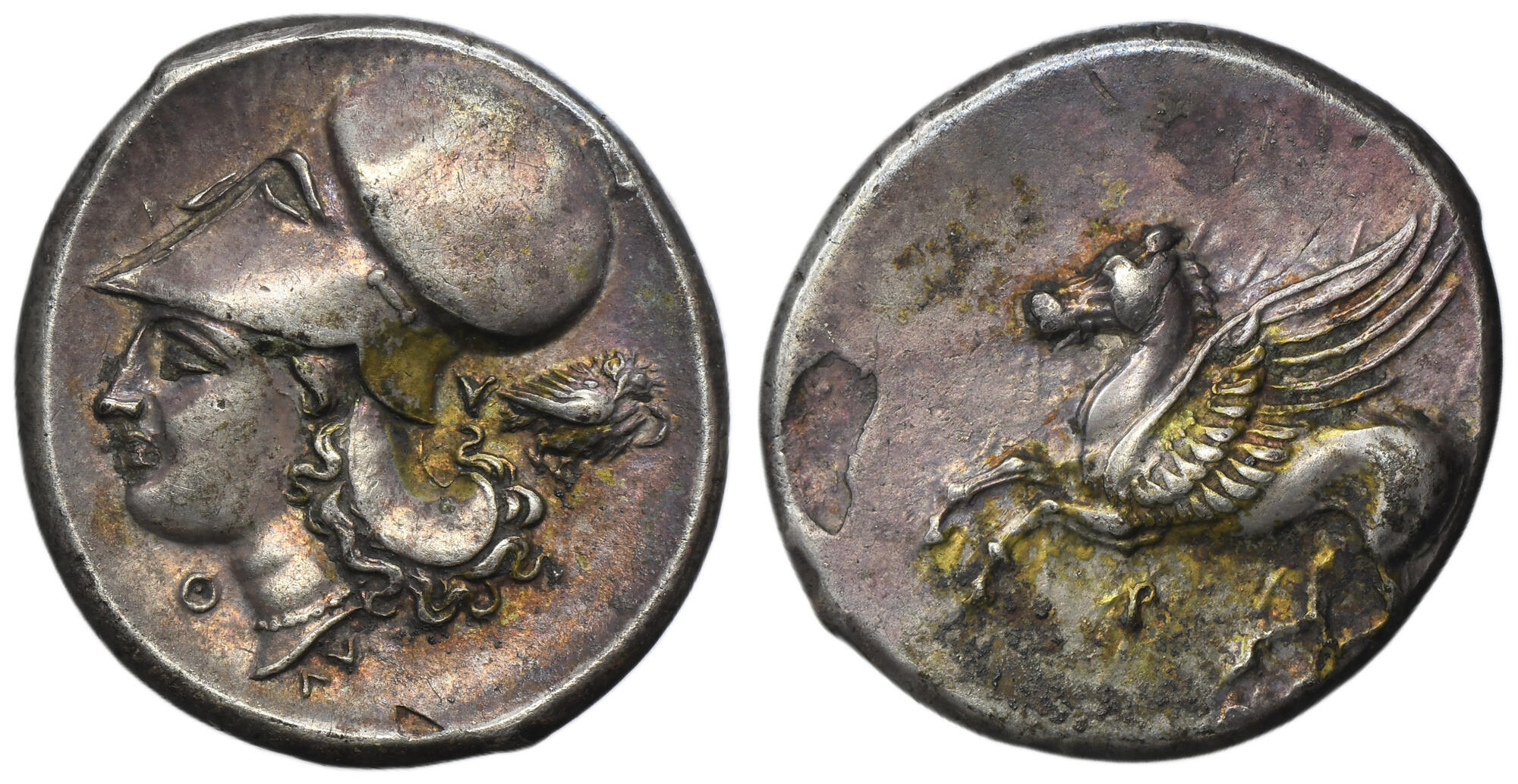 |
