

Our partner for world banknotes research

| Wojcicki Polish Auction House > Premium Auction 18 | Auction date: 26 September 2026 |
| Lot number: 14057 Price realized: 527 EUR (Approx. 601 USD) Note: Prices do not include buyer's fees. | Show similar lots on CoinArchives Find similar lots in upcoming auctions on  |
| Lot description: Greece, Epeiros, Ambrakia, StaterThe stater of Ambrakia belongs to the characteristic group of Corinthian-type staters, issued by Corinth and numerous cities within its economic and cultural sphere. Ambrakia, situated in Epirus on the Ambracian Gulf, was founded as a Corinthian colony during the Archaic period, and its close ties with the mother city were clearly reflected in its coinage.The obverse depicts Pegasus flying right, one of the most recognizable symbols of Corinth. Below the winged horse appears the letter A, identifying the issue with Ambrakia. The reverse features the head of Athena wearing a Corinthian helmet, facing left.The combination of Pegasus and Athena was not accidental. According to Greek mythology, Athena helped Bellerophon tame Pegasus by providing him with a golden bridle. These two motifs formed the principal iconographic programme of Corinthian coinage and were subsequently adopted by its colonies and other cities striking coins according to the Corinthian standard.These issues also played an important economic role. Corinthian staters and their local counterparts circulated widely throughout western Greece, Epirus and southern Italy, forming one of the most distinctive monetary systems of the Greek world during the 4th century BC. Owing to its location and close connections with Corinth, Ambrakia participated actively in this extensive network of exchange. The present specimen, dated to c. 360–338 BC, is a characteristic example of the adaptation of traditional Corinthian imagery to the autonomous coinage of its colony. Ex NAC Autumn Sale 95, 1995, Lot 202. Ex. Fritz Rudolf Künker, eLive Auction 81, Lot 7045. Greece Epeiros, Ambrakia, Stater 360-338 BC Obverse: pegasus flying right, letter A below it Reverse: head of Athena in Corinthian helmet left Diameter 26 mm, weight 8.76 gStater Ambrakii należy do charakterystycznej grupy staterów typu korynckiego, emitowanych przez Korynt oraz liczne miasta pozostające w jego kręgu gospodarczym i kulturowym. Ambrakia, położona w Epirze nad Zatoką Ambrakijską, została założona jako kolonia Koryntu w okresie archaicznym, a związki z metropolią znalazły wyraźne odzwierciedlenie w jej mennictwie.Na awersie przedstawiono Pegaza lecącego w prawo, jednego z najbardziej rozpoznawalnych symboli Koryntu. Pod skrzydlatym koniem znajduje się litera A, pełniąca funkcję znaku identyfikującego emisję Ambrakii. Rewers przedstawia natomiast głowę Ateny w hełmie korynckim, zwróconą w lewo.Połączenie Pegaza i Ateny nie było przypadkowe. Według mitu Atena pomogła Bellerofontowi okiełznać Pegaza, przekazując mu złote wędzidło. Motywy te tworzyły podstawowy program ikonograficzny monet Koryntu, a następnie zostały przejęte przez jego kolonie i inne ośrodki emitujące monety według korynckiego standardu.Emisje tego rodzaju miały również istotne znaczenie gospodarcze. Statery korynckie i ich lokalne odpowiedniki były szeroko wykorzystywane w handlu zachodniej Grecji, Epiru i południowej Italii, tworząc jeden z najbardziej charakterystycznych systemów monetarnych greckiego świata IV wieku p.n.e. Ambrakia, dzięki swojemu położeniu i związkom z Koryntem, uczestniczyła w tej rozległej sieci wymiany. Prezentowany egzemplarz datowany na ok. 360–338 p.n.e. stanowi bardzo dobry przykład przeniesienia tradycyjnej ikonografii Koryntu na autonomiczne mennictwo jego kolonii. Ex NAC Autumn Sale 95, 1995, Lot 202. Ex. Artemide Aste, LX Auction, Lot 234. Grecja Epeiros, Ambrakia, Stater 360-338 pne Awers: pegaz lecący w prawo, pod nim litera A Rewers: głowa Ateny w korynckim hełmie w lewo Średnica 26 mm, waga 8.76 g Reference: Calciati 44, Ravel 71b Grade: XF Starting price: 282 EUR | 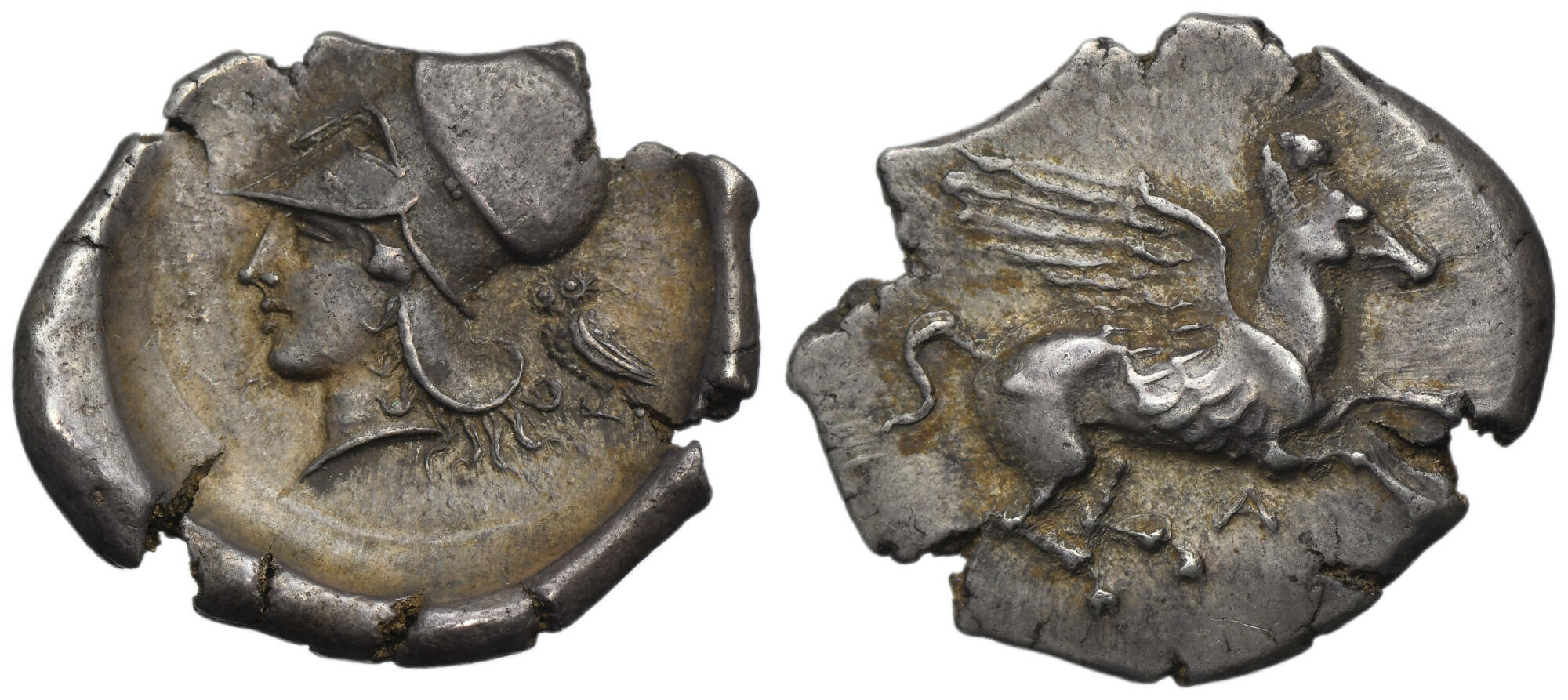 |
