

Our partner for world banknotes research

| Morton & Eden > Auction 138 | Auction date: 7 October 2026 |
| Lot number: 90 Price realized: 10,000 GBP (Approx. 13,219 USD / 11,808 EUR) Note: Prices do not include buyer's fees. | Show similar lots on CoinArchives Find similar lots in upcoming auctions on  |
| Lot description: A Byzantine bronze struck medal commemorating the Epiphany, Ravenna, 6th-7th century AD, EMMA - NVHL, either side of nimbus cruciger facing bust of Jesus Christ as Emmanuel, with long flowing hair and beard, wearing pallium over colobium, rev., scene of the Adoration of the Magi: the three kings dressed in Persian style robes, cloaks and Phrygian caps, bearing gifts and standing before the nimbate infant Jesus whose right hand is raised in benediction, sitting upright on the lap of Mary who is seated on a high back chair; star of Bethlehem above; in ex., two confronted doves, 23.4 mm, 9.46g (S. Bendall, PCPC, 387.1 = H. Goodacre, A Handbook of the Coinage of the Byzantine Empire, London 1957, p. 340 [pierced and in poor condition]; Bendall, op. cit. 387.2 (cast copy); F. Madden, 'Christian emblems on the Coins of Constantine I the Great, his family and his successors', in Num. Chron. 1878, pp. 214-5, 11, pl. 10, 11), with dark patina, some file marks on obverse border (beneath the patina), extremely fine and of the highest rarity, only two others recorded (and the cast copy in the Bendall Collection) Ex Porphyra Collection; Roma Byzantine Collection (2023), 389; Roma XV (2018), 712; Exhibited at the 3rd Congress of Christian Archaeology, 1932 (sold with contemporary congress envelope dated 25 - 29 Sett. 1932 X).Mis-attributed by Madden, who first published the type in 1878, followed by Goodacre in 1957 and Bendall in 1988 in dating it to the Palaeologan period based on the erroneous interpretation of its superficial similarity to the reverse type of a small and obscure bronze assarion of the Thessalonican mint attributed to the reign of John V and Anna of Savoy (c. AD 1365). The scene on this coin could not be more dissimilar to the Epiphany presented on the present medal since it depicts the brutal martyrdom of St Demetrius by three soldiers impaling the city's patron saint with spears (with no Christ Child which was added to the line drawing by Madden in error).This important example of a devotional medal displays a Late Antique image of Christ as seen on several mosaic scenes in the church of St. Apollinare in Classis, Ravenna, dated to the reign of Justinian I (527-565) and a fresco on a wall of the Catacomb of Commodilla on the Via Ostiense in the periphery of Rome, dated to the reign of Constantine IV (668-685). The image of the Epiphany can also be compared to a gold fibula in the Museo Arqueológico Nacional, inv. 1963/56/1, dated to the late 6th century (Lecturas de Bizancio: el legado escrito de Grecia en España, Madrid, 2008, cat. 11) and the embossed gold pendant in the British Museum. inv. 1983.0704.1 (https://www.britishmuseum.org/Collection/object/H_1983-0704-1), dated to the 6-7th century.During the reign of Tiberius II Constantine (578-582) large gold medallions are known to have been struck to the weight of one Roman pound (= 72 solidi, 327 grams). The 6th century historian Gregory of Tours describes how he witnessed several of them in the possession of the Frankish king Chilperic (539-584): 'He also displayed aurei weighing one pound which the emperor had sent, having on one side a likeness of the emperor represented, and the writing in a circle, TIBERII CONSTANTINI PERPETVI AVGVSTI; on the other side there was a four-horse chariot and its driver, and it contained the writing GLORIA ROMANORVM' (Historia Ecclesiastica Francorum 6.2; E. Babylon RN 1906, pp. 185-9; BMC Byzantine p. 105; TNR 656). A similar gold and unique 6 solidi medallion struck in the name of Maurice Tiberius (582-602) with a facing quadriga reverse type is now in the Metropolitan Museum of Art, New York: published by Philip Grierson, 'The Kyrenia girdle of Byzantine medallions and solidi', Num. Chron. 1955, pp. 55-70; MIB 1; DO 1; Sear 473. The Romanised title Emmanuel derives from the Hebrew Immanu'El ('God with us') and appears in the Book of Isaiah as a sign that God will protect the House of David. The Gospel of St Matthew (1:22-3) quotes part of this: 'a virgin shall be with child, and shall bring forth a son, and they shall call his name Emmanuel', as a prophecy of the birth of the Messiah and the fulfilment of Scripture in the person of Jesus. With the possible exception of the Good Shepherd, the scene of the Magi in worshipful adoration before the Holy Child is the earliest and most frequent artistic representation of Jesus' life and ministry. The iconography here is in the style of the celebrated mosaic of the Epiphany scene in the church of St. Apollinare.For the earliest image of Christ on coins, which were struck by Justinian II, see lots 197-199 in all three gold denominations. Estimate: 4000 - 6000 GBP | 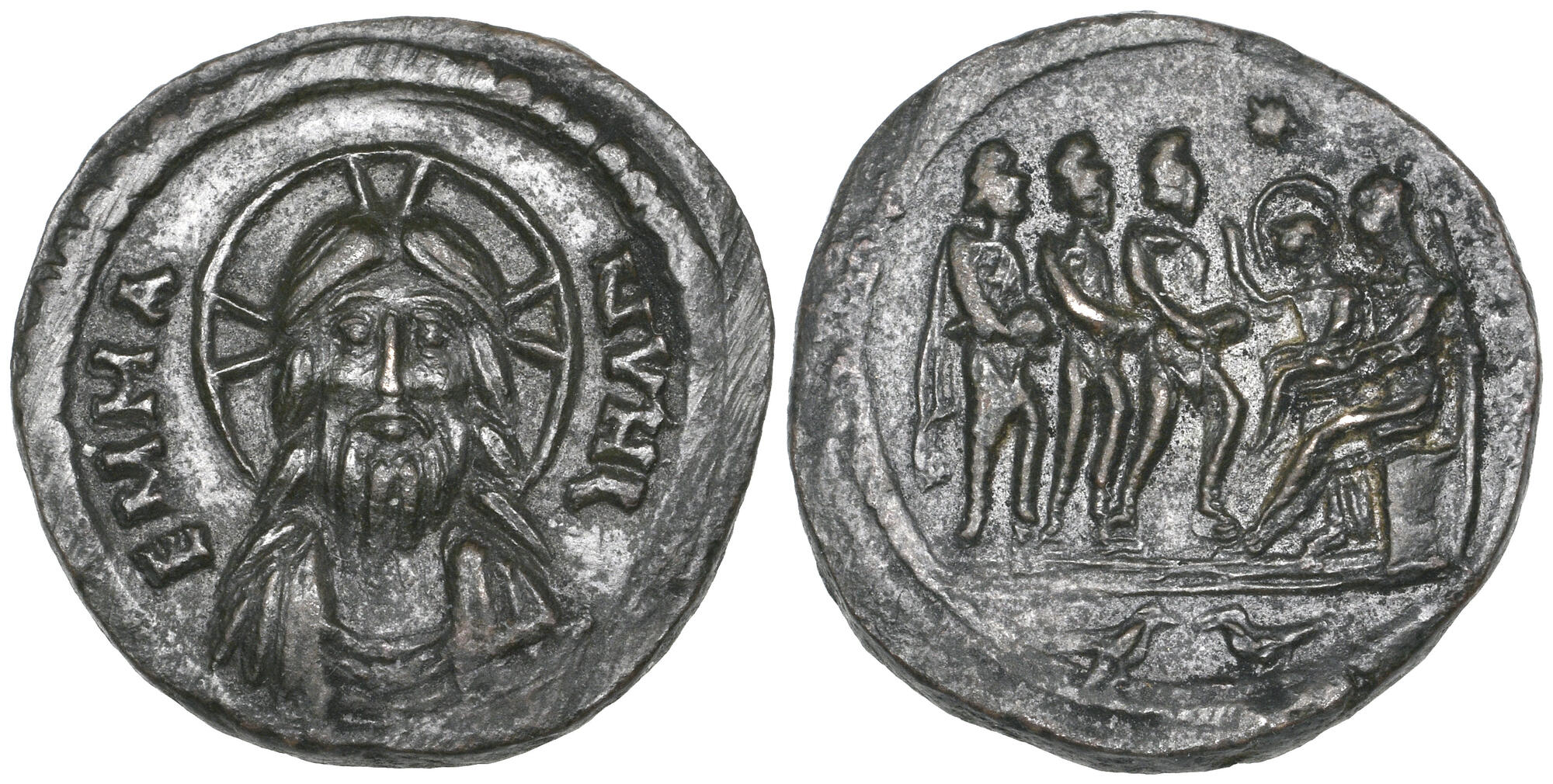 |
