

Our partner for world banknotes research

| Heritage World Coin Auctions > Showcase Auction 61638 | Auction date: 20 September 2026 |
| Lot number: 21059 Price realized: 120 USD (Approx. 105 EUR) Note: Prices do not include buyer's fees. | Show similar lots on CoinArchives Find similar lots in upcoming auctions on  |
| Lot description: Ancients Trajan Decius (AD 249-251). AE sestertius (30mm, 17.12 gm, 1h). NGC XF 4/5 - 4/5. Rome. IMP C M Q TRAIANVS DECIVS AVG, laureate, cuirassed bust of Trajan Decius right, seen from behind / D-A-CIA, Dacia standing facing, head left, grounded draco battle standard in right hand; S-C across fields. RIC IV.III 112a. From the Dr. Charles Jay Deur Collection, for the charitable benefit of Calvin University and Peace Lutheran Church of Hurst. Ex Pegasi Numismatics, private sale with dealer's tag included. The Dacian cavalry holds a noteworthy position in the annals of warfare, emerging as a pivotal component of the military might that characterized ancient Dacia, a region that epitomized today's Romania and its surrounding territories. These horse-mounted warriors, armed with an arsenal of weapons such as long swords, spears, and light armor, were renowned for their agility and speed, which they magnificently juxtaposed with strategical precision and improvisational genius. For them, the battlefield wasn't merely a platform of brute force, but more of a complex pattern wherein movement, formation, and an acute forecast of the adversary's maneuvers guided their tactical play. A symbol that resonated prominently with the Dacian cavalry's prowess was the Draco battle standard. A typical Draco device consisted of a dragon or serpent-shaped head crafted from metal, through which a gaping mouth, aligned with the wind direction, led into a tubular structure often made of colored silk. As the cavalry galloped into battle, the wind would rush through this construct, creating a fearsome, hissing sound, accompanied by the sight of the cloth body undulating in the air, mimicking a dragon in flight. But the Draco was more than just an intimidating sight or sound on the battlefield. It served as a valuable functional tool - its orientation helped to indicate wind direction, and with it, the optimal usage of arrows and other wind-affected projectiles. The Draco standard, beyond its functionality, encapsulated the fervor and the fierce identity of the Dacian cavalry, embodying the terrifying and awe-inspiring presence the warriors wielded over the theater of ancient warfare. The Draco was originally developed by the Sarmatians and Alans, cavalry peoples of the steppes. The earliest evidence of the Draco in Dacia was found on 4th century BC pottery discovered in the Prahova county of Romania. On Trajan's Column the Dacian soldiers are represented no less than 20 times with a Draco. The only example currently extant was found in Germany, which was probably a trophy won by the Roman troops from the wars with the Dacians. After the Dacian wars the Draco was adopted by Roman cavalry. www.HA.com/TexasAuctioneerLicenseNotice https://coins.ha.com/itm/ancients/roman-imperial/trajan-decius-ad-249-251-ae-sestertius-30mm-1712-gm-1h-ngc-xf-4-5-4-5/p/61638-11246.s?type=DA-DMC-CoinArchives-WorldCoins-61638-09202026 HID02906262019 © 2026 Heritage Auctions | All Rights Reserved Certification number: NGC 8747752012 | 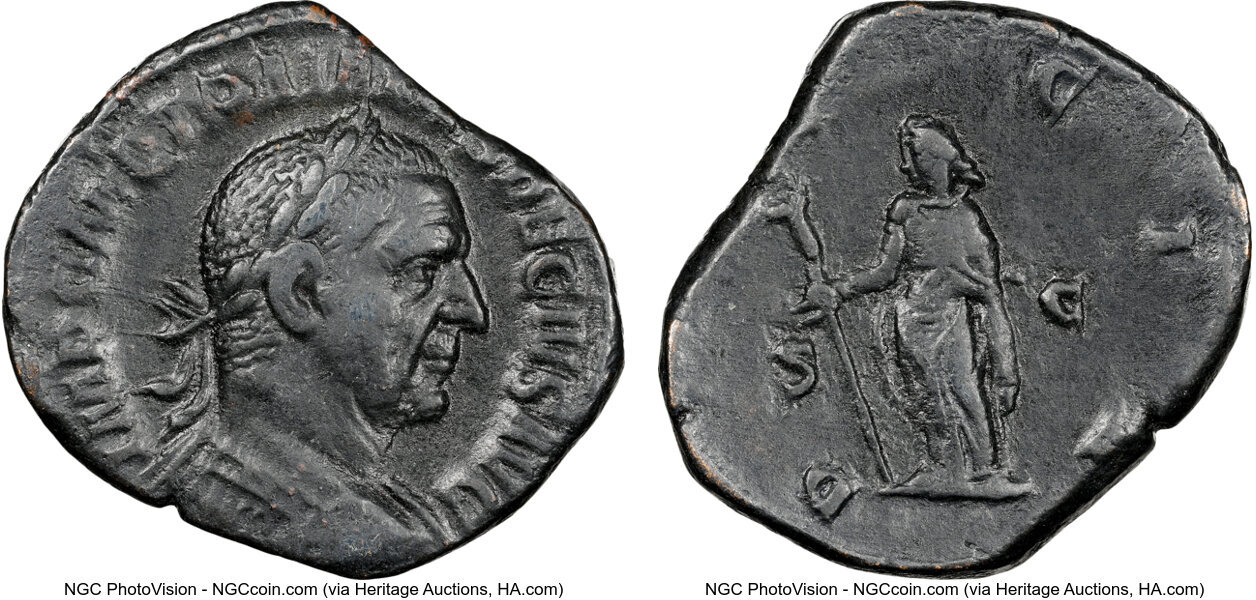 |

