

Our partner for world banknotes research

| Classical Numismatic Group > Auction 133 | Auction date: 15 September 2026 |
| Lot number: 395 Price realized: 8,000 USD (Approx. 6,934 EUR) Note: Prices do not include buyer's fees. | |
| Lot description: ARABIA, Northern. Uncertain. 2nd-1st centuries BC(?). AV Stater (23mm, 12.72 g, 11h). Head of bearded(?) male left; staff surmounted by flower(?) to right; letters of an uncertain script around / Head of female left; staff surmounted by flower(?) to right; letters of an uncertain script around. M. Huth, "The Gold Coins" in CCK, 10–10a (same dies?). Slight bend in flan, edge marks. Fine. Extremely rare, only two published examples, one in CoinArchives (Nomos 35, lot 517). Estimate: 1000 USD | 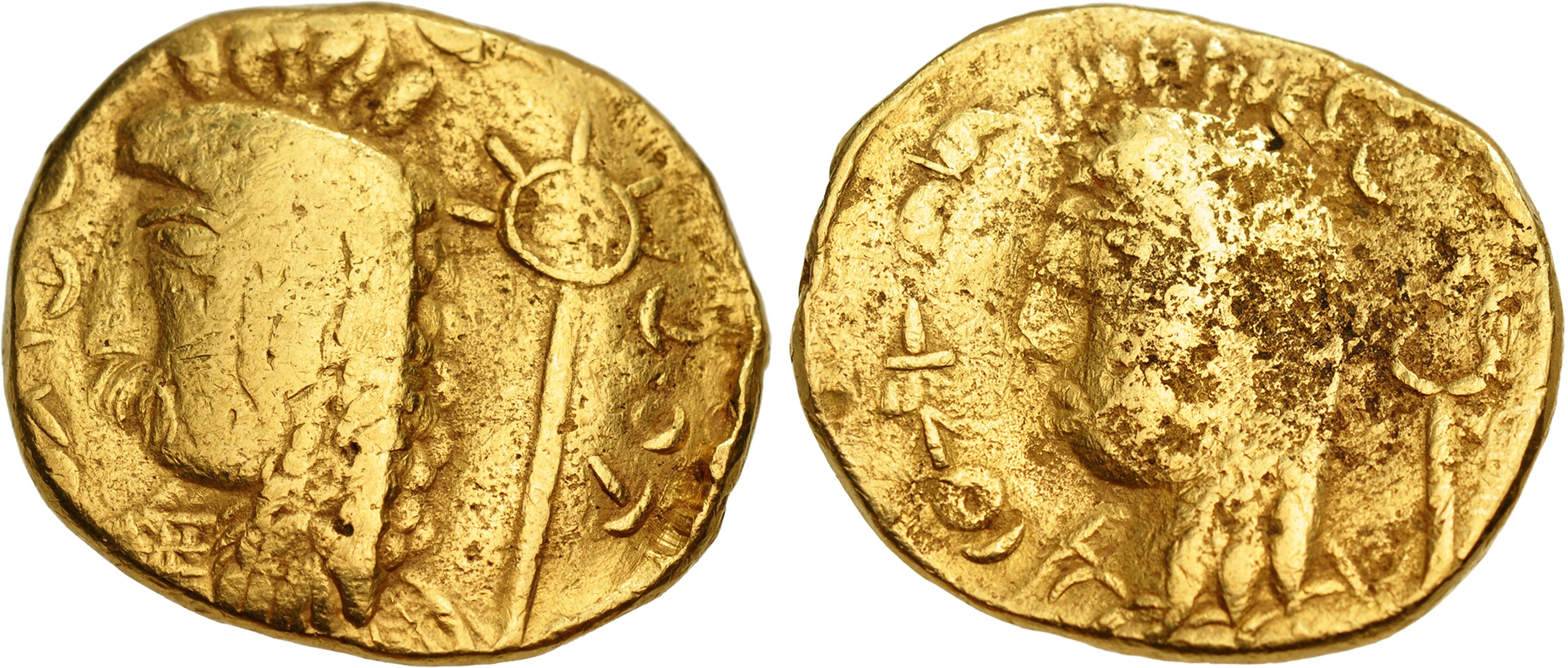 |

Match 1:
| GSA Numis > Dragoos 2 | Auction date: 13 September 2026 |
| Lot number: 108 Price realized: 700 USD (Approx. 603 EUR) Note: Prices do not include buyer's fees. | |
| Lot description: ARABIA, Northwestern. Lihyan. 2nd–1st centuries BC. AR Tetradrachm (24mm, 13.70g). Imitating Athens. Schematic head right, two upward crescents on cheek / Owl standing right, head facing; olive spray to left, (retrograde C)ΘE to right. Huth, Athenian, fig. 5, b = SNG ANS 1453; cf. Huth 39. Black patina, trace deposits . VF. Rare.The ancient Kingdom of Lihyan was one of the most important and prosperous states of pre-Islamic Arabia. Situated in the oasis region of Dedan, near modern Al-'Ula in northwestern Saudi Arabia, Lihyan flourished as a major commercial center controlling vital caravan routes that linked southern Arabia with Egypt, the Levant, and the Mediterranean world. The coinage of Lihyan provides fascinating evidence of the kingdom's economic strength and its participation in the international trade networks of the Hellenistic era. Among the most remarkable products of Lihyanite numismatics are the silver tetradrachms modeled after the famous "Owls" of Athens. By the second and first centuries BC, the Athenian tetradrachm had become one of the most recognized and trusted currencies of the ancient world. Even centuries after the height of Athenian power, its design continued to be copied by numerous kingdoms and trading communities from Egypt to Central Asia. The adoption of Athenian imagery by Lihyan reflects both the prestige of the original coinage and the kingdom's desire to participate in long-distance commerce using a familiar monetary standard. Starting price: 700 USD | 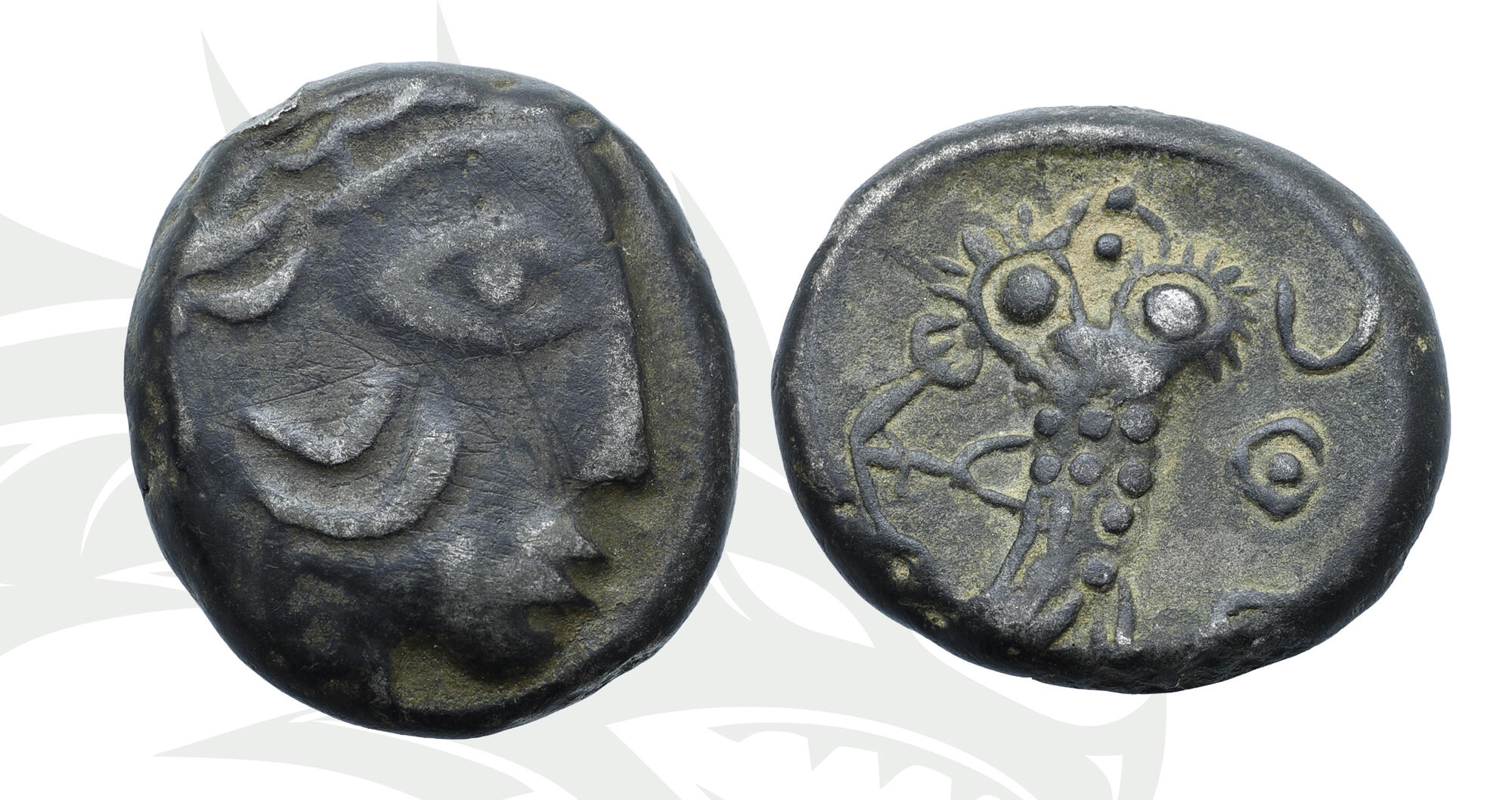 |
Match 2:
| Leu Numismatik AG > Web Auction 44 | Auction date: 5 September 2026 |
| Lot number: 217 Price realized: 600 CHF (Approx. 741 USD / 638 EUR) Note: Prices do not include buyer's fees. | |
| Lot description: WESTERN ASIA MINOR, Uncertain. 2nd-1st centuries BC. AE (Bronze, 18 mm, 6.20 g, 12 h). Facing head of a bull; above, eight-rayed star. Rev. ΣΟΑΤΙ[Σ](?) Owl standing right, head facing and wings spread, on palm frond; ti left, monogram. Classical Numismatic Group E-Auction 461 (2020), 137. SNG Tübingen 2442 ('Pergamon'). Very rare. Light deposits and the obverse struck slightly off center, otherwise, good very fine. Ex Leu Web Auction 36, 6-7 September 2025, 423, and Aquila 3, 2 July 2022, 466. In SNG Tübingen and in Leschhorn (p. 552), the inscription on this very rare and enigmatic type is interpreted as ZΩATIΣ (?). However, our specimen shows the inscription as ΣΟΑΤΙ[.], with the final letter remaining unclear. The meaning of this legend is uncertain. Unless it represents an otherwise unattested ethnic, the most plausible interpretation is that it refers to an unusual magistrate's name, Soati(s) (?). Iconographically, the reverse of the coin closely resembles types from Pergamon (cf. BMC 190), which notably also omit an ethnic. However, these Pergamene issues do not name a magistrate, but instead identify the victorious Athena depicted on the obverse. A frontal bull's head, as seen on our coin, does not appear elsewhere in the known Pergamene coinage, though bull heads in profile are attested. The issuing authority behind this extremely rare coin therefore remains unknown, as does the question of whether it was struck in Pergamon or at another, as yet unidentified, mint. This lot cannot be shipped to a US address. Starting price: 50 CHF | 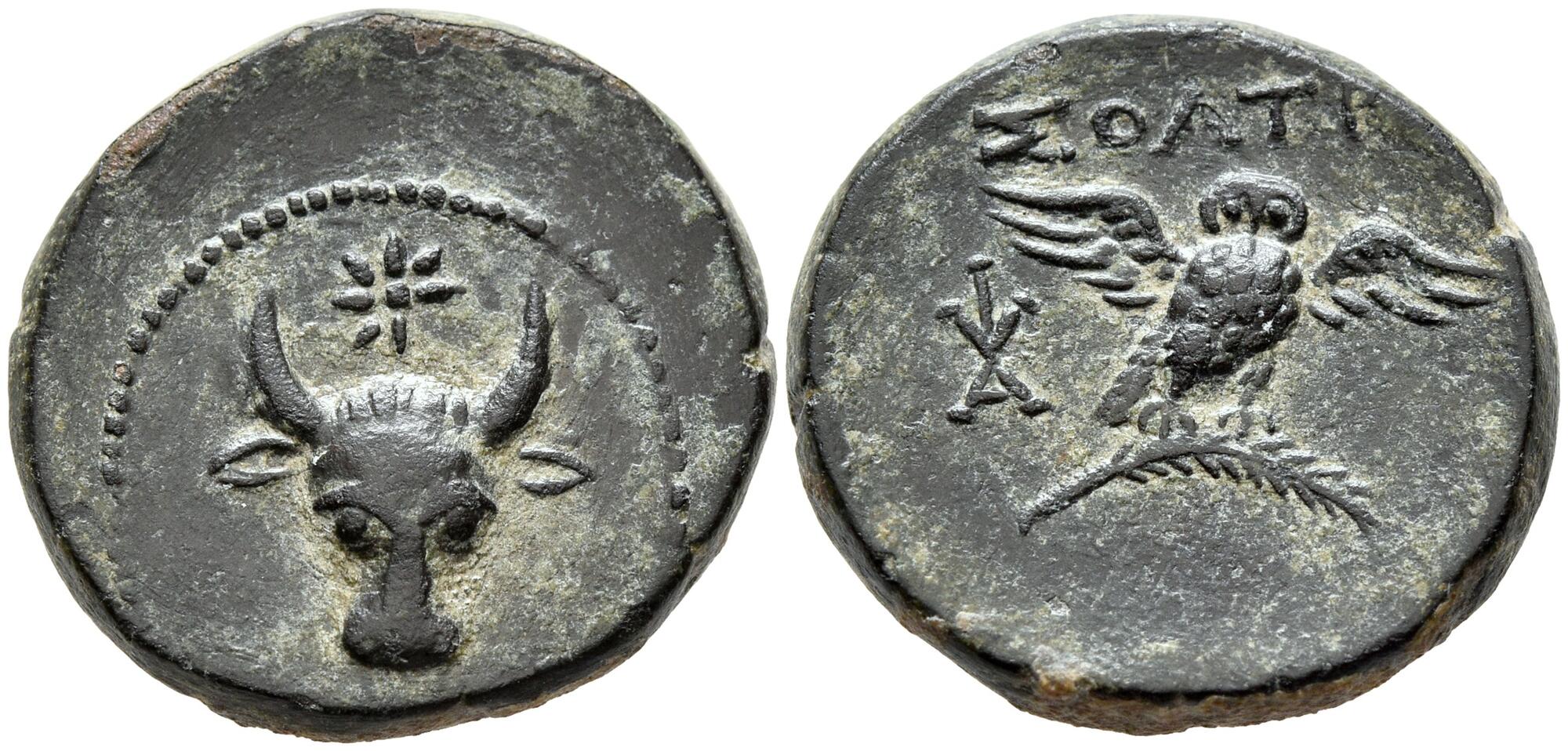 |

Match 3:
| Leu Numismatik AG > Web Auction 42 | Auction date: 27 June 2026 |
| Lot number: 929 Price realized: 150 CHF (Approx. 185 USD / 163 EUR) Note: Prices do not include buyer's fees. | |
| Lot description: UNCERTAIN EAST. Circa 2nd-1st centuries BC. AE (Bronze, 20 mm, 4.24 g, 12 h). Bearded bare male head to right. Rev. Turreted and draped bust of the city-goddess to right; behind, Z (?), all within wreath. Leu Web Auction 5 (2018), 411 (same obverse die). Of the highest rarity, perhaps the second known example. Good fine. The two pieces resemble the bronzes with a head of Zeus on the obverse that are commonly attributed to 'Simyra' (see lot 930 below). On our specimens, however, the obverse does not show Zeus, but rather a bare-headed face whose individualized features suggest the portrait of a ruler or dynast rather than that of a god. Yet we know neither where the coins were struck - the attribution to Simyra is merely conjectural - nor whom the portrait may represent. This lot cannot be shipped to a US address. Starting price: 50 CHF | 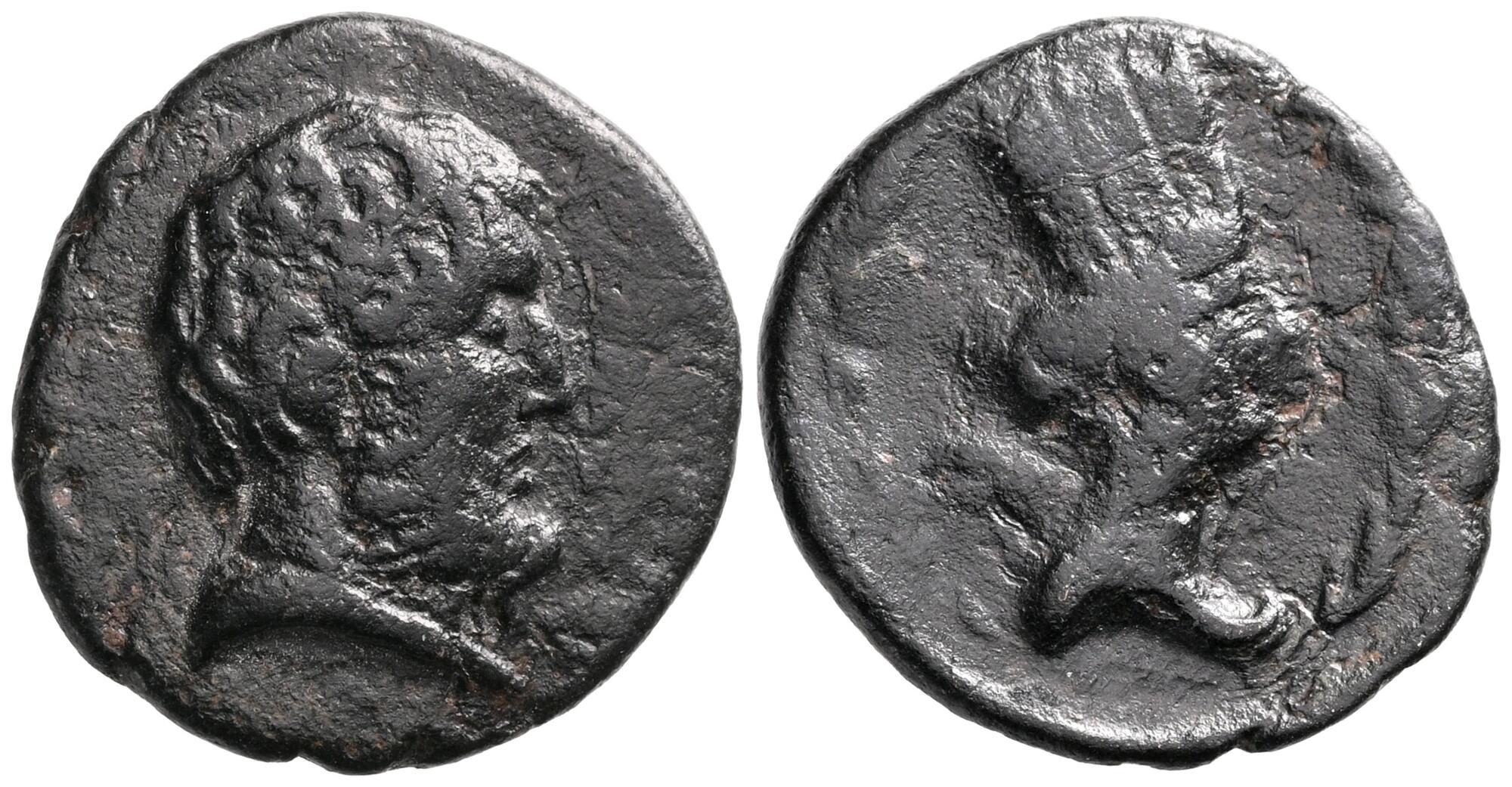 |
Match 4:
| Heritage World Coin Auctions > Showcase Auction 61641 | Auction date: 2 August 2026 |
| Lot number: 23143 Price realized: 5,500 USD (Approx. 4,782 EUR) Note: Prices do not include buyer's fees. | |
| Lot description: Ancients MACEDONIAN KINGDOM. Philip III Arrhidaeus (323-317 BC). AV stater (17mm, 8.56 gm, 11h). NGC AU 4/5 - 4/5. Lifetime issue, Phoenicia, Sidon, dated Regnal Year 16 of Abdalonymus (318/317 BC). Head of Athena right, hair flowing loose and upswept at temple, wearing necklace and triple-crested Corinthian helmet pushed back on head, long parallel crest ends, bowl decorated with coiled serpent right / ΦΙΛΙΠΠOY, Nike advancing left, wreath in outstretched right hand, stylis cradled in left arm; Π (date) in left field below wing. Price P176. Arrhidaeus was the eldest son of Philip II and the half-brother of Alexander the Great. Despite being older than Alexander, Arrhidaeus was illegitimate: his mother a Thessalian woman outside of Philip II's marriage to Olympias. Alexander was thus deemed heir without contest. During Alexander's campaigns, Arrhidaeus stayed in Macedon under the watchful eye of Antipater, a general and father to Cassander. When Alexander died in 323 BC, Arrhidaeus was ultimately deemed heir as Roxana was still pregnant with Alexander's son - taking on the title Philip III Arrhidaeus. Soon after, he would marry Eurydice, an intelligent noblewoman who aimed to substantiate his rule as he was simply a figurehead to the regent Perdiccas. Yet, as the Wars of the Diadochi broke out in 322 BC, Perdiccas was killed and Antipater gained control of Arrhidaeus. He would appoint Polyperchon, an older officer, as his successor, which led Cassander, backed by Eurydice, to revolt. By 317 BC, Cassander was officially the regent to Arrhidaeus. In response, Olympias and her coalition invaded Macedon with Roxana's now young son, Alexander IV, in tow. As Alexander's biological son, Alexander IV was considered the lawful successor. With the army turning their loyalty to Alexander IV, Arrhidaeus and Eurydice were killed by Olympias. However, when Cassander returned from his campaign the following year, he had Olympias executed and would later assassinate Alexander IV - becoming king by 305 BC. www.HA.com/TexasAuctioneerLicenseNotice https://coins.ha.com/itm/ancients/greek/macedonian-kingdom-philip-iii-arrhidaeus-323-317-bc-av-stater-17mm-856-gm-11h-ngc-au-4-5-4-5/p/61641-28001.s?type=DA-DMC-CoinArchives-WorldCoins-61641-08022026 HID02906262019 © 2026 Heritage Auctions | All Rights Reserved Certification number: NGC 8748438009 |  |

Match 5:
| Classical Numismatic Group > Auction 132 | Auction date: 18 May 2026 |
| Lot number: 312 Price realized: 10,000 USD (Approx. 8,590 EUR) Note: Prices do not include buyer's fees. | |
| Lot description: ELIS, Olympia. 108th Olympiad. 348 BC. AR Stater (23mm, 11.64 g, 12h). Head of Hera right, wearing stephanos ornamented with three palmettes connected by tendrils at their base; F-[A] flanking neck / Eagle standing left within olive wreath. Seltman, Temple 327 (dies FB/ιη); BCD Olympia 149 (same dies); HGC 5, 382. Toned, flan crack, cleaning scratches, marks, roughness. Good VF. Struck from dies of elegant style. Extremely rare. Only two known to Seltman. Lot includes an old collector's ticket in Greek. From the Thomas Palmer Collection, purchased from Atlantis. Located on the northwest corner of the Peloponnesos, the sacred shrine of Olympia became established as the site of the most important Greek festival of athletics in the eighth century BC. The first Olympic Games were held in 776 BC, consisting solely of a foot race, or stadion, won in that year by Koroibus of Elis. As time went on, more events were added, including wrestling, boxing, long jump, javelin, discus, and chariot races. The contests became so important that Greek cities at war would declare a temporary truce to allow athletes to cross their lines. Soon a permanent complex was built to house the games, and a magnificent temple of Zeus containing a statue ranked as one of the Seven Wonders of the World was completed in 463 BC. The first coins of Olympia date to the games of 468 BC, and new types were issued at four year intervals (to coincide with the games) thereafter. Three basic types were struck, depicting a head of Zeus, his wife Hera, or an eagle, Zeus' animal avatar; it is likely that different workshops of the mint struck each type. The exceedingly rare example offered here is from the Hera mint and is dated to the 108th Olympiad, circa 348 BC, a time of great ferment in the Greek world. The Macedonian king Philip II, who was beginning to pull the other Greek city-states under his control, is actually recorded that year as the winner of the Synoris, or chariot race. Estimate: 5000 USD |  |
