Our partner for world banknotes research

| Classical Numismatic Group > Auction 133 | Auction date: 15 September 2026 |
| Lot number: 221 Price realized: 900 USD (Approx. 780 EUR) Note: Prices do not include buyer's fees. | Show similar lots on CoinArchives Find similar lots in upcoming auctions on  |
| Lot description: CORINTHIA, Corinth. Circa 525/10-490 BC. AR Stater (20.5mm, 8.13 g). Pegasos flying left / Quadripartite incuse square with swastika pattern. Ravel Period I, Class 2, 35; Pegasi 17; BCD Corinth 3; HGC 4, 1815. Toned, delaminations on reverse. VF. In terms of population, wealth and political clout, Corinth was the second city in Greece throughout the Classical era, outshone only by Athens. A Mycenaean settlement on the narrow Isthmus of Corinth, it was seized by the Dorian Greeks in circa 900 BC and by the fifth century BC the city boasted two fine harbors, a host of imposing public buildings, and a population of about 100,000. Corinth's military innovations included the trireme, a warship powered by three banks of oarsmen, and a popular style of enclosed bronze helmet ("Corinthian") that became ubiquitous throughout Greece. Corinth's colonies abounded in Greece proper and Magna Graecia, chief among them Syracuse, Korkyra, Ambrakia, and Apollonia. From the late sixth century BC, Corinth's coinage featured the winged horse Pegasos and a fine head of Athena wearing a Corinthian helmet. In mythology, Pegasos was captured and tamed by the hero Bellerophon, who went on to become king of Corinth. Corinthian "pegasi" staters were struck in enormous numbers both in the mother city and its colonies, rivaling the Athenian "owl" as an international trade coin. Estimate: 1000 USD | 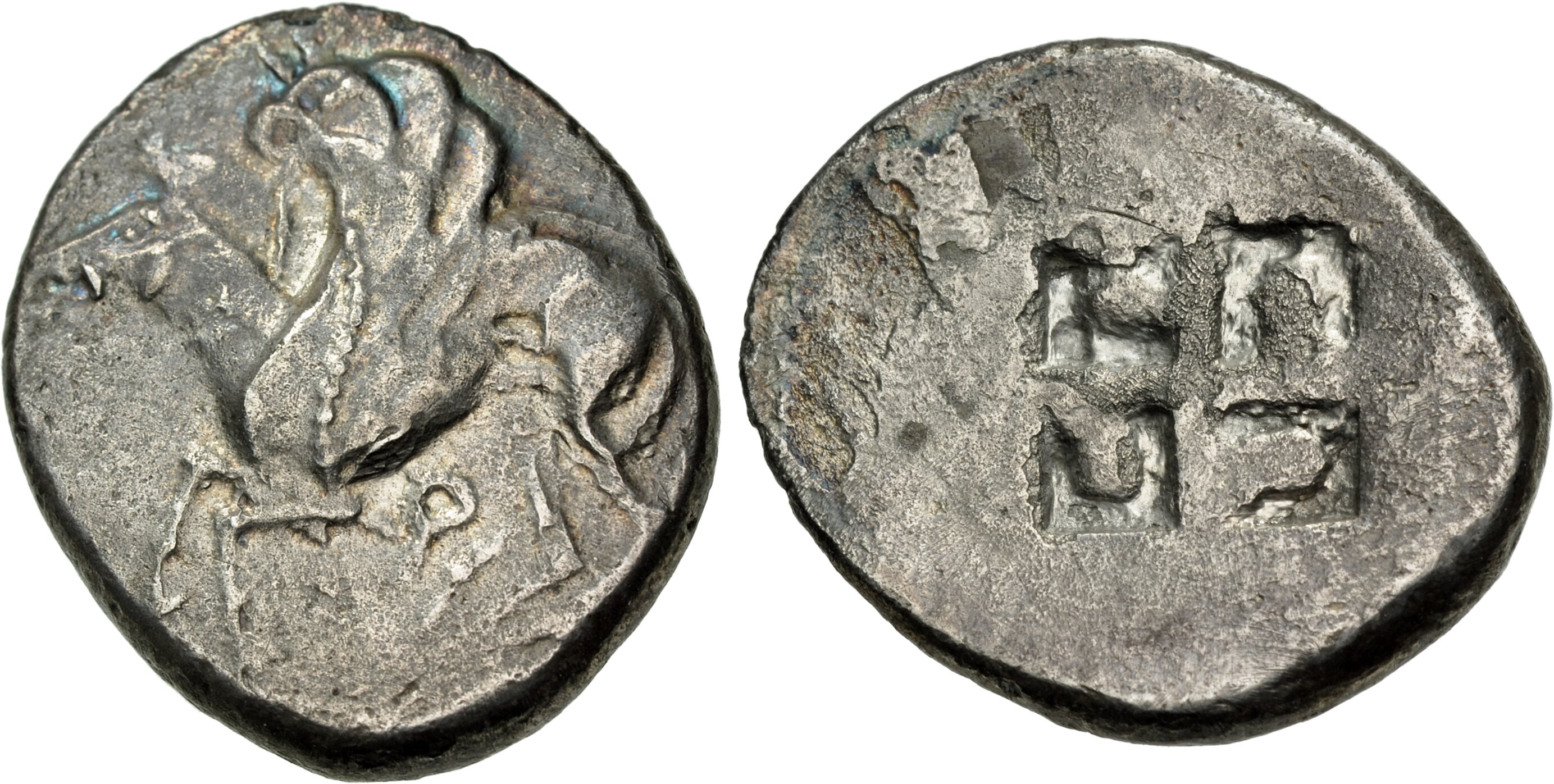 |