

Our partner for world banknotes research

| Heritage World Coin Auctions > Showcase Auction 61636 | Auction date: 10 August 2026 |
| Lot number: 21271 Price realized: 2,000 USD (Approx. 1,731 EUR) Note: Prices do not include buyer's fees. | |
| Lot description: Ancients Vespasian (AD 69-79). AE sestertius (35mm, 26.48 gm, 5h). NGC VF 5/5 - 2/5, smoothing. Rome, AD 71. IMP CAES VESPASIAN AVG P M TR P P P COS III, laureate head of Vespasian right / IVDAEA-CAPTA, palm tree in center with two bunches of dates, Vespasian (on left), standing right in military dress, grounded spear in right hand, parazonium cradled in left, left foot on helmet, and Jewess (on right), seated right on cuirass, right arm on knee, left hand propping head in attitude of mourning; SC in exergue. RIC II.1, 167. GBC 6, 6534. Ex Heritage Auctions, Auction 232145 (11 November 2021), lot 62199. From the Eyeappealing Collection. Ex Heritage Auctions, Auction 232145 (10 November 2021), lot 62199. The famous reverse legend IVDAEA CAPTA refers to the triumph of Vespasian's son Titus over the Jewish rebels and the destruction of the Second Temple in Jerusalem the prior year. Six hundred years earlier, the Babylonian king Nebuchadnezzar II and his conquering army had destroyed the Temple of Jerusalem, carrying away the Jewish people as slaves back to Babylon. The Romans chose to leave the subjugated Jewish population in place, a mistake that would come back to haunt them in the Bar Kokhba Revolt 60 years later. But if not steal the Jewish population as the Babylonians had done, what did the Romans loot from Judaea as spoils of war? Though the Romans had been enraged by the insubordination of the Jews, they held a certain respect for the ancient nature of the Jewish religion and its institutions, part of the reason that Roman authorities permitted Judaism while persecuting newer "cults" like Christianity. When the triumphant army of Titus descended upon the city in August AD 70, they fixated on the Temple, the center of the Jewish faith and therefore of the revolt against Rome. Before destroying the structure, the Roman legionaries looted the sacred relics of the Temple, including the Table of the Sacred Bread, a table of solid gold that held various food and drink that was a type of permanent offering to God. But the greatest prize of all was the gold menorah, which was paraded through the streets of Rome along with the aforementioned Table and the sacred trumpets during Titus' triumph. The whole scene, including the menorah, is featured prominently on the Arch of Titus, which still stands today in Rome. www.HA.com/TexasAuctioneerLicenseNotice https://coins.ha.com/itm/ancients/roman-imperial/vespasian-ad-69-79-ae-sestertius-35mm-2648-gm-5h-ngc-vf-5-5-2-5-smoothing/p/61636-11103.s?type=DA-DMC-CoinArchives-WorldCoins-61636-08102026 HID02906262019 © 2026 Heritage Auctions | All Rights Reserved Certification number: NGC 2117020007 |  |

Match 1:
| Heritage World Coin Auctions > Showcase Auction 61636 | Auction date: 10 August 2026 |
| Lot number: 21270 Price realized: 2,200 USD (Approx. 1,904 EUR) Note: Prices do not include buyer's fees. | |
| Lot description: Ancients Vespasian (AD 69-79). AE sestertius (34mm, 22.51 gm, 7h). NGC VF 5/5 - 2/5. Rome, AD 71. IMP CAES VESPASIAN AVG P M TR P P P COS III, laureate head of Vespasian right / VICTORIA-AVGVSTI, Victory standing right, left foot on helmet, affixing shield inscribed OB / CIV / SERV to palm tree, at base of which sits mourning Jewess to right in attitude of mourning; S C in exergue. RIC II 221. GBC 6, 6538. From the Eyeappealing Collection. The famous reverse legend IVDAEA CAPTA refers to the triumph of Vespasian's son Titus over the Jewish rebels and the destruction of the Second Temple in Jerusalem the prior year. Six hundred years earlier, the Babylonian king Nebuchadnezzar II and his conquering army had destroyed the Temple of Jerusalem, carrying away the Jewish people as slaves back to Babylon. The Romans chose to leave the subjugated Jewish population in place, a mistake that would come back to haunt them in the Bar Kokhba Revolt 60 years later. But if not steal the Jewish population as the Babylonians had done, what did the Romans loot from Judaea as spoils of war? Though the Romans had been enraged by the insubordination of the Jews, they held a certain respect for the ancient nature of the Jewish religion and its institutions, part of the reason that Roman authorities permitted Judaism while persecuting newer "cults" like Christianity. When the triumphant army of Titus descended upon the city in August AD 70, they fixated on the Temple, the center of the Jewish faith and therefore of the revolt against Rome. Before destroying the structure, the Roman legionaries looted the sacred relics of the Temple, including the Table of the Sacred Bread, a table of solid gold that held various food and drink that was a type of permanent offering to God. But the greatest prize of all was the gold menorah, which was paraded through the streets of Rome along with the aforementioned Table and the sacred trumpets during Titus' triumph. The whole scene, including the menorah, is featured prominently on the Arch of Titus, which still stands today in Rome. www.HA.com/TexasAuctioneerLicenseNotice https://coins.ha.com/itm/ancients/roman-imperial/vespasian-ad-69-79-ae-sestertius-34mm-2251-gm-7h-ngc-vf-5-5-2-5/p/61636-11037.s?type=DA-DMC-CoinArchives-WorldCoins-61636-08102026 HID02906262019 © 2026 Heritage Auctions | All Rights Reserved Certification number: NGC 6830167001 |  |
Match 2:
| Heritage World Coin Auctions > Showcase Auction 61636 | Auction date: 10 August 2026 |
| Lot number: 21272 Price realized: 3,600 USD (Approx. 3,116 EUR) Note: Prices do not include buyer's fees. | |
| Lot description: Ancients Vespasian (AD 69-79). AE sestertius (34mm, 27.03 gm, 6h). NGC Choice Fine 4/5 - 3/5. Lugdunum, AD 72. IMP CAES VESPASIAN AVG P M TR P P P COS IIII, laureate head of Vespasian right / IVDAEA-CAPTA, Vespasian standing right (on left), in military dress, grounded spear in right hand, parazonium cradled in left, left foot on helmet, and Jewess, seated right on cuirass (on right), right arm on knee, left hand propping head in attitude of mourning, palm tree with two bunches of dates between; SC in exergue. RIC II.1, 1181. Ex Heritage Auctions, Auction 3073 (29 April 2019), lot 30298. The famous reverse legend IVDAEA CAPTA refers to the triumph of Vespasian's son Titus over the Jewish rebels and the destruction of the Second Temple in Jerusalem the prior year. Six hundred years earlier, the Babylonian king Nebuchadnezzar II and his conquering army had destroyed the Temple of Jerusalem, carrying away the Jewish people as slaves back to Babylon. The Romans chose to leave the subjugated Jewish population in place, a mistake that would come back to haunt them in the Bar Kokhba Revolt 60 years later. But if not steal the Jewish population as the Babylonians had done, what did the Romans loot from Judaea as spoils of war? Though the Romans had been enraged by the insubordination of the Jews, they held a certain respect for the ancient nature of the Jewish religion and its institutions, part of the reason that Roman authorities permitted Judaism while persecuting newer "cults" like Christianity. When the triumphant army of Titus descended upon the city in August AD 70, they fixated on the Temple, the center of the Jewish faith and therefore of the revolt against Rome. Before destroying the structure, the Roman legionaries looted the sacred relics of the Temple, including the Table of the Sacred Bread, a table of solid gold that held various food and drink that was a type of permanent offering to God. But the greatest prize of all was the gold menorah, which was paraded through the streets of Rome along with the aforementioned Table and the sacred trumpets during Titus' triumph. The whole scene, including the menorah, is featured prominently on the Arch of Titus, which still stands today in Rome. www.HA.com/TexasAuctioneerLicenseNotice https://coins.ha.com/itm/ancients/roman-imperial/vespasian-ad-69-79-ae-sestertius-34mm-2703-gm-6h-ngc-choice-fine-4-5-3-5/p/61636-24002.s?type=DA-DMC-CoinArchives-WorldCoins-61636-08102026 HID02906262019 © 2026 Heritage Auctions | All Rights Reserved Certification number: NGC 4883363010 |  |
Match 3:
| Heritage World Coin Auctions > Showcase Auction 61659 | Auction date: 11 October 2026 |
| Lot number: 24038 Price realized: This lot is for sale in an upcoming auction - Bid on this lot  | |
| Lot description: Ancients Vespasian (AD 69-79). AE as (27mm, 11.81 gm, 7h). NGC Choice Fine★ 5/5 - 4/5. Rome, 71 AD. IMP CAES VESPASIAN AVG COS III, laureate head of Vespasian right / VICTORIA-NAVALIS, Victory advancing right on prow, wreath in outstretched right hand, palm branch over left shoulder; S-C across fields. RIC II.1, 336. Well-preserved surfaces for its type. Ex the Rabbi Victor H. Weissberg and Tamar Weissberg Collection. Descended from a family of small-time entrepreneurs and tax farmers in the Sabine hill country north of Rome, Flavius Vespasianus was born in AD 9 and rose to prominence in the Roman Army. He gained distinction during Claudius' invasion of Britain in AD 43-44 and won a Consulship in AD 51, but fell from imperial favor when he dozed off during one of Nero's musical performances. When a Jewish faction in the province of Judaea rebelled and massacred the local Roman garrison in AD 66, Nero sent Vespasian at the head of three legions to crush the revolt. Through his able son Titus, Vespasian gained the friendship and support of Mucianus, governor of Syria, who had another three legions at his disposal. When the collapse of Nero's regime in AD 68 led to a free-for-all for the throne, with Galba, Otho, and Vitellius following in quick succession, Vespasian realized he had the means and ability to make his own try for supreme power. On 1 July AD 69, the legions of Alexandria, Egypt declared Vespasian as emperor. He decided on a policy of blockade and attrition to defeat Vitellius, but the sudden declaration of support by the Danubian legions and their invasion of Italy in the fall of AD 69 brought a much quicker victory. Vitellius was executed on 20 December, and the Senate proclaimed Vespasian emperor two days later. Arriving in Rome the following October, Vespasian celebrated a magnificent triumph for the Judaean campaign before launching an austerity program to put the Empire's finances on sound footing. His decade of rule was largely untroubled by revolts and conspiracies. Upon his death due to a sudden illness in AD 79 he was widely and sincerely mourned, and power passed smoothly to his son Titus. www.HA.com/TexasAuctioneerLicenseNotice https://coins.ha.com/itm/ancients/roman-imperial/vespasian-ad-69-79-ae-as-27mm-1181-gm-7h-ngc-choice-fineand-9733-5-5-4-5/p/61659-1002.s?type=DA-DMC-CoinArchives-WorldCoins-61659-10112026 HID02906262019 © 2026 Heritage Auctions | All Rights Reserved Certification number: NGC 8493951034 | 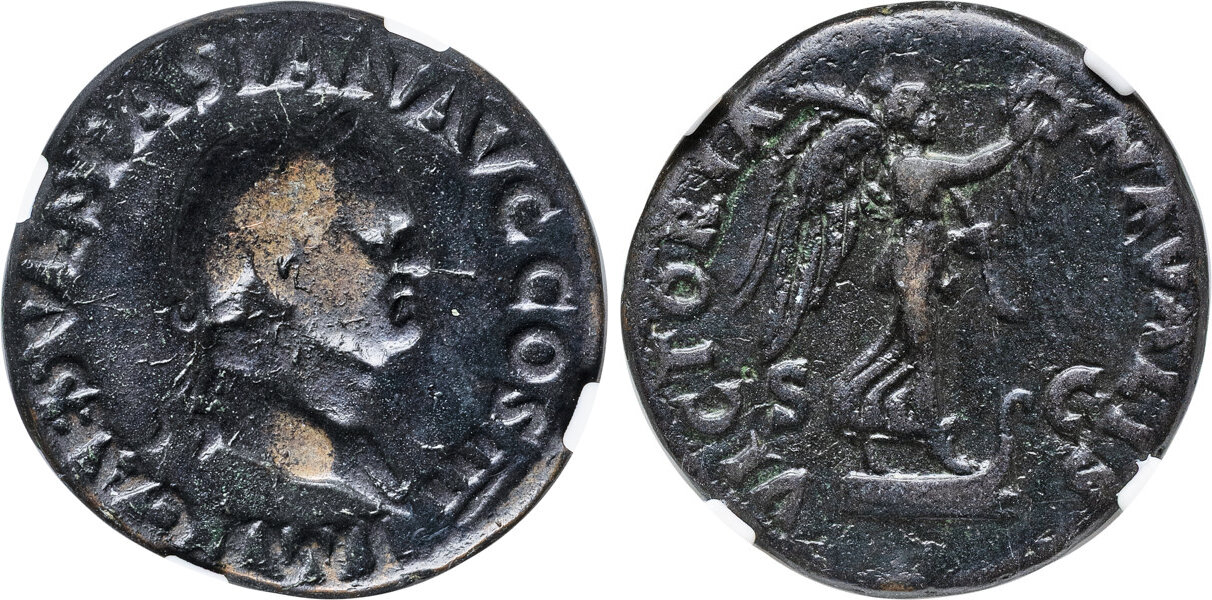 |
Match 4:
| Heritage World Coin Auctions > Showcase Auction 61636 | Auction date: 10 August 2026 |
| Lot number: 21276 Price realized: 2,600 USD (Approx. 2,251 EUR) Note: Prices do not include buyer's fees. | |
| Lot description: Ancients Nerva (AD 96-98). AE sestertius (33mm, 23.63 gm, 6h). NGC Fine 4/5 - 2/5. Rome, late AD 96. IMP NERVA CAES AVG P M TR P COS II DESIGN III P P, laureate head of Nerva right / FISCI IVDAICI-CALVMNIA SVBLATA ("the insult of the Jewish tax has been abated"), palm tree bearing two large bunches of dates; S-C across fields. RIC II 72. GBC 6, 6634. Rare. Reddish-brown patina with orichalcum highlights. An attractive example of this rare and controversial type. From the Eyeappealing Collection There is ongoing discussion regarding whether this coin actually commemorates the elimination of the insult of the tax on Jews or the cessation of the insult to the Emperor of the Jews continuing to pay taxes to Jerusalem (cf. GBC 6, pp. 419-421). For a fascinating discussion of this coin as it relates to the separation between Judaism and early Christianity see Marius Heemstra's book "The Fiscus Judaicus and the Parting of the Ways". www.HA.com/TexasAuctioneerLicenseNotice https://coins.ha.com/itm/ancients/roman-imperial/nerva-ad-96-98-ae-sestertius-33mm-2363-gm-6h-ngc-fine-4-5-2-5/p/61636-11036.s?type=DA-DMC-CoinArchives-WorldCoins-61636-08102026 HID02906262019 © 2026 Heritage Auctions | All Rights Reserved Certification number: NGC 6831167004 |  |
Match 5:
| Heritage World Coin Auctions > Showcase Auction 61635 | Auction date: 28 July 2026 |
| Lot number: 23062 Price realized: 775 USD (Approx. 681 EUR) Note: Prices do not include buyer's fees. | |
| Lot description: Ancients Vespasian (AD 69-79). AR denarius (19mm, 3.48 gm, 5h). NGC Choice XF 4/5 - 4/5. Rome, AD 75. IMP CAESAR-VESPASIANVS AVG, laureate head of Vespasian right / PON MAX-TR P COS VI, Pax seated left, branch in outstretched right hand. RIC II.1, 772. Descended from a family of small-time entrepreneurs and tax farmers in the Sabine hill country north of Rome, Flavius Vespasianus was born in AD 9 and rose to prominence in the Roman Army. He gained distinction during Claudius' invasion of Britain in AD 43-44 and won a Consulship in AD 51, but fell from imperial favor when he dozed off during one of Nero's musical performances. When a Jewish faction in the province of Judaea rebelled and massacred the local Roman garrison in AD 66, Nero sent Vespasian at the head of three legions to crush the revolt. Through his able son Titus, Vespasian gained the friendship and support of Mucianus, governor of Syria, who had another three legions at his disposal. When the collapse of Nero's regime in AD 68 led to a free-for-all for the throne, with Galba, Otho, and Vitellius following in quick succession, Vespasian realized he had the means and ability to make his own try for supreme power. On 1 July AD 69, the legions of Alexandria, Egypt declared Vespasian as emperor. He decided on a policy of blockade and attrition to defeat Vitellius, but the sudden declaration of support by the Danubian legions and their invasion of Italy in the fall of AD 69 brought a much quicker victory. Vitellius was executed on 20 December, and the Senate proclaimed Vespasian emperor two days later. Arriving in Rome the following October, Vespasian celebrated a magnificent triumph for the Judaean campaign before launching an austerity program to put the Empire's finances on sound footing. His decade of rule was largely untroubled by revolts and conspiracies. Upon his death due to a sudden illness in AD 79 he was widely and sincerely mourned, and power passed smoothly to his son Titus. www.HA.com/TexasAuctioneerLicenseNotice https://coins.ha.com/itm/ancients/roman-imperial/vespasian-ad-69-79-ar-denarius-19mm-348-gm-5h-ngc-choice-xf-4-5-4-5/p/61635-35006.s?type=DA-DMC-CoinArchives-WorldCoins-61635-07282026 HID02906262019 © 2026 Heritage Auctions | All Rights Reserved Certification number: NGC 5872293002 |  |
