

Our partner for world banknotes research

| Nomos AG > obolos 43 | Auction date: 5 July 2026 |
| Lot number: 989 Price realized: 280 CHF (Approx. 349 USD / 305 EUR) Note: Prices do not include buyer's fees. | |
| Lot description: Hadrian, 117-138. Sestertius (Orichalcum, 31 mm, 19.84 g, 6 h), Rome, 120-121. IMP CAESAR TRAIANVS HADRIANVS AVG P M TR P COS III Laureate head of Hadrian to right. Rev. RESTITVTORI ORBIS TERRARVM / S C Orbis kneeling to the right, holding globe and extending hand to Hadrian, who is standing to the left, extending his hand to Orbis, and holding a scroll in his other hand. Banti 676. BMC 1211. Cohen 1285. RIC II.3, 450. Some encrrustations on the obverse; old scrapes, otherwise, very fine. From the collection of Justice F. R. Sanborn (1924-1973), Sotheby Parke Bernet, 24 February 1977, 273, aquired from Rudolf Habelt in 1954. Judge Sanborn represented the United States on the Supreme Restitution Court of Berlin from 1954 to 1959. It was established by international agreement to pass on cases of restitution to persons deprived of property by the war-time regime. Starting price: 100 CHF |  |

Match 1:
| Leu Numismatik AG > Auction 21 | Auction date: 30 May 2026 |
| Lot number: 356 Price realized: 3,600 CHF (Approx. 4,587 USD / 3,938 EUR) Note: Prices do not include buyer's fees. | |
| Lot description: Hadrian, 117-138. Dupondius (Orichalcum, 28 mm, 11.09 g, 6 h), Rome, 119-120. IMP CAESAR TRAIANVS HADRIANVS AVG P M TR P COS III Radiate head of Hadrian to right, with slight drapery on his left shoulder. Rev. SALVS PVBLICA / S - C Salus standing left, holding patera in her right hand and rudder upright in her left, placing her right foot on globe. BMC 1237. Cohen 1358 var. (no drapery). RIC 276. A beautiful coin with a wonderful turquoise patina. Light deposits and with minor area of weakness on the reverse, otherwise, about extremely fine. From the Pavlos Seitanidis Collection and from the collection of Armin Mathis, Auctiones GmbH E-Auction 88, 15 June 2025, 89, ex Numismatica Ars Classica 11, 29 April 1998, 425. This lot can be shipped to a US address. When delivered in Switzerland, this item is subjected to margin taxation in accordance with Art. 24a MWSTG (Swiss VAT Act), provided that the buyer is not registered for VAT. Estimate: 750 CHF |  |

Match 2:
| Leu Numismatik AG > Web Auction 42 | Auction date: 27 June 2026 |
| Lot number: 2029 Price realized: 150 CHF (Approx. 185 USD / 163 EUR) Note: Prices do not include buyer's fees. | |
| Lot description: Hadrian, 117-138. Dupondius (Orichalcum, 26 mm, 10.06 g, 6 h), Rome, 120-121. IMP CAESAR TRAIANVS HADRIANVS AVG P M TR P COS III Radiate bust of Hadrian to right, with slight drapery on his left shoulder. Rev. MONETA AVGVSTI / S - C Moneta standing front, head to left, holding scales in her right hand and cornucopiae in her left. BMC 1229. RIC 440. Beautiful green patina. Flan crack and minor corrosion, otherwise, good very fine. From the Pavlos Seitanidis Collection, ex Numisart E-Auction 9, 13 April 2025, 95. This lot can be shipped to a US address. When delivered in Switzerland, this item is subjected to margin taxation in accordance with Art. 24a MWSTG (Swiss VAT Act), provided that the buyer is not registered for VAT. Starting price: 75 CHF |  |
Match 3:
| Bertolami Fine Arts - ACR Auctions > Auction 391 | Auction date: 2 July 2026 |
| Lot number: 150 Price realized: 700 EUR (Approx. 801 USD) Note: Prices do not include buyer's fees. | |
| Lot description: Hadrian (117-138), Sestertius, Rome, 118; Æ (25,87 g; 34,6 mm; 6 h) IMP CAESAR TRAIANVS HADRIANVS AVG P M TR P COS III Laureate head of Hadrian to r., with slight drapery on his l. shoulder; Rv. PONT MAX TR POT COS II // LIBERALITAS AVG / S – C Hadrian seated left on platform, extending his r. arm toward citizen; in front of him, Liberalitas standing front, head to l., holding counting-board in her r. hand, and an officer seated to l. and making distribution to citizen standing to r. on steps, holding up fold of toga. RIC 163; Cohen 914. Good very fine / very fine. Glossy green patina. Ex Leu Numismatik Web Auction 26 (8-13 July 2023), lot 3304. Starting price: 400 EUR |  |
Match 4:
| Leu Numismatik AG > Auction 23 | Auction date: 2 November 2026 |
| Lot number: 364 Price realized: This lot is for sale in an upcoming auction - Bid on this lot  | |
| Lot description: Vespasian, 69-79. Sestertius (Orichalcum, 34 mm, 26.61 g, 6 h), Rome, 71. IMP CAES VESPASIAN AVG P M TR P P P COS III Laureate head of Vespasian to right. Rev. IVDAEA CAPTA / S C Palm tree with two bunches of dates; to left, Vespasian standing right in military attire, resting his left foot on helmet, holding spear in his right hand and parazonium in his left; to right, Judaea, draped and veiled, seated right on cuirass in attitude of mourning, resting her head on her left hand. BMC 543-7. Bromberg II 611. CBN 498. Cohen 239. Hendin 6534. RIC 167. Samel 2295-9. Shoshana -. A magnificent example of this prestigious issue, undoubtedly among the finest known. Beautifully preserved, with a delightful, even olive-green patina and excellent reverse detail. Small scratch and minor spot of corrosion on the reverse, otherwise, extremely fine. Ex Leu 75, 25 October 1999, 1483 (with original ticket). Among the most powerful designs of the Judaea Capta series, this sestertius represents a major change in the visual language of the Flavian victory. On the familiar captive-and-Judaea reverses (see lots 358-362 above), Roman conquest is expressed primarily through the defeated: a male prisoner and the seated female personification of Judaea arranged on either side of the palm tree. Here, however, the male captive has disappeared and is replaced by Vespasian himself. The composition is no longer simply an image of captivity, but a direct confrontation between the victorious emperor and the defeated province. Vespasian stands in military dress, holding spear and parazonium and resting one foot upon a captured helmet. The pose draws on the traditional imagery of Roman military virtue and command, while the palm tree remains the central marker of Judaea. Opposite the emperor, Judaea sits at ground level, creating a deliberate contrast between standing and seated, armed and unarmed, victor and vanquished. The result is not a literal representation of the triumph, but a concentrated image of imperial victory in which Vespasian himself has become the dominant figure. This emphasis on Vespasian is particularly significant. Jerusalem had been captured by Titus in 70 CE, but under Roman imperial ideology the victory ultimately belonged to the emperor under whose auspices the campaign had been fought. The same idea was later expressed explicitly in the inscription of the now lost Arch of Titus in the Circus Maximus, which credited Titus with subduing the Jewish people praeceptis patris consiliisque et auspiciis – 'under his father's instructions, guidance and auspices' (CIL VI 944). The reverse of the present sestertius gives visual form to precisely this principle: Titus may have commanded the final siege, but Vespasian appears as the ultimate victor. Struck in 71 CE, the coin also belongs to the year of the great joint triumph of Vespasian and Titus at Rome. Josephus describes how the Senate had originally granted separate triumphs, but father and son chose to celebrate a single triumph together; in the procession itself, Vespasian took precedence, followed by Titus (Josephus, B.J. 7.123-152). More tellingly, Josephus saw the celebrations as marking not only victory over an external enemy, but also 'the end ... of their civil miseries' (B.J. 7.157). The Judaean victory thus allowed the new dynasty to replace the memory of civil war with the image of victory over a foreign enemy. The present type gives direct visual expression to that message. Judaea is no longer merely shown among the captives of Rome: she is placed directly before the emperor who claims her defeat as his own. In our exceptionally well-preserved sestertius, the contrast between the commanding figure of Vespasian and the seated province is particularly striking, offering a wonderful illustration of this important development within the Judaea Capta series. This lot can be shipped to a US address. When delivered in Switzerland, this item is subjected to margin taxation in accordance with Art. 24a MWSTG (Swiss VAT Act), provided that the buyer is not registered for VAT. Estimate: 35000 CHF | 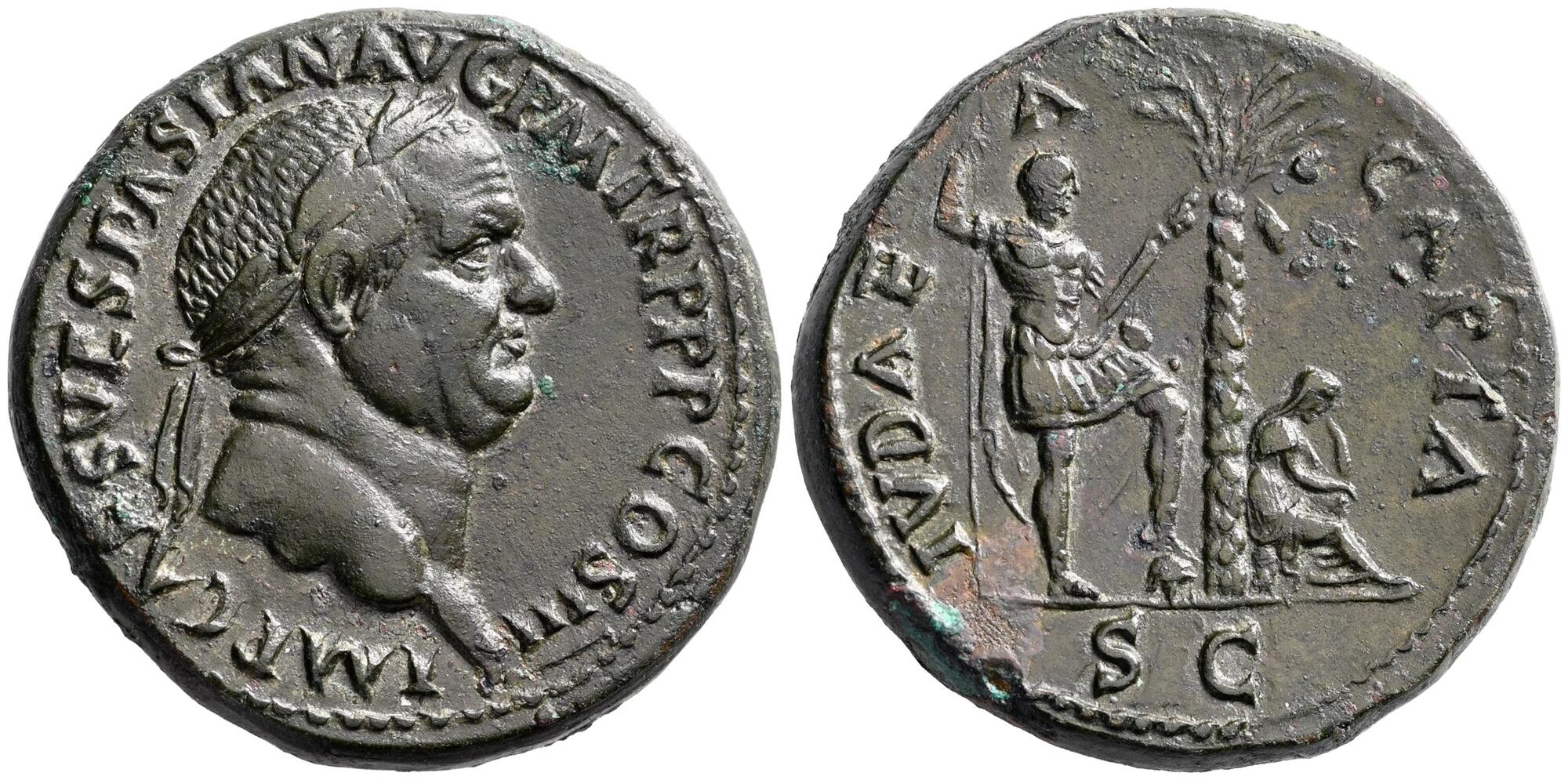 |
Match 5:
| Leu Numismatik AG > Auction 23 | Auction date: 2 November 2026 |
| Lot number: 369 Price realized: This lot is for sale in an upcoming auction - Bid on this lot | |
| Lot description: Vespasian, 69-79. Sestertius (Orichalcum, 36 mm, 25.46 g, 6 h), Rome, 71. IMP CAESAR VESPASIANVS AVG P M T P P P COS III Laureate head of Vespasian to right, with slight drapery on his left shoulder. Rev. VICTORIA AVGVSTI / S C Victory advancing right, holding palladium in her right hand and presenting it to Vespasian, standing front in military attire, head to left, extending his right hand and holding spear in his left. BMC 786 corr. (not aegis, but drapery on shoulder). Bromberg -. CBN -. Cohen 620 var. (no drapery). Hendin -. RIC 132. Samel -. Shoshana -. An extremely rare type, and with an unusual and exceptionally lifelike portrait. Slightly smoothed and with minor traces of corrosion and some doubling on the reverse, otherwise, very fine. Ex Numismatica Ars Classica 59, 4 April 2011, 943 (with original ticket) and Numismatica Ars Classica 33, 6 April 2006, 452. Struck in 71 CE, this extremely rare sestertius belongs to the great series of victory issues following the Flavian triumph over Judaea. Rather than showing the defeated province, however, the reverse presents Victory offering Vespasian the Palladium, the ancient image of Pallas Athena regarded as a sacred guarantee of Rome's safety and continued existence. The scene thus links the recent military victory with the security and permanence of Roman rule. This meaning is reinforced by closely related sestertii showing the same scene under the legend AETERNITAS P R, the 'eternity of the Roman people'. In the context of 71 CE, the type forms a natural counterpart to the explicit Judaea Capta issues, presenting Vespasian not only as conqueror, but as the ruler under whom victory, stability and the continuity of Rome had been restored. This lot can be shipped to a US address. When delivered in Switzerland, this item is subjected to margin taxation in accordance with Art. 24a MWSTG (Swiss VAT Act), provided that the buyer is not registered for VAT. Estimate: 7500 CHF | 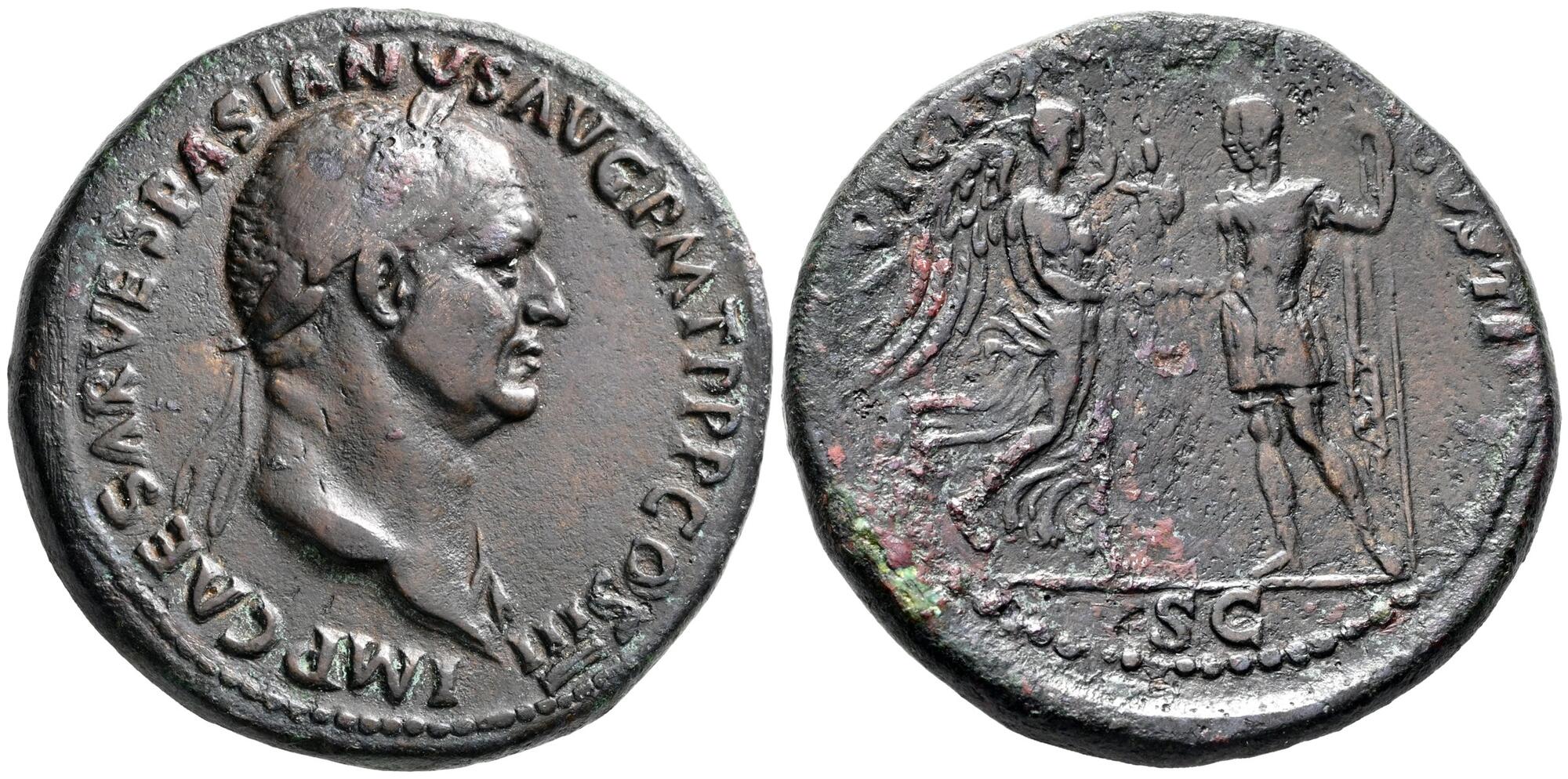 |
