

Our partner for world banknotes research

| Nomos AG > obolos 43 | Auction date: 5 July 2026 |
| Lot number: 378 Price realized: 180 CHF (Approx. 224 USD / 196 EUR) Note: Prices do not include buyer's fees. | |
| Lot description: TROAS. Neandria (?). Late 6th to early 5th century. Tetartemorion (Silver, 4.5 mm, 0.12 g). Corinthian helmet to right. Rev. Quadripartite incuse square alternating raised and sunken quarters. Unpublished in the standard refferences. For the only other example struck from the same dies, see Naumann 111, 2021, 421. Cf. SNG Arikantürk 664-5 (for a hemiobol of the same series attributed to the same mint). Extremely rare and seemingly the second known example. Rough surfaces, otherwise, about very fine. This series was traditionally attributed to Skione in Macedon, an attribution which is not longer accepted. Although a few numismatists have catalogued similar examples as a product of an uncertain Ionian mint, the attribution of the hemiobol from the same series in SNG Arikantürk, to Neandria in Troas looks very tempting. A mint in Thrace could also be a possibility as the reverse with the alteration of sunken and raised quarters is also found there (for example in Chersonesos). Starting price: 50 CHF |  |

Match 1:
| Nomos AG > obolos 42 | Auction date: 3 May 2026 |
| Lot number: 276 Price realized: 50 CHF (Approx. 64 USD / 55 EUR) Note: Prices do not include buyer's fees. | |
| Lot description: TROAS. Neandria (?). Late 6th to early 5th century. Hemiobol (Silver, 7.5 mm, 0.23 g, 5 h). Crested Corinthian helmet to left. Rev. Amphora, to left, club; all within linear square frame within shallow circular incuse punch. Cf. Naumann 129, 2023, 189 (kerykeion to right). Cf. Nomos, obolos 34, 2024, 63 (ivy leaf to left, attributed to thraco-Macedonian region). Cf. SNG Arikantürk 683 (Π on reverse). Very rare and apparently unpublished. Toned. Minor roughness, otherwise, very fine. Starting price: 50 CHF |  |
Match 2:
| Nomos AG > obolos 42 | Auction date: 3 May 2026 |
| Lot number: 264 Price realized: 220 CHF (Approx. 281 USD / 240 EUR) Note: Prices do not include buyer's fees. | |
| Lot description: TROAS. Dardanos. late 6th-early 5th century BC. Obol (Silver, 7 mm, 0.32 g). Head of cock to right. Rev. Quadripartite incuse square. Seemingly unpublished in the standard references. Classical Numismatic Group e385, 26 October 2016, 199. Porous surfaces, otherwise, very fine. Starting price: 50 CHF |  |
Match 3:
| Leu Numismatik AG > Auction 21 | Auction date: 30 May 2026 |
| Lot number: 4 Price realized: 11,000 CHF (Approx. 14,015 USD / 12,033 EUR) Note: Prices do not include buyer's fees. | |
| Lot description: CENTRAL EUROPE. Helvetii (?). Late 4th to early 3rd century BC. Stater (Gold, 19 mm, 8.50 g, 11 h), 'type de Soy au canthare', imitating Philip II of Macedon. Laureate head of Apollo to right. Rev. ΦΙΛΙΠΠOY Charioteer driving biga to right, holding reins in his left hand and kentron in his right; below the horses, kantharos. D. F. Allen: The Philippus in Switzerland and the Rhineland, in: SNR 53 (1974), 3. DT 2001. Flesche 123. LT -. Leu 4 (2019), 92 (same dies). SLM 375. Extremely rare and among the finest of a very few known examples. Tiny scuff on the edge and with a very light scratch on the reverse, otherwise, good extremely fine. From the Appassionato Collection, ex Leu 5, 27 October 2019, 5, and previously from a Swiss collection. The exact minting place of this remarkable coin remains uncertain. Delestrée and Tache assign it to Armorica in northwestern France, whereas Allen considered it a Helvetian issue. Recorded findspots range from Brittany and Central France to Switzerland, Baden-Württemberg, and Rhineland-Palatinate - an exceptionally broad distribution that suggests the issue served chiefly as a medium of trade. The present specimen is of very early style and must have been struck by the late 4th or, at the latest, the early 3rd century BC, at a time when the first Macedonian prototypes from Pella were reaching Celtic Europe. This lot can be shipped to a US address. Estimate: 10000 CHF |  |

Match 4:
| Nomos AG > obolos 42 | Auction date: 3 May 2026 |
| Lot number: 221 Price realized: 130 CHF (Approx. 166 USD / 142 EUR) Note: Prices do not include buyer's fees. | |
| Lot description: ASIA MINOR, Uncertain. late 6th-early 5th century Bc. Obol (Silver, 7.5 mm, 0.69 g). Quadruped (possibly a griffin or a goat) standing to right, with a triangular-shaped object on his back, behind his neck, and something else on his back above his rump. Rev. Quadripartite incuse square. Apparently unpublished, but struck from the same dies as Heritage 61356, January 2024, 25009 and Leu (WH) e32, December 2024, 665. Very rare, one of three examples presently known. Intriguing and clear. Die break on the obverse. Nearly very fine. On the two other known examples their cataloguers identified the animal on the obverse as a camel; which implies that those people never actually saw a camel! They also dated it solely to the 5th century BC, which is definitely too late. It is clear from this coin (and the Heritage piece) that our animal has a horn on its head (rarely if ever found on camels, even those from ancient Asia Minor) and, while there is something on his back, it is not a hump. The small, seemingly curved horn on his head is reminiscent of a griffin's horn - perhaps the protuberance on his back behind his neck is a kind of wing (?); while the other thing on his back, above his rump, is reminiscent of the bird perching on the back of the donkeys at Mende. In fact, this creature is almost certainly a griffin: its head is similar to that of the griffin found on the early coins of Assos. Starting price: 50 CHF |  |
Match 5:
| Nomos AG > obolos 43 | Auction date: 5 July 2026 |
| Lot number: 313 Price realized: 282 CHF (Approx. 351 USD / 307 EUR) Note: Prices do not include buyer's fees. | |
| Lot description: ASIA MINOR, Uncertain. late 6th-early 5th century Bc. Obol (Silver, 7.5 mm, 0.61 g). Quadruped (possibly a griffin or a goat) standing to right, with a triangular-shaped object on his back, behind his neck, and something else on his back above his rump. Rev. Quadripartite incuse square. Apparently unpublished, but struck from the same dies as Heritage 61356, January 2024, 25009 and Leu (WH) e32, December 2024, 665. Very rare; toned. Very fine. On the other known examples their cataloguers identified the animal on the obverse as a camel; which implies that those people never actually saw a camel! They also dated it solely to the 5th century BC, which is definitely too late. It is clear from this coin (and the Heritage piece) that our animal has a horn on its head (rarely if ever found on camels, even those from ancient Asia Minor) and, while there is something on his back, it is not a hump. The small, seemingly curved horn on his head is reminiscent of a griffin's horn - perhaps the protuberance on his back behind his neck is a kind of wing (?); while the other thing on his back, above his rump, is reminiscent of the bird perching on the back of the donkeys at Mende. In fact, this creature is almost certainly a griffin: its head is similar to that of the griffin found on the early coins of Assos. Starting price: 50 CHF | 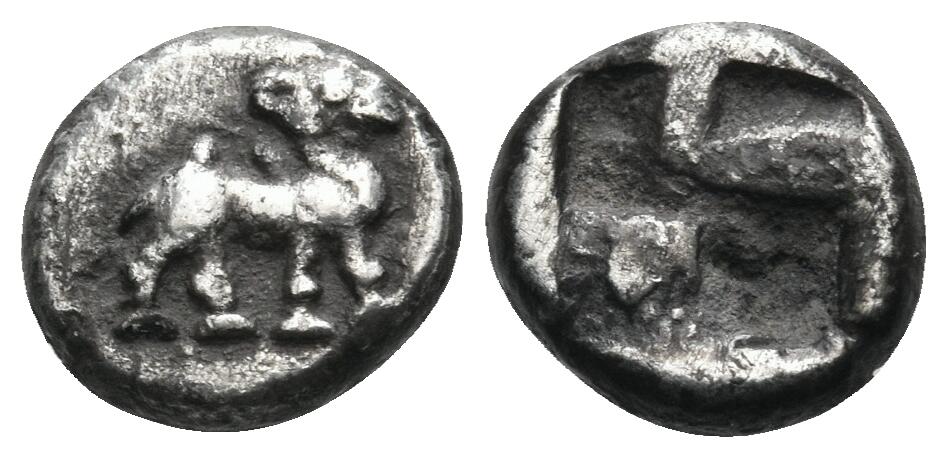 |
