

Our partner for world banknotes research

| Baldwin's Auctions Ltd > Auction 131 | Auction date: 22 July 2026 |
| Lot number: 2 Price realized: 600 GBP (Approx. 802 USD / 703 EUR) Note: Prices do not include buyer's fees. | |
| Lot description: Coins Apulia, Luceria (c. 217‑212 BC) AE Aes Grave As, 80.08g. Head of Hercules facing right, wearing a lionskin headdress. Rev. Horse leaping right, star above, L below. (ICC 344; Haeberlin pl. 71, 11; HN Italy 676). Good Very Fine or better for issue. An exceptionally round and well‑formed example. Estimate: 600 - 800 GBP |  |

Match 1:
| Leu Numismatik AG > Web Auction 44 | Auction date: 5 September 2026 |
| Lot number: 223 Price realized: 900 CHF (Approx. 1,111 USD / 956 EUR) Note: Prices do not include buyer's fees. | |
| Lot description: CILICIA. Nephelis (?). Circa 334-early 3rd century BC. Obol (Silver, 11 mm, 0.60 g, 3 h). Head of Herakles to right, wearing lion skin headdress. Rev. Monogram of NE between bow to left and arrowhead to right. Imhoof-Blumer, Monnaies grecques, p. 467. 47 = Svoronos 1888, p. 60, 3 and pl. IV, 10 = Svoronos 1905, p. 165, 5a and pl. V, 17 = Yarkin p. 2, 1. Tatar Series 1. Extremely rare, apparently the seventh known example of this enigmatic issue, and by far the finest. Light traces of cleaning and with minor edge chipping, otherwise, good extremely fine. Ex Demos E-Auction 63, 13 February 2026, 57. Since Pellerin first published the type in 1763, coins bearing the enigmatic EN or ENA monogram have remained among the most hotly debated issues of Asia Minor (Pellerin, Recueil de médailles de peuples et de villes (1763), p. 128, pl. CXVI, 8). In 1883, Imhoof-Blumer read the monogram as EN and suggested that the series had been struck by an as yet unidentified coastal city in Caria, Pamphylia, or Pisidia (Imhoof-Blumer, Monnaies grecques (1883), p. 467, 47–53). Svoronos revised his interpretation several times, attributing the coins first to Erannos on Crete, then to Erythrai in Ionia, and finally to Enaia/Anaia in Caria (Svoronos 1888, pp. 59–64; 1903, p. 182, no. 27; 1905, pp. 161–174). In 1995, U. Yarkın placed the mint in eastern Pamphylia or western Cilicia (U. Yarkın, Enaia/Anaia Sikkeleri, in: Moneta 4 (1995), pp. 1–2), while in 2008 T. Gökyıldırım associated the series with Alexander's officer Nearchos and proposed Side as the mint for the Herakles coins and Phaselis for the prow series (T. Gökyıldırım, Etenna Definesi (1991), in: İ. Delemen et al. (eds.), Prof. Dr. Haluk Abbasoğlu'na 65. Yaş Armağanı, vol. 1, 2008, pp. 505–517). A Künker cataloguer later suggested an attribution to the Enetoi of Paphlagonia (Künker, Auction 333, 16–17 March 2020, lot 52). A major advance in the attribution came with Ömer Tatar's comprehensive reassessment of the group, in which he identified Nephelis on the western Cilician coast as the most convincing candidate (Tatar, The Re-Attribution of Some Uncertain Asia Minor Coins to Nephelis in Cilicia, in: AIIN 66, 2020, pp. 71–97, esp. pp. 77–85). Central to his argument is the marked concentration of finds in the Alanya region, including the first example recovered in a controlled archaeological excavation at Alanya Castle, while no specimens are known from excavations at Side or Phaselis (Tatar 2020, pp. 77–79). Since civic bronze coins generally circulated only within a limited radius of their mint, this distribution strongly points to western Cilicia. The monogram can also plausibly be read in retrograde as NE, providing a further link with Nephelis (Tatar 2020, p. 79). Located approximately 60 km east of Alanya, Nephelis was already inhabited in the Hellenistic period and had the status of a polis (Karamut/Russell 1999, pp. 355–371; Tatar 2020, pp. 82–83). On stylistic and metrological grounds, the Herakles series may be dated to the final quarter of the 4th or the 3rd century BC. The known silver coins weigh between 0.57 and 0.68 g and are best understood as obols struck on the Attic standard, while the head of Herakles on the present specimen clearly follows the coinage of Alexander the Great and his successors. Tatar recorded only six silver obols of the series, in contrast to a substantially larger bronze coinage. The present coin, the finest known specimen to our knowledge, therefore represents the exceptionally rare and prestigious silver denomination of this remarkable series; for its attribution, we follow Tatar in assigning it to Nephelis. This lot cannot be shipped to a US address. Starting price: 200 CHF | 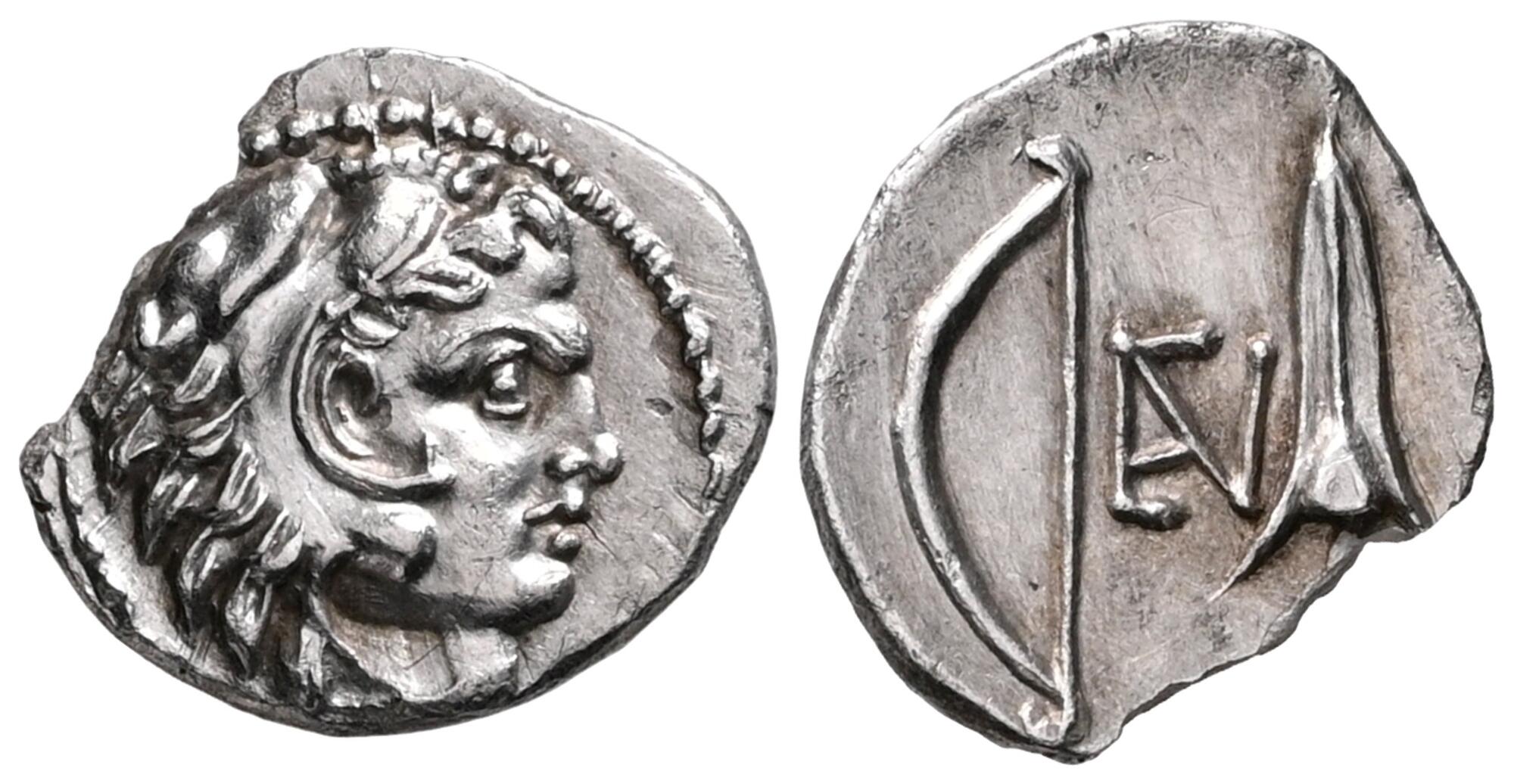 |

Match 2:
| Classical Numismatic Group > Auction 132 | Auction date: 18 May 2026 |
| Lot number: 699 Price realized: 3,750 USD (Approx. 3,221 EUR) Note: Prices do not include buyer's fees. | |
| Lot description: Anonymous. Circa 270 BC. Æ Aes Grave As (66mm, 326.0 g, 12h). Rome mint. Diademed head of Apollo right; | (mark of value) above; all on raised disk / Diademed head of Apollo left; | (mark of value) above; all on raised disk. Crawford 18/1; Sydenham 15; HN Italy 279; ICC 33; Haeberlin pl. 34, 1-10; RBW 20. Beautiful green patina with patches of red, small casting voids. Good VF. Impressive cast in high relief giving a sculptural appearance. Rare. From the D. K. Collection. Bronze was, from very early times, the traditional medium of exchange for the peoples of central Italy. Economically and artistically the region was behind when compared with the highly developed monetary systems of the Greek colonies in the south. Initially, the population of this area, including the Romans, made do with irregular lumps of bronze, known as Aes Rude, for their currency requirements. Toward the close of the 4th century BC, they advanced to producing cast bronze bars with designs on both sides. These large and cumbersome pieces are known today by the term Aes Signatum. Later still, probably around 280 BC, cast bronze coinage on circular flans (Aes Grave) was introduced and gradually superseded the bars as the 3rd century progressed, the transition being complete by about the time of the end of the First Punic War (241 BC). Aes Grave was produced in a range of denominations, initially from the As (weighing approximately 324 grams or one Roman pound) down to its twenty-fourth part, the Semuncia. The large Aes Grave issues, commencing circa 225 BC, were on a somewhat reduced standard, with the As weighing in at about 275 grams, although they were still quite massive and likely inconvenient for use in everyday commerce. For convenience introduced a bimetallic system with inclusion of silver and began to circulate silver didrachms known as quadrigati, which also featured the two-faced god Janus, albeit in a more youthful form. As inflation took its toll the Romans replaced the smaller bronze denominations with struck coins, introducing new bronze and silver denominations when they reform circa 212-211 BC. The final winners of all CNG Feature Auction 132 lots will be determined at the live online sale that will be held on 18-19 May 2026. CNG Feature Auction 132 – Session Three – Lot 588-888 will be held Tuesday morning, 19 May 2026 beginning at 9:00 AM ET. Winning bids are subject to a 22.5% buyer's fee for bids placed on this website and 25% for all others. We recognize that our users may have various Internet Browsers and Operating Systems. We like our visitors to have the best possible experience when using our bidding platform. However, we do recognize that it is impossible to develop applications that work identically, efficiently and effectively on all web browsers. The CNG bidding platform supports the latest stable major version and stable previous version of Chrome and Firefox. We recognize that our users may have various Internet Browsers and Operating Systems. We like our visitors to have the best possible experience when using our bidding platform. However, we do recognize that it is impossible to develop applications that work identically, efficiently and effectively on all web browsers. The CNG bidding platform supports the latest stable major version and stable previous version of Chrome and Firefox. Estimate: 5000 USD |  |

Match 3:
| Nomos AG > Auction 38 | Auction date: 31 May 2026 |
| Lot number: 171 Price realized: 16,000 CHF (Approx. 20,385 USD / 17,502 EUR) Note: Prices do not include buyer's fees. | |
| Lot description: LUCANIA. Metapontion. Circa 280-279 BC. 1/3 Stater (Gold, 13 mm, 2.88 g, 12 h), Pyrrhic War issue. ΛΕΥΚΙΠΠ[ΟΣ] Bearded head of Leukippos to right, wearing a crested Corinthian helmet adorned, on the bowl, with Skylla hurling a stone to right. Rev. Μ-Ε Two six-grained barley ears, each with a curly leaf on their outer side; between them, ΣΙ. Johnston G 5.1 (same dies). HN III 1630. SNG ANS 397 (same obverse die). SNG Lockett 404 (same reverse die). Rare and one of the best examples known. Struck from beautifully engraved dies, with a particularly fine 'portrait' of Leukippos. Obverse very slightly double-struck with minor amounts of die rust, otherwise, good extremely fine. From an old French collection, and from the collection of Marchese R. Venturi-Ginori, Santamaria, 24 January 1938, 52, and apparently from the Bernalda Hoard of 1935 (IGCH 1958). When a Greek polis struck coins of gold, war was usually not far away. This artistically impressive 1/3 stater, with the mythical oikist Leukippos on the obverse and barley ears, the emblem of Metapontum, on the reverse, is no exception. In 280/279 BC King Pyrrhus was at the pinnacle of power in Italy, taking his army as far north as Praeneste (today's Palestrina), and from its hilltop location Rome is visible with the naked eye on a clear day. The future of the Greek cities of Southern Italy looked bright indeed. A few more months of footing the bill for the military expedition – hence the need for high-value coinage – and all would be well. Who could have guessed that within less than two years' time Metapontum would have to surrender to the forces of Rome? Estimate: 15000 CHF |  |

Match 4:
| Classical Numismatic Group > Auction 132 | Auction date: 18 May 2026 |
| Lot number: 705 Price realized: 37,500 USD (Approx. 32,213 EUR) Note: Prices do not include buyer's fees. | |
| Lot description: Anonymous. Third century BC. Æ Aes Grave Tressis or Triple-Nummus(?) (85mm, 948 g, 12h). Northern Apulia, Venusia(?) mint. Head of young Bacchus left, wearing ivy wreath with berries / Head and neck of antelope left. Unpublished in the standard references, but for similar reverse type Cf. ICC 268 (janiform head of maenad with Silenus); cf. Thurlow-Vecchi Addendum 288 (same); cf. Haeberlin p. 280, tx. A, 1 (same); HN Italy p. 51 (Uncertain aes grave, introductory paragraph); cf. Sydenham, Aes Grave 1926, 349 (Tressis or Tripondius). Brown and green patina with natural earthen deposits. VF. Unique. CNG would like to extend our thanks to Italo Vecchi, author of Italian Cast Coinage, who assisted with attribution of this unique piece and will add this coin to the next version of ICC. Italo writes: "The tentative identification of this extraordinary cast Tressis/Triple-nummus to the mint of Venusia, originally a settlement of the Peucetti, which became a Latin colony in 291 BC following the Third Samnite War, is based on several factors apart from its obvious similarity to the Tressis now in the Münzkabinett of Berlin Staatliche Museem (Haeberlin p. 280, pl. A, 1). According to Haeberlin it was acquired by the Berlin museum from a private collection in Naples, just before the printing in 1910 of his magnum opus, Aes Grave, only 180km from the ancient site of Venusia, near modern Venosa, and the most southerly mint of all Italic Cast Coinages. The weight standard is that of the earliest coinage of Venusia based on a Nummus of about 321g, comfortably accommodating the metrology of the above and Berlin examples. The large standard cast and struck bronze denominations at Luceria and Venusia were defined as Nummi (singular Nummus), the Latin equivalent of the Greek nomós (Varro, Ling. 5.173; Melville Jones TNR, p. 939), meaning 'custom, habit, practice, rule, law,' in this case: 'regular or statutory unit of currency,' cf. ICC Venusia 354. The bulging bronze fabric of the cast flan is similar to those of Venusia Æ Nummus ICC 351 as well as Tressis ICC 268. A third important element is the general similarity in portrait style of the obverse head of a young Bacchus, again from the city of Venusia, cf. Æ Nummus, HN Italy 719." Estimate: 3000 USD |  |
Match 5:
| Classical Numismatic Group > Keystone Auction 17 | Auction date: 22 July 2026 |
| Lot number: 209 Price realized: 3,000 USD (Approx. 2,630 EUR) Note: Prices do not include buyer's fees. | |
| Lot description: Anonymous. Circa 240 BC. Æ Aes Grave Sextans (36mm, 49.27 g, 6h). Sickle series. Rome mint. Scallop-shell; •• (mark of value) across field / Caduceus; sickle to right, •• (mark of value) across field. Crawford 25/8; ICC 52; HN Italy 304; RBW 45. Dark green patina with earthen highlights, flan crack, slight roughness, casting void on reverse. Good VF. From the W. Toliver Besson Collection. Ex Plus 20 Collection (Classical Numismatic Group 130, 23 September 2025), lot 389 (hammer $3000); Numismatica Ars Classica 138 (18 May 2023), lot 326; Künker 124 (16 March 2007), lot 8215; Lanz 72 (29 May 1995), lot 335. The story of Rome's adoption of bronze coinage is a complex one. While the Roman Republic was officially founded circa 510 BC, its rather rustic population resisted the Greek innovation of coined money for more than two centuries before an abortive start in the last quarter of the fourth century BC. This consisted of small bronze coins bearing a head of Apollo and a man-headed bull reverse, along with the Greek legend ΡΩΜΑΙΩΝ. Likely produced under contract at the Campanian Greek city of Neapolis, these circulated very little, and seemingly outside of Rome proper. When the Romans resumed issuing bronze coins circa 280 BC, they looked not toward the Greeks, but toward the Etruscan- and Oscan-speaking peoples of the Italian heartland, who already had an established system utilizing huge coins of literal, as opposed to fiduciary, value. Rather than being produced by hammer and dies, these Aes Grave ("heavy bronze") coins were created by pouring molten bronze into a mold, resulting in a roughened surface scant in fine detail. Hence, the designs were simple and crude by the standards of the Greeks. The main denomination, or As, weighed in at a full Roman pound, or about 325 grams of leaded bronze. Denominations included the As, Semis (half), Triens (third), Quadrans (quarter), Sextans (sixth), and Uncia (twelfth). Practical considerations resulted in a staged reduction in weight. By circa 240 BC, when this sextans was produced, the As now weighed somewhat less than 300 grams, as a quick calculation of this piece at 49.27 grams times six will show. By 225 BC, the Roman As weighed in at a still-hefty 275 grams. Despite the evident clumsiness in using such large pieces in everyday commerce, the Romans and their Italian allies clung to the unwieldy Aes Grave system until midway through the Second Punic War, circa 217-211 BC, when it was gradually replaced by a series of struck bronze denominations on a much reduced fiduciary standard. Estimate: 1000 USD |  |
