

Our partner for world banknotes research

| Astarte S.A. > Web Auction 13 | Auction date: 19 July 2026 |
| Lot number: 516 Price realized: 550 CHF (Approx. 680 USD / 594 EUR) Note: Prices do not include buyer's fees. | |
| Lot description: Hadrian, 117-138. Sestertius (Bronze, 32 mm, 23.01 g). Rome. 128-129. HADRIANVS - AVGVSTVS P P, Laureate and draped bust right. Rev. HILA - RI - TAS P R / S - C / COS III, Hilaritas standing left, holding palm frond and cornucopia; on left, a small boy lays hands on palm frond; on right, a small girl grasping dress of Hilaritas. RIC II.3, 989. Cohen 819. Riverine patina. A most refined portrait. Good Very Fine. Very Rare with draped bust. Starting price: 200 CHF | 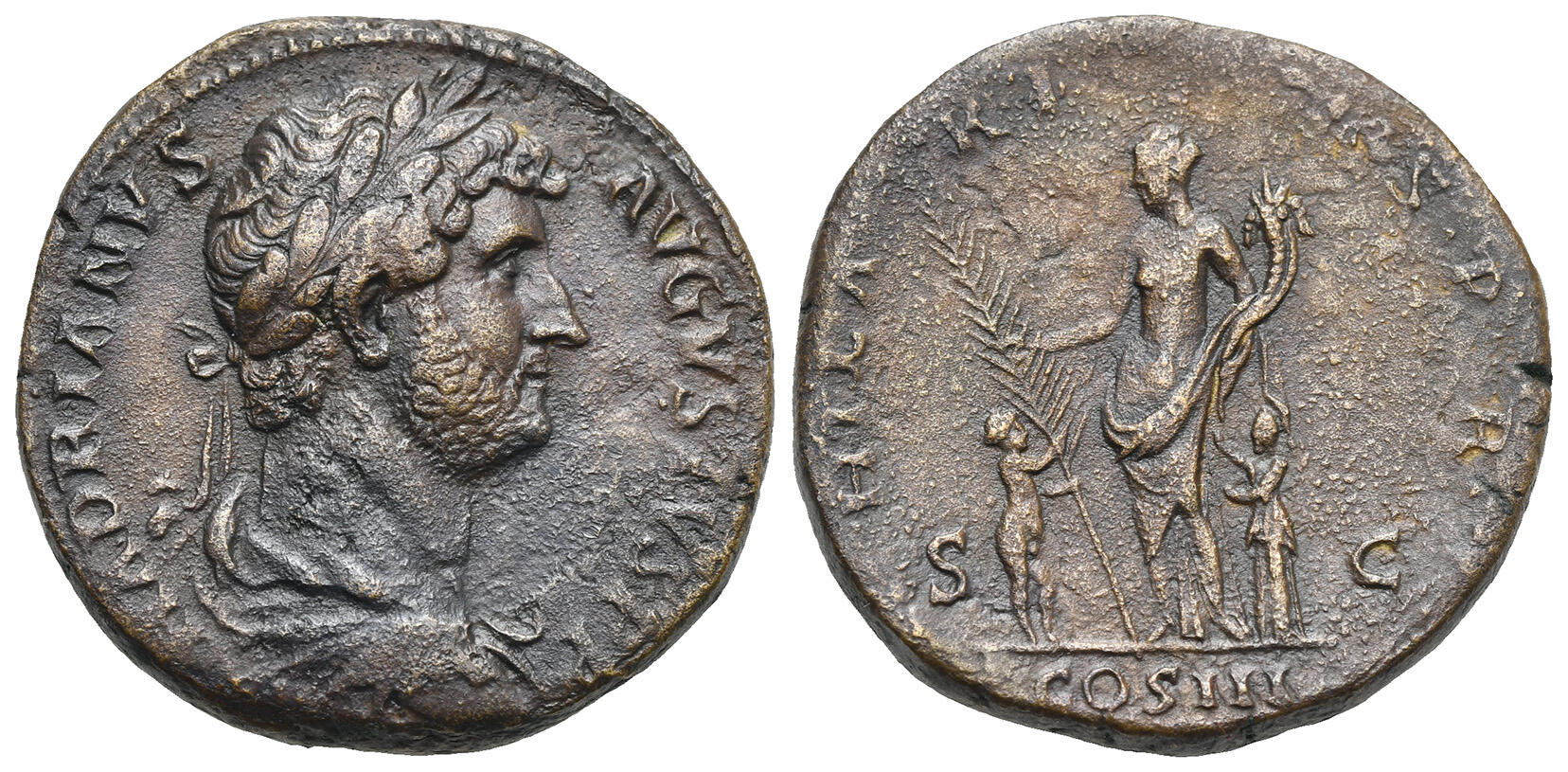 |
Match 1:
| Astarte S.A. > Web Auction 13 | Auction date: 19 July 2026 |
| Lot number: 517 Price realized: 300 CHF (Approx. 371 USD / 324 EUR) Note: Prices do not include buyer's fees. | |
| Lot description: Hadrian, 117-138. Sestertius (Bronze, 30 mm, 25.65 g). Rome. 128-129. HADRIANVS - AVG COS III P P, Laureate and draped bust right. Rev. FORTVNAE - REDV - CI / S C, Emperor standing right, holding scroll and greeting Fortuna, enthroned left and holding cornucopia. RIC II.3, 2104. Cohen 795 var. (bust). Riverine patina. Good Very Fine. Rare. Starting price: 150 CHF | 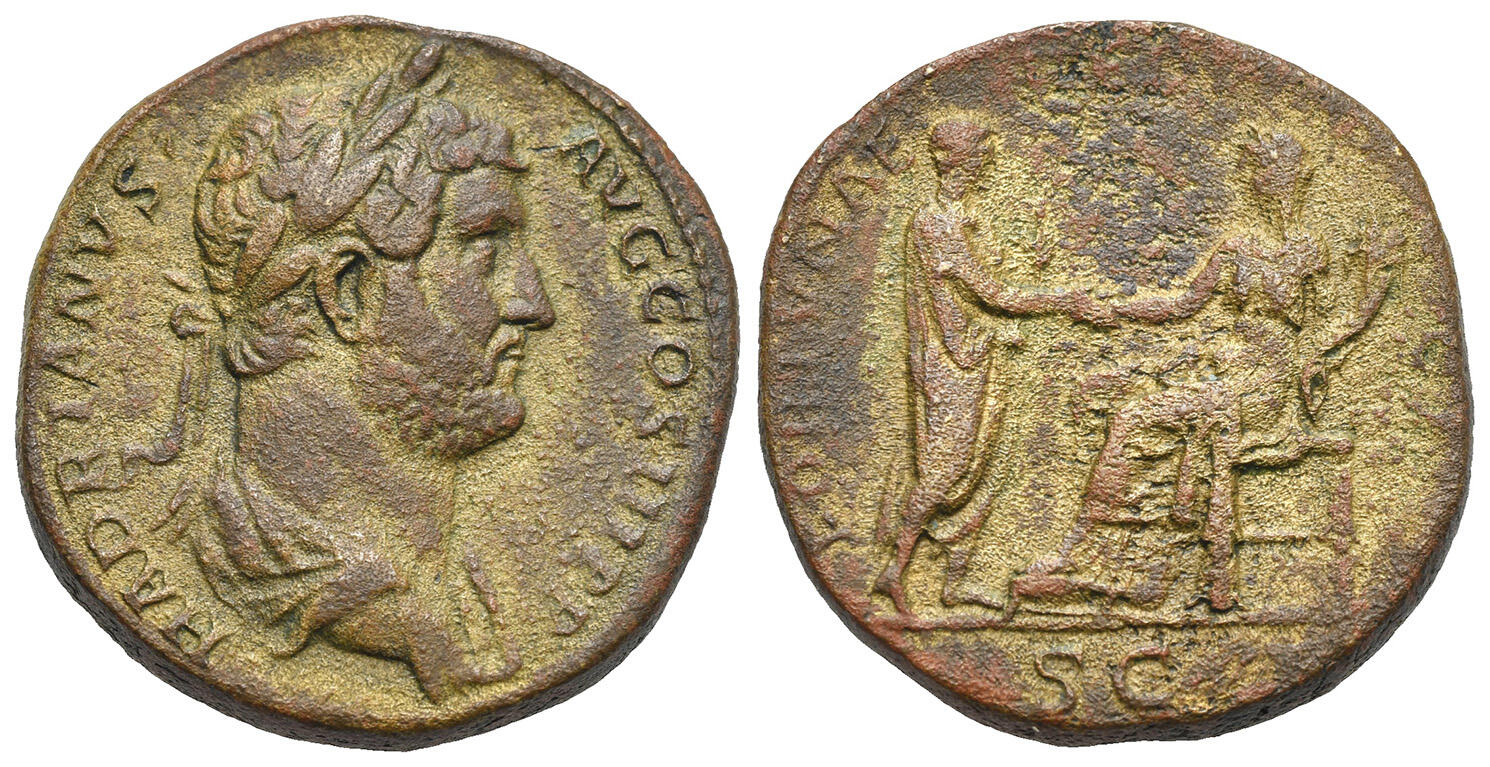 |
Match 2:
| MARS VLTOR GmbH > Auction 27 | Auction date: 26 July 2026 |
| Lot number: 109 Price realized: Unsold | |
| Lot description: Roman Imperial Hadrian, AD 117-138. Orichalcum Sestertius (32 mm. 21.62 g.). Rome. HADRIANVS AVG COS III P P. Laureate and draped bust of Hadrian right. Rev. ADVENTVI AVG MAVRETANIAE / S C. Hadrian, togate, standing right, raising hand and holding scroll, facing Mauretania, standing left, sacrificing from patera over altar and holding vexillum. Estimate: 50 EUR Starting price: 40 EUR | 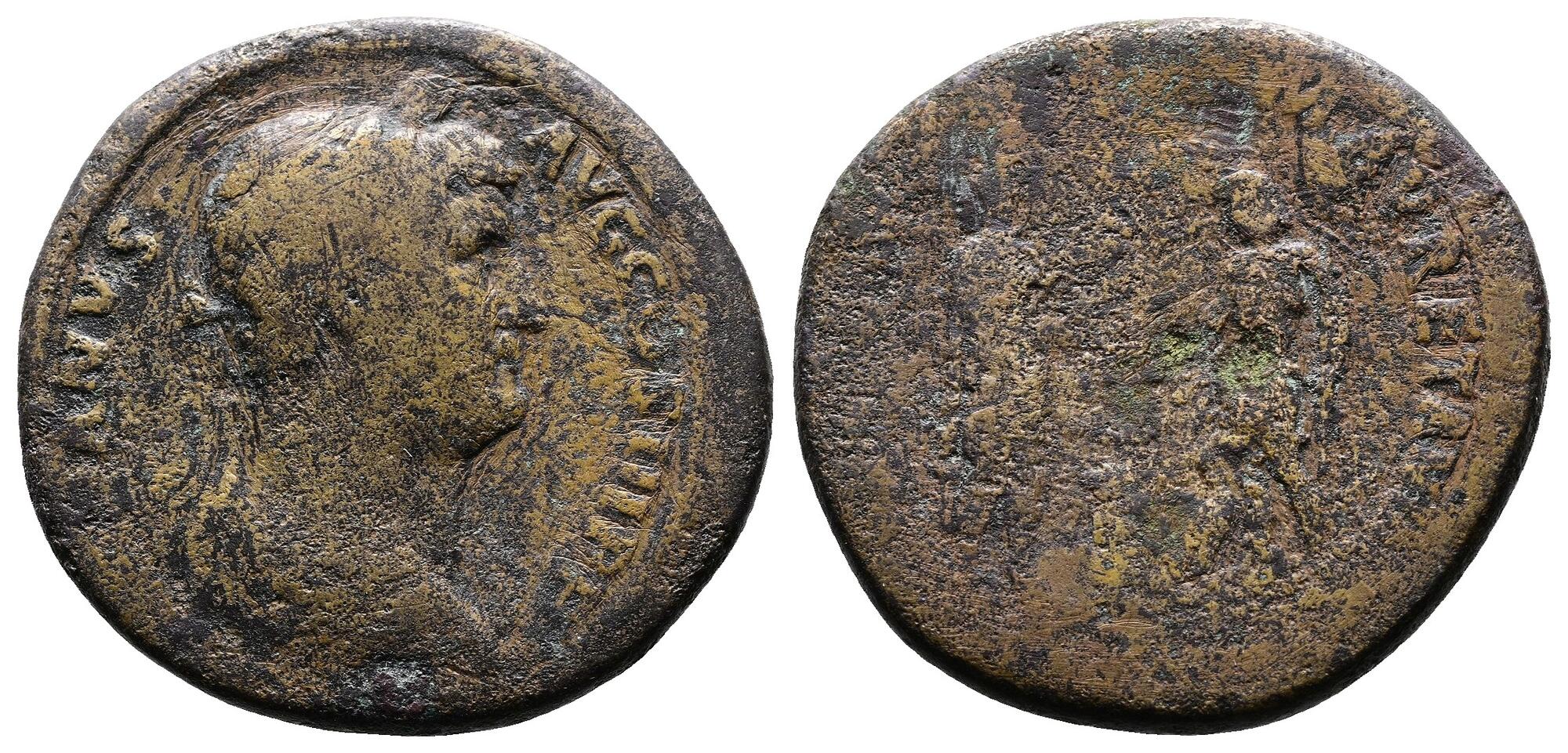 |
Match 3:
| Leu Numismatik AG > Web Auction 42 | Auction date: 27 June 2026 |
| Lot number: 2052 Price realized: 440 CHF (Approx. 544 USD / 477 EUR) Note: Prices do not include buyer's fees. | |
| Lot description: Hadrian, 117-138. Sestertius (Orichalcum, 33 mm, 28.00 g, 12 h), Rome, circa 129-130. HADRIANVS AVGVSTVS Laureate and draped bust of Hadrian to right, seen from behind. Rev. FELICITATI AVG / S - C / COS III P P Galley sailing left, with steerman and six rowers; at stern acrostolium, at prow, mast slanted forward and sail. BMC 1394. Cohen 664. RIC 1290. With a very old pedigree. Light tooling on the obverse, otherwise, nearly very fine. From the collection of an economist from Geneva and from the HJR Collection, Classical Numismatic Group E-Auction 426, 8 August 2018, 528, ex Numismatica Ars Classica 106, 9 May 2018, 1500, from the Zschiesche & Koder inventory, and ex Helbing, 9 April 1913, 1153. This lot can be shipped to a US address. When delivered in Switzerland, this item is subjected to margin taxation in accordance with Art. 24a MWSTG (Swiss VAT Act), provided that the buyer is not registered for VAT. Starting price: 100 CHF | 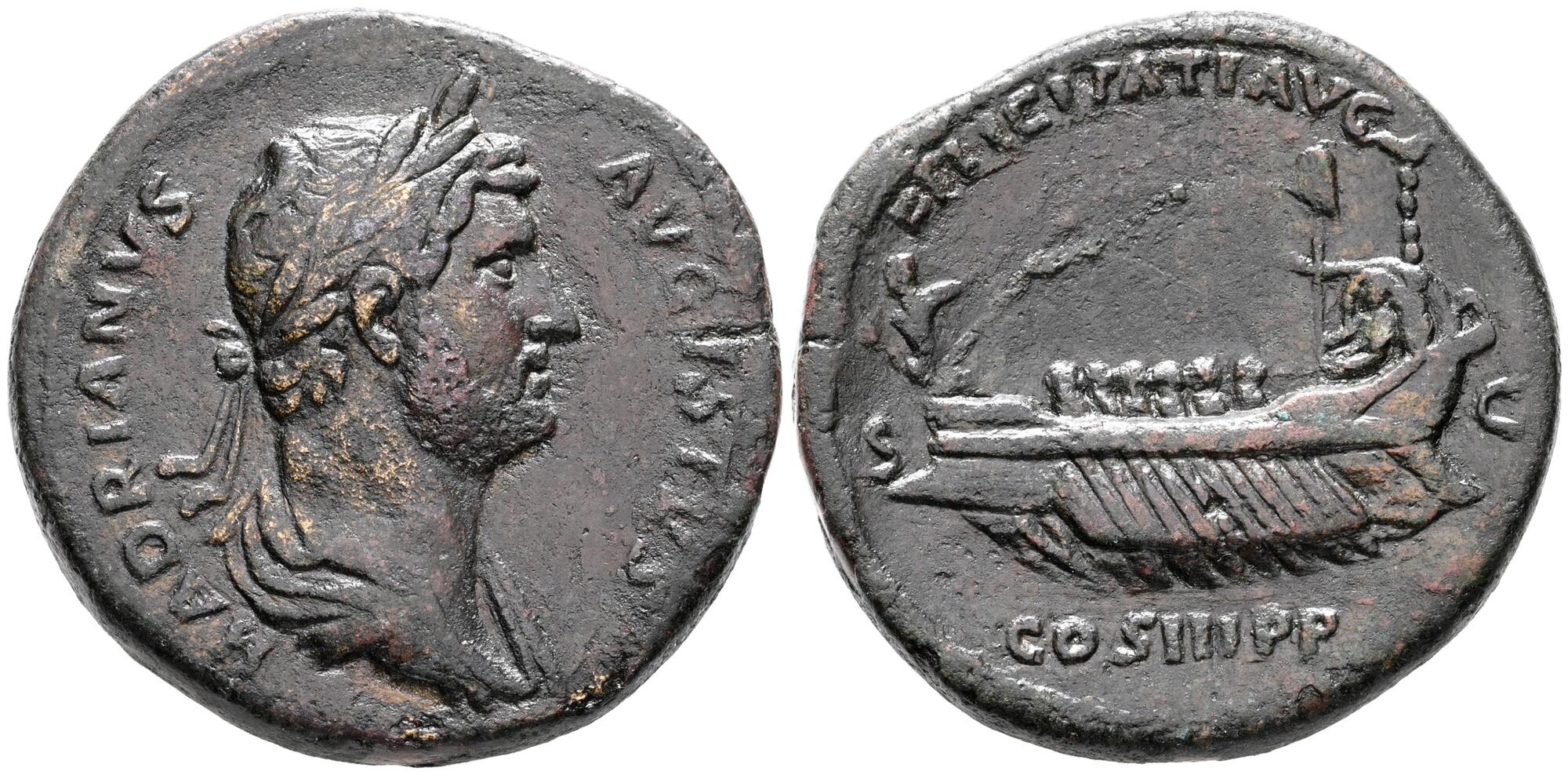 |

Match 4:
| Numismatica Ars Classica > Auction 165 | Auction date: 26 May 2026 |
| Lot number: 513 Price realized: 4,250 CHF (Approx. 5,387 USD / 4,647 EUR) Note: Prices do not include buyer's fees. | |
| Lot description: Hadrian augustus, 117 – 138 Sestertius 133-135, Æ 32 mm, 29.27 g. HADRIANVS – AVG COS IIII P P Bareheaded and draped bust r. Rev. FORTVNAE REDVCI Hadrian standing r., holding roll and clasping hand with Fortuna standing l., holding cornucopiae and rudder resting on exergual line. In exergue, S – C. C 790 var. (rudder on globe). BMC 1516. RIC 2098 var. (rudder on globe). Lovely olive green patina and extremely fine Ex Leu 36, 1985, 262; NAC 23, 2002, 1558; NAC 27, 2004, 397 and NAC 84, 2015, 999 sales. Purchased privately from Oslo Myntgalleri. From a Scandinavian collection. Estimate: 4500 CHF | 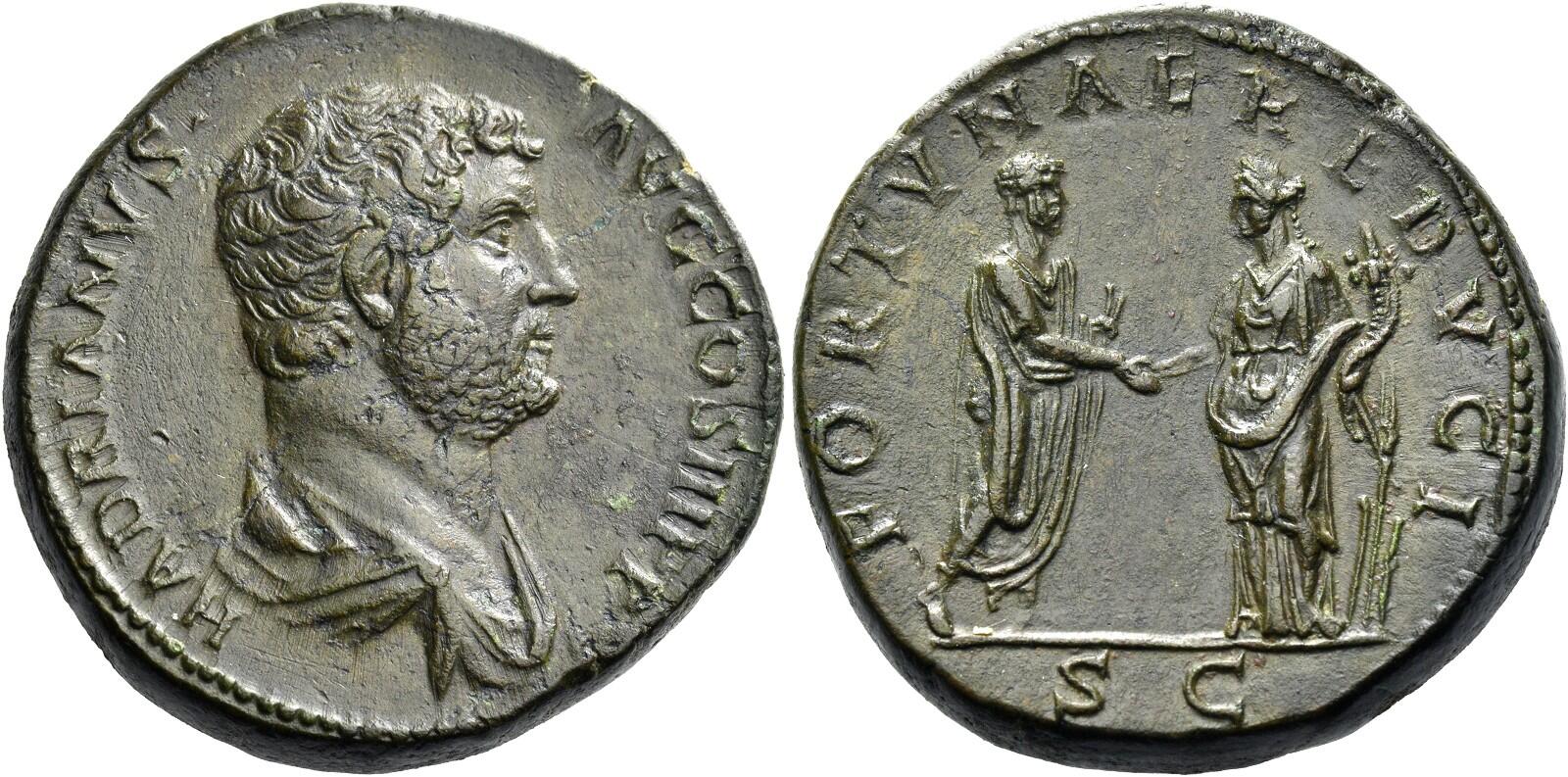 |

Match 5:
| Numismatica Ars Classica > Auction 165 | Auction date: 26 May 2026 |
| Lot number: 535 Price realized: 24,000 CHF (Approx. 30,422 USD / 26,242 EUR) Note: Prices do not include buyer's fees. | |
| Lot description: Commodus augustus, 177 – 192 Aureus 191, AV 20 mm, 7.28 g. L AEL AVREL CO – MM AVG P FEL Laureate and draped bust r. Rev. HERCVLI ROMANO AVG Hercules, naked, standing to front, head l., holding club and lion's skin in l. hand and placing r. on trophy. C 201 var. (also cuirassed). BMC –, cf. 346 (bust l.). RIC 254b var. (also cuirassed). Calicó 2262 var. (also cuirassed). Very rare and in exceptional condition for this very interesting issue. Virtually as struck and almost Fdc Ex NAC 23, 2002, 1589; NAC 51, 2009, 332 and Gadoury 15 October 2022, 71 sales. Few Roman coins excite as much commentary as those of Commodus which show him possessed of Hercules. Not only do they present an extraordinary image, but they offer incontrovertible support to the literary record. The reports of Commodus' megalomania and infatuation with Hercules are so alarming and fanciful that if the numismatic record was not there to confirm, modern historians would almost certainly regard the literary record as an absurd version of affairs, much in the way reports of Tiberius' depraved behaviour on Capri are considered to be callous exaggerations. Faced with such rich and diverse evidence, there can be no question that late in his life Commodus believed Hercules was his divine patron. Indeed, he worshipped the demigod so intensely that he renamed the month of September after him, and he eventually came to believe himself an incarnation of the mythological hero. On the reverse of this coin Hercules is depicted holding a club and a lion's skin and placing is r. hand on a trophy. By tradition, Hercules had fashioned his knotted club from a wild olive tree that he tore from the soil of Mount Helicon and subsequently used to kill the lion of Cithaeron when he was only 18 years old. The reverse inscription HERCVLI ROMANO AVG ('to the August Roman Hercules') makes the coin all the more interesting, especially when it put into context with those of contemporary coins inscribed HERCVLI COMMODO AVG, which amounts to a dedication 'to Hercules Comodus Augustus'. This massive bronze medallion was struck in 191, a year that witnessed Commodus' increasing megalomania, and his fear of plots, against which he sought divine help. Chief among his patrons was Hercules, whom Commodus worshipped so intensely that he soon believed himself to be an incarnation of the mythological hero. Though Toynbee describes the figure on the reverse simply as Hercules, it is better described as Commodus in the guise of Hercules, especially when we compare this scene to a subsequent issue that shows Commodus-Hercules tilling the soil of Rome, which he re-founded as Colonia Commodiana. This reverse, inscribed HERC COMMODIANO, shows Commodus sacrificing at an altar, with a club, lion's skin and quiver nearby. He holds an unusual object for his Herculian guise: a cornucopiae, indicating his role as a patron of agriculture. Commodus had taken a personal interest in improving grain deliveries to the capital. In 186 he celebrated his new (and outrageously expensive) African grain fleet by depicting a commercial vessel on aurei and sestertii. Again, in 192, he makes reference to this topic by showing himself, as Hercules-Commodus, with his foot on a prow. Months before this medallion was struck the capital was hit with a grain shortage and a plague that at their peak caused 2,000 deaths a day. Commodus' prefect Cleander was so despised that the grain commissioner Dionysius engineered the grain shortage to cause his downfall. It was risky, but it worked, and in 190 Cleander fell victim to an angry mob. With these dramatic events fresh in mind, the cornucopia must symbolise the resolution of the grain shortage, and the sacrifice scene must allude to the cessation of the plague. The politician Commodus would have had a strong stake in both, and the fact that he chose to show himself in the guise of Hercules may be seen as further evidence of his increasingly open association with the hero. Estimate: 15000 CHF | 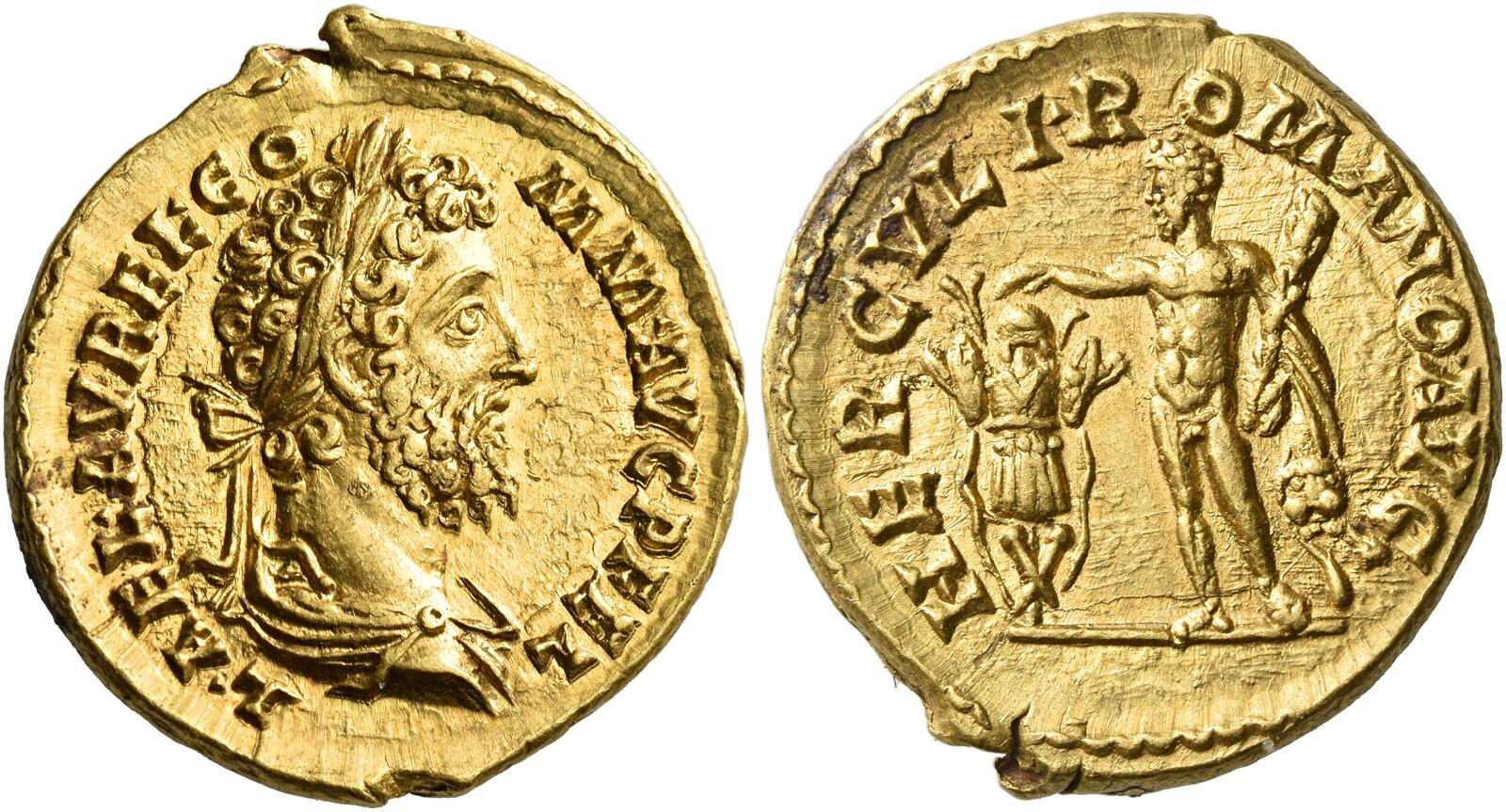 |
