

Our partner for world banknotes research

| Wojcicki Polish Auction House > Lech Kokociński Collection | Auction date: 22 April 2026 |
| Lot number: 336 Price realized: 205 EUR (Approx. 240 USD) Note: Prices do not include buyer's fees. | |
| Lot description: Roman Imperial, Titus, Denarius Scarcer denarius of Titus (AD 79–81), struck at the Rome mint in AD 80, belongs to issues produced during his brief yet well-documented reign, continuing the political and ideological program of the Flavian dynasty established by Vespasian. Coins of this type form part of a broader iconographic series emphasizing Roman military success, particularly in reference to the recently concluded Jewish War. The obverse features a laureate head of the emperor facing right with the legend IMP TITVS CAES VESPASIAN AVG P M, identifying Titus as Augustus and explicitly linking him to the Flavian dynasty through the reference to Vespasian. This titulature is consistent with issues from the early years of his independent rule. The reverse depicts a military trophy, flanked by two seated, bound captives, with the legend TR P IX IMP XV COS VIII P P. This composition belongs to the standard repertoire of Roman triumphal iconography, in which trophies constructed from captured arms symbolize victory, while subdued figures represent the defeated enemy. This type is directly connected with the Jewish War (AD 66–73), culminating in the capture of Jerusalem in AD 70, events well documented in ancient sources, including Flavius Josephus, and reflected in the extensive Flavian coinage commonly referred to as the "Judaea Capta" series. Although the main phase of the conflict preceded Titus' accession, the continued use of triumphal imagery in his coinage served to reinforce dynastic legitimacy and to commemorate the military achievements upon which Flavian authority was founded. Roman Imperial Titus (79-81), Denarius 80, Rome mint Obverse: laureate head right IMP TITVS CAES VESPASIAN AVG P M Reverse: trophy with a captive on either side TR P IX IMP XV COS VIII P P Diameter 18 mm, weight 3.14 g Rzadszy denar Tytusa (79–81 n.e.), wybity w mennicy rzymskiej w 80 r. n.e., należy do emisji powstałych w okresie jego krótkiego, lecz dobrze udokumentowanego panowania, kontynuującego politykę dynastii flawijskiej zapoczątkowaną przez Wespazjana. Monety tego typu wpisują się w program ikonograficzny podkreślający sukcesy militarne Rzymu, zwłaszcza w kontekście zakończonej niedawno wojny żydowskiej. Na awersie przedstawiono laureowaną głowę cesarza zwróconą w prawo z legendą IMP TITVS CAES VESPASIAN AVG P M, identyfikującą Tytusa jako augustusa oraz podkreślającą jego przynależność do dynastii flawijskiej poprzez odniesienie do Wespazjana. Tytulatura ta odpowiada emisjom z pierwszych lat jego samodzielnych rządów. Rewers ukazuje trofeum wojenne, po którego obu stronach siedzą związani jeńcy, z legendą TR P IX IMP XV COS VIII P P. Przedstawienie to należy do klasycznego repertuaru ikonografii triumfalnej w mennictwie rzymskim, gdzie trofeum złożone z uzbrojenia pokonanych przeciwników symbolizowało zwycięstwo, a postacie jeńców stanowiły bezpośrednie odniesienie do podporządkowania wroga. Typ ten jest bezpośrednio związany z wojną żydowską (66–73 n.e.), zakończoną zdobyciem Jerozolimy w 70 r. n.e., co znajduje potwierdzenie zarówno w źródłach antycznych, m.in. u Józefa Flawiusza, jak i w szerokiej serii emisji monetarnych dynastii flawijskiej, określanych w literaturze jako „Judaea Capta". Choć zasadnicza faza konfliktu zakończyła się przed objęciem władzy przez Tytusa, motywy triumfalne były kontynuowane w jego mennictwie jako element legitymizacji władzy i podkreślenia militarnego sukcesu dynastii. Cesarstwo Rzymskie Tytus (79-81), Denar 80, mennica Rzym Awers: głowa w wieńcu laurowym, w prawo IMP TITVS CAES VESPASIAN AVG P M Rewers: trofeum, po jego obu stronach siedzący związani jeńcy TR P IX IMP XV COS VIII P P Średnica 18 mm, waga 3.14 g Reference: RIC 102 Grade: XF- Roman Titus Denarius Starting price: 73 EUR | 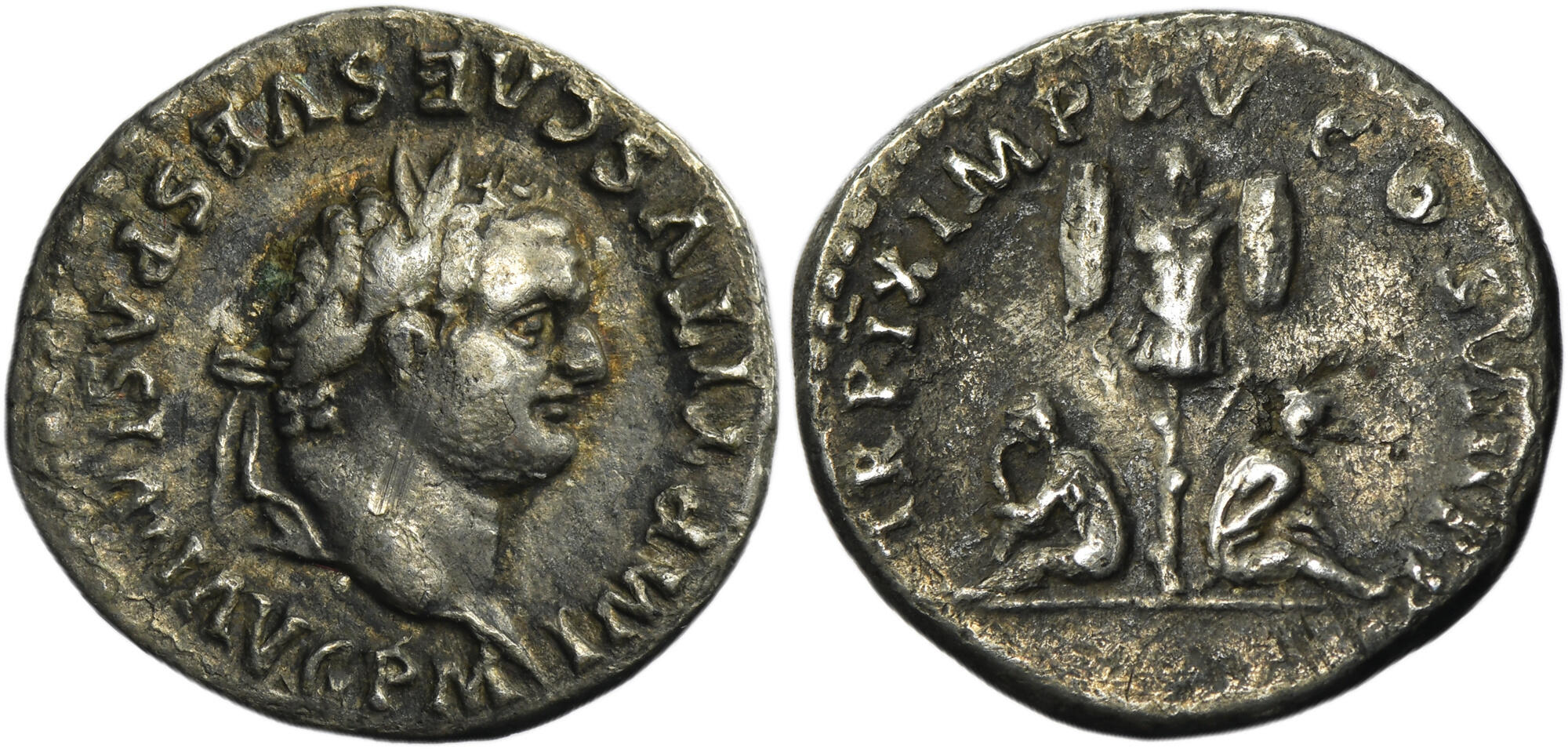 |
Match 1:
| Wojcicki Polish Auction House > Lech Kokociński Collection | Auction date: 22 April 2026 |
| Lot number: 348 Price realized: 53 EUR (Approx. 62 USD) Note: Prices do not include buyer's fees. | |
| Lot description: Roman Imperial, Hadrian, Denarius Silver denarius of Hadrian (AD 117–138), struck at the Rome mint in AD 134–138, belongs to issues from the final phase of his reign, when the imperial coinage strongly emphasized the emperor's safe return and the stability of the state following his extensive travels throughout the provinces. The obverse shows a head of the emperor facing right with the legend HADRIANVS AVG COS III P P, reflecting his official titulature, including his third consulship and the title Pater Patriae. This combination of titles is characteristic of the later years of his rule and provides a firm basis for dating the issue. The reverse depicts the emperor standing left, clasping hands with Fortuna, accompanied by the legend FORTVNAE REDVCI. This type belongs to the established iconography of Fortuna Redux, the aspect of Fortuna associated with the safe return of the ruler. Such imagery appears in Roman coinage in connection with imperial journeys and reflects the formal cult practice of offering vows for the emperor's successful return to Rome. Roman Imperial Hadrian (117-138), Denarius 134-138, Rome mint Obverse: bare head right HADRIANVS AVG COS III PP Reverse: Hadrian standing right, clasping hands with Fortuna FORTVNAE REDVCI Diameter 19 mm, weight 2.86 g Srebrny denar Hadriana (117–138 n.e.), wybity w mennicy rzymskiej w latach 134–138 n.e., należący do emisji z końcowego okresu jego panowania, kiedy program ikonograficzny mennictwa silnie akcentował powrót cesarza oraz stabilność państwa po licznych podróżach po prowincjach. Na awersie przedstawiono głowę cesarza zwróconą w prawo z legendą HADRIANVS AVG COS III P P, zawierającą jego oficjalną tytulaturę, w tym trzeci konsulat oraz tytuł Pater Patriae. Zestawienie tych elementów odpowiada emisjom z ostatnich lat jego rządów i stanowi jedno z podstawowych kryteriów ich datowania. Rewers ukazuje cesarza stojącego w lewo, ściskającego dłoń Fortuny, z legendą FORTVNAE REDVCI. Przedstawienie to należy do utrwalonego typu ikonograficznego odnoszącego się do idei Fortuna Redux, czyli Fortuny sprowadzającej władcę bezpiecznie z podróży. Motyw ten pojawia się w mennictwie rzymskim w kontekście powrotów cesarskich i był ściśle związany z oficjalnym kultem oraz praktyką składania ślubów za pomyślny powrót władcy do Rzymu. Cesarstwo Rzymskie Hadrian (117-138), Denar 134-138, mennica Rzym Awers: głowa w prawo HADRIANVS AVG COS III PP Rewers: cesarz stojący w lewo, ściskający dłoń Fortuny FORTVNAE REDVCI Średnica 19 mm, waga 2.86 gReference: RIC 248 Grade: VF- Hadrian, denarius Starting price: 13 EUR | 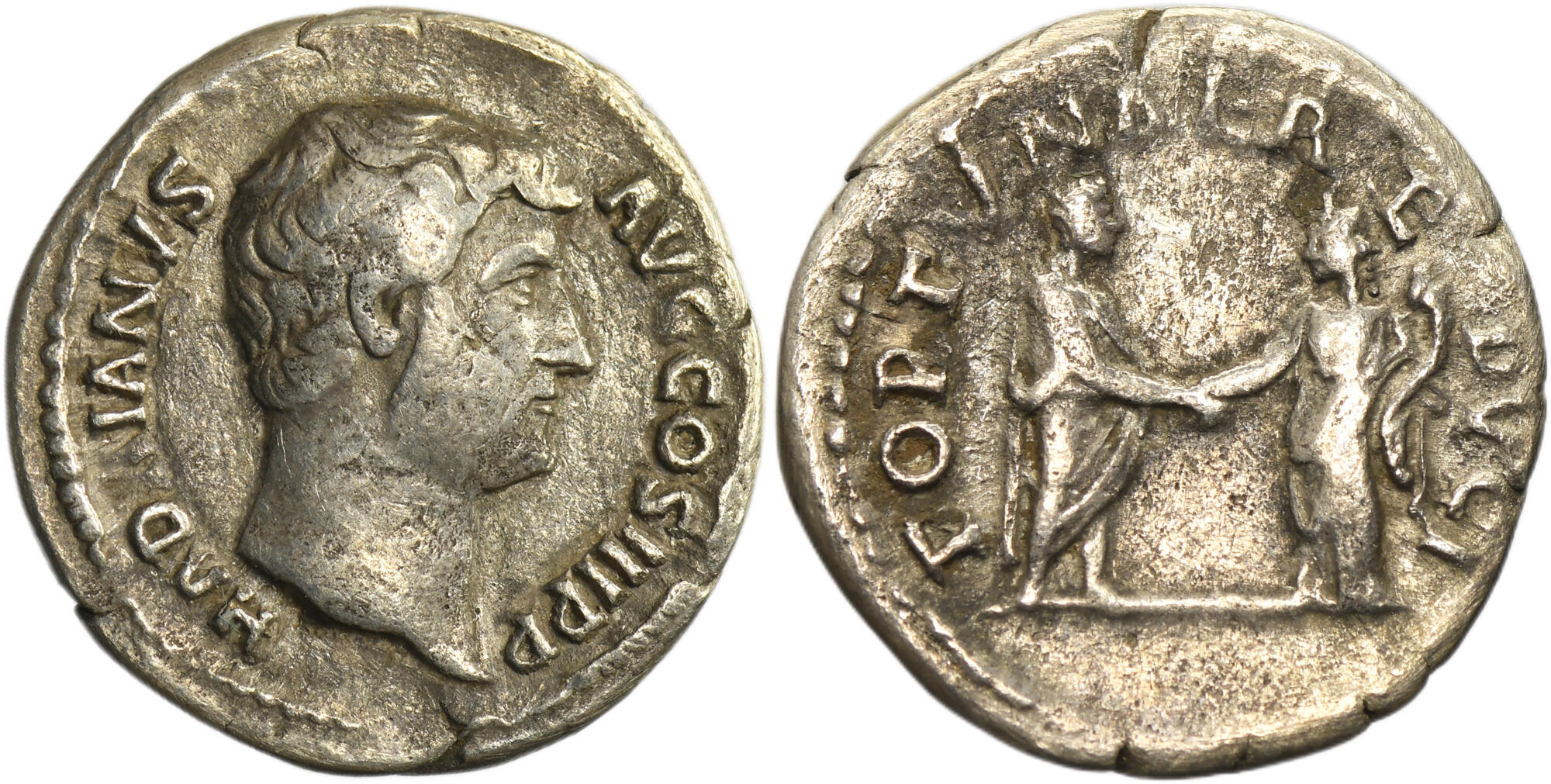 |
Match 2:
| Wojcicki Polish Auction House > Lech Kokociński Collection | Auction date: 22 April 2026 |
| Lot number: 347 Price realized: 67 EUR (Approx. 79 USD) Note: Prices do not include buyer's fees. | |
| Lot description: Roman Imperial, Hadrian, Denarius Silver denarius of Hadrian (AD 117–138), struck at the Rome mint in AD 134–138, belongs to issues from the final phase of his reign, during which imperial coinage consistently emphasized themes of the emperor's return, the stability of the state, and divine protection over his person. The obverse presents a head of the emperor facing right with the legend HADRIANVS AVG COS III P P, reflecting his official titulature, including his third consulship and the title Pater Patriae. This combination of titles is characteristic of the later emissions of the Rome mint and serves as a key chronological indicator for dating these coins to the closing years of Hadrian's reign. The reverse depicts the emperor standing left, clasping hands with Fortuna, with the legend FORTVNAE REDVCI. This type refers to the concept of Fortuna Redux, the goddess who ensures the safe return of the ruler from his journeys. The motif is well attested in Roman coinage and is closely associated with official vows made for the emperor's safe return to Rome. The gesture of handclasp (dextrarum iunctio) symbolically represents the meeting between the emperor and the personification of fate, emphasizing his successful return and the favor of divine forces. Roman Imperial Hadrian (117-138), Denarius 134-138, Rome mint Obverse: bare head right HADRIANVS AVG COS III PP Reverse: Hadrian standing right, clasping hands with Fortuna FORTVNAE REDVCI Diameter 18 mm, weight 2.85 g Srebrny denar Hadriana (117–138 n.e.), wybity w mennicy rzymskiej w latach 134–138 n.e., należący do emisji z końcowego okresu jego panowania, w którym mennictwo cesarskie konsekwentnie akcentowało motywy związane z powrotem władcy, stabilnością państwa oraz opieką boską nad jego osobą. Na awersie przedstawiono głowę cesarza zwróconą w prawo z legendą HADRIANVS AVG COS III P P, zawierającą jego oficjalną tytulaturę, w tym trzeci konsulat oraz tytuł Pater Patriae. Tego rodzaju zestawienie legendy jest charakterystyczne dla późnych emisji mennicy rzymskiej i stanowi jedno z podstawowych kryteriów ich datowania na schyłek panowania Hadriana. Rewers ukazuje cesarza stojącego w lewo, ściskającego dłoń Fortuny, z legendą FORTVNAE REDVCI. Przedstawienie to odnosi się do idei Fortuna Redux, czyli Fortuny sprowadzającej władcę bezpiecznie z podróży. Motyw ten jest dobrze poświadczony w mennictwie rzymskim i wiąże się z oficjalnym kultem oraz praktyką składania ślubów za pomyślny powrót cesarza do Rzymu. Gest uścisku dłoni (dextrarum iunctio) podkreśla symboliczne „spotkanie" cesarza z personifikacją losu, akcentując jego szczęśliwy powrót oraz przychylność boskich sił. Cesarstwo Rzymskie Hadrian (117-138), Denar 134-138, mennica Rzym Awers: głowa w prawo HADRIANVS AVG COS III PP Rewers: cesarz stojący w lewo, ściskający dłoń Fortuny FORTVNAE REDVCI Średnica 18 mm, waga 2.85 gReference: RIC 248 Grade: VF Hadrian, denarius Starting price: 25 EUR | 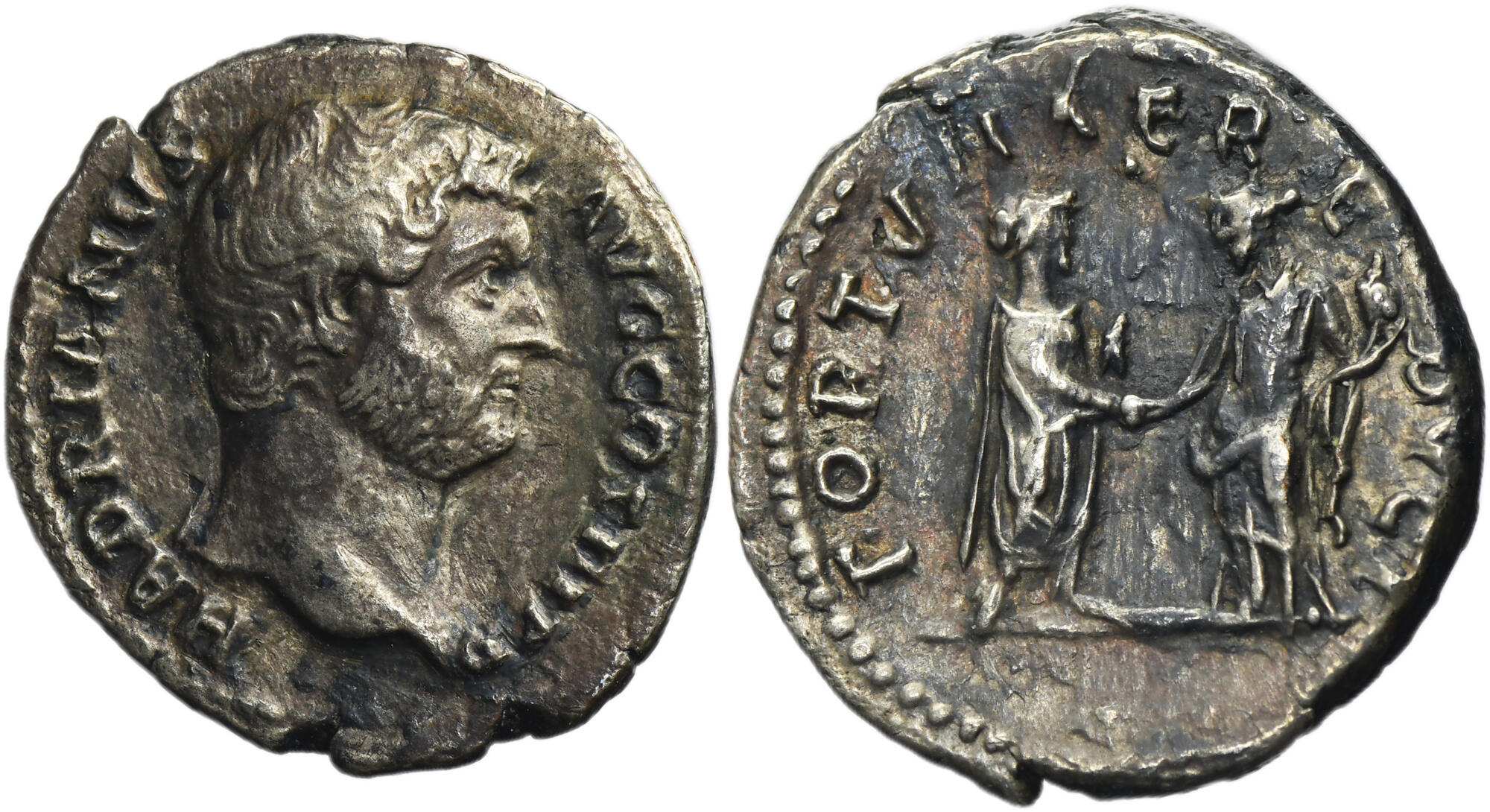 |
Match 3:
| Wojcicki Polish Auction House > Lech Kokociński Collection | Auction date: 22 April 2026 |
| Lot number: 346 Price realized: 181 EUR (Approx. 212 USD) Note: Prices do not include buyer's fees. | |
| Lot description: Roman Imperial, Hadrian, Denarius Silver denarius of Hadrian (AD 117–138), struck at the Rome mint in AD 134–138, belongs to issues from the final phase of his reign, when imperial coinage emphasized themes of stability, prosperity, and divine favor supporting the emperor and the state. The obverse presents a head of the emperor facing right with the legend HADRIANVS AVG COS III P P, reflecting his official titulature, including his third consulship and the title Pater Patriae. This combination of titles is characteristic of the later emissions of the Rome mint and serves as a reliable basis for dating this group of denarii. The reverse depicts Fortuna standing left, holding a rudder (gubernaculum) and a cornucopia, with the legend FORTVNA AVG. In Roman iconography, Fortuna embodied fate and prosperity; the rudder symbolized control over the course of events, while the cornucopia represented abundance and well-being. The addition of AVG associates this aspect of Fortuna directly with the emperor, emphasizing the concept that the fortune of the state is guided and secured under imperial authority. Roman Imperial Hadrian (117-138), Denarius 134-138, Rome mint Obverse: bare head right HADRIANVS AVG COS III PP Reverse: Fortuna standing left, holding rudder and cornucopiae FORTVNA AVG Diameter 19 mm, weight 3.08 g Srebrny denar Hadriana (117–138 n.e.), wybity w mennicy rzymskiej w latach 134–138 n.e., należący do emisji z końcowego okresu jego panowania, kiedy mennictwo cesarskie eksponowało motywy związane z trwałością władzy, pomyślnością państwa oraz opieką boską nad imperium. Na awersie przedstawiono głowę cesarza zwróconą w prawo z legendą HADRIANVS AVG COS III P P, zawierającą jego oficjalną tytulaturę, w tym trzeci konsulat oraz tytuł Pater Patriae. Tego rodzaju zestawienie legendy jest charakterystyczne dla późnych emisji mennicy rzymskiej i stanowi jedno z podstawowych kryteriów chronologicznych tej grupy denarów. Rewers ukazuje Fortunę stojącą w lewo, trzymającą ster (gubernaculum) oraz róg obfitości, z legendą FORTVNA AVG. W ikonografii rzymskiej Fortuna była personifikacją losu i pomyślności, a jej atrybuty niosły precyzyjne znaczenie symboliczne: ster odnosił się do kierowania biegiem wydarzeń, natomiast róg obfitości symbolizował dobrobyt i dostatek. Dodanie skrótu AVG wskazuje na szczególną relację tej personifikacji z osobą cesarza, podkreślając ideę, że los i pomyślność państwa pozostają pod jego opieką. Cesarstwo Rzymskie Hadrian (117-138), Denar 134-138, mennica Rzym Awers: głowa w prawo HADRIANVS AVG COS III PP Rewers: Fortuna stojąca w lewo, trzymająca ster i róg obfitości FORTVNA AVG Średnica 19 mm, waga 3.08 gReference: RIC 244a Grade: XF- Hadrian, denarius Starting price: 37 EUR | 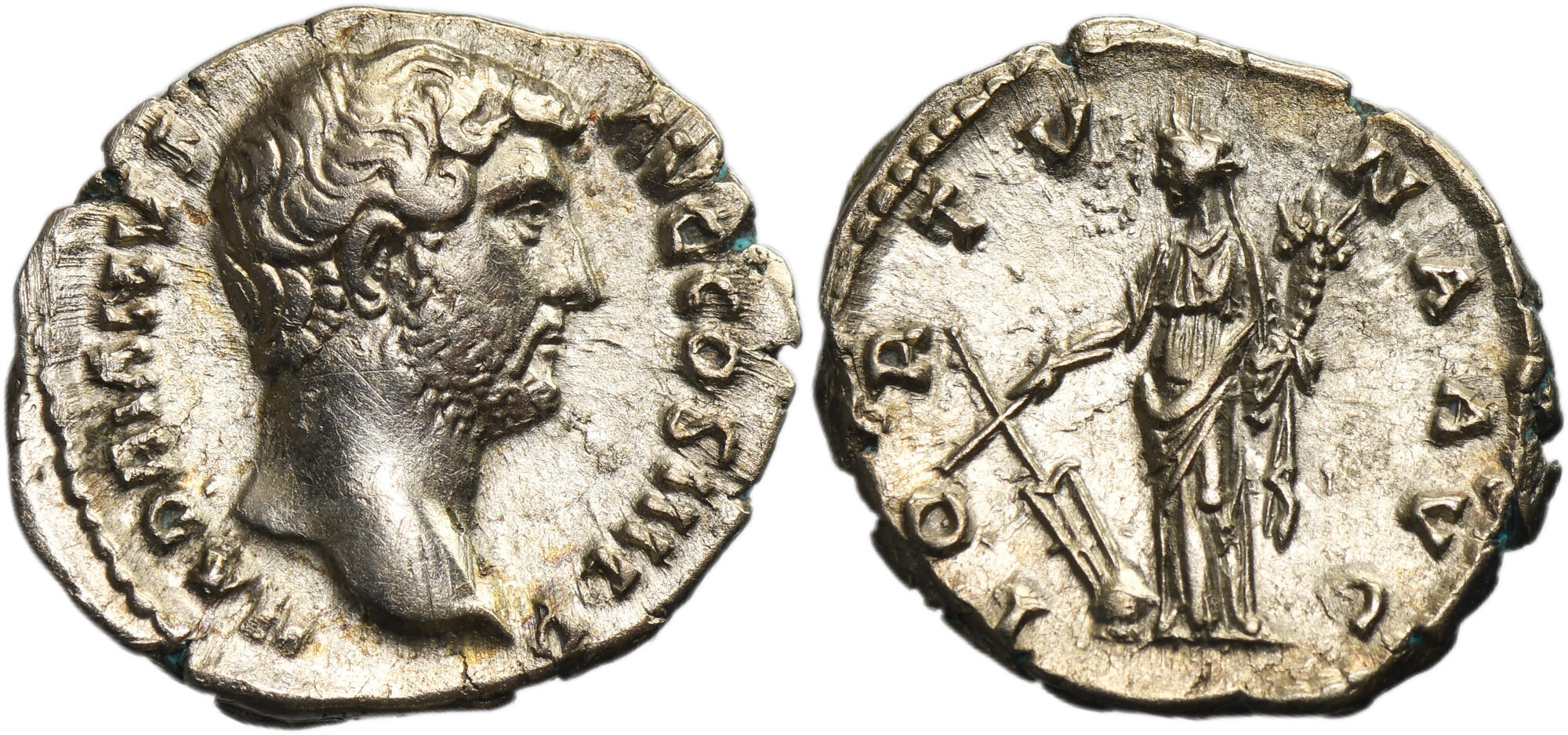 |
Match 4:
| Wojcicki Polish Auction House > Lech Kokociński Collection | Auction date: 22 April 2026 |
| Lot number: 349 Price realized: 48 EUR (Approx. 56 USD) Note: Prices do not include buyer's fees. | |
| Lot description: Roman Imperial, Hadrian, Denarius Silver denarius of Hadrian (AD 117–138), struck at the Rome mint in AD 119–120, belongs to the early issues of his reign, produced during the period of consolidating power after succeeding Trajan and stabilizing the situation within the empire. The obverse shows a laureate bust of the emperor facing right with the legend IMP CAESAR TRAIAN HADRIANVS AVG, emphasizing his formal dynastic continuity through reference to Trajan. This form of titulature is characteristic of the initial years of Hadrian's rule and serves as an important chronological indicator for dating the issue to the period immediately following his accession. The reverse depicts Aeternitas standing left, holding the heads of the Sun (Sol) and the Moon (Luna), with the legend divided across the fields AETER–AVG and the surrounding inscription P M TR P COS III. This type belongs to a clearly ideological group of representations in which Aeternitas symbolizes the eternity and permanence of imperial rule. The attributes of the celestial bodies-Sol and Luna-refer to a universal, cosmic dimension of this concept, suggesting the enduring nature of the emperor's власть within an order encompassing the entire world. Roman Imperial Hadrian (117-138), Denarius 119-120, Rome mint Obverse: laureate bust right IMP CAESAR TRAIAN HADRIANVS AVG Reverse: Aeternitas standing left, holding heads of the Sun and Moon, AETER-AVG across fields P M TR P COS III Diameter 19 mm, weight 2.94 g Srebrny denar Hadriana (117–138 n.e.), wybity w mennicy rzymskiej w latach 119–120 n.e., należący do wczesnych emisji jego panowania, powstałych w okresie umacniania władzy po przejęciu rządów po Trajanie oraz stabilizacji sytuacji w imperium. Na awersie przedstawiono popiersie cesarza w wieńcu laurowym, zwrócone w prawo, z legendą IMP CAESAR TRAIAN HADRIANVS AVG, która podkreśla jego formalną ciągłość dynastyczną poprzez odniesienie do Trajana. Tego rodzaju tytulatura jest charakterystyczna dla pierwszych lat panowania Hadriana i stanowi istotny element datowania emisji na okres bezpośrednio po objęciu władzy. Rewers ukazuje Aeternitas stojącą w lewo, trzymającą głowy Słońca (Sol) i Księżyca (Luna), z legendą rozłożoną w polach AETER–AVG oraz inskrypcją w otoku P M TR P COS III. Przedstawienie to należy do wyraźnie ideologicznych typów ikonograficznych, w których Aeternitas symbolizuje wieczność i nieprzemijalność władzy cesarskiej. Atrybuty w postaci personifikowanych ciał niebieskich, Słońca i Księżyca, odnoszą się do uniwersalnego, kosmicznego wymiaru tej idei, sugerując trwanie panowania w porządku obejmującym cały świat. Cesarstwo Rzymskie Hadrian (117-138), Denar 119-120, mennica Rzym Awers: popiersie w wieńcu laurowym w prawo IMP CAESAR TRAIAN HADRIANVS AVG Rewers: Aeternitas stojąca w lewo, trzymająca głowy Słońca i Księżyca, w polach AETER-AVG P M TR P COS III Średnica 19 mm, waga 2.94 g Reference: RIC 115b Grade: VF- Roman Hadrian Denarius Starting price: 13 EUR | 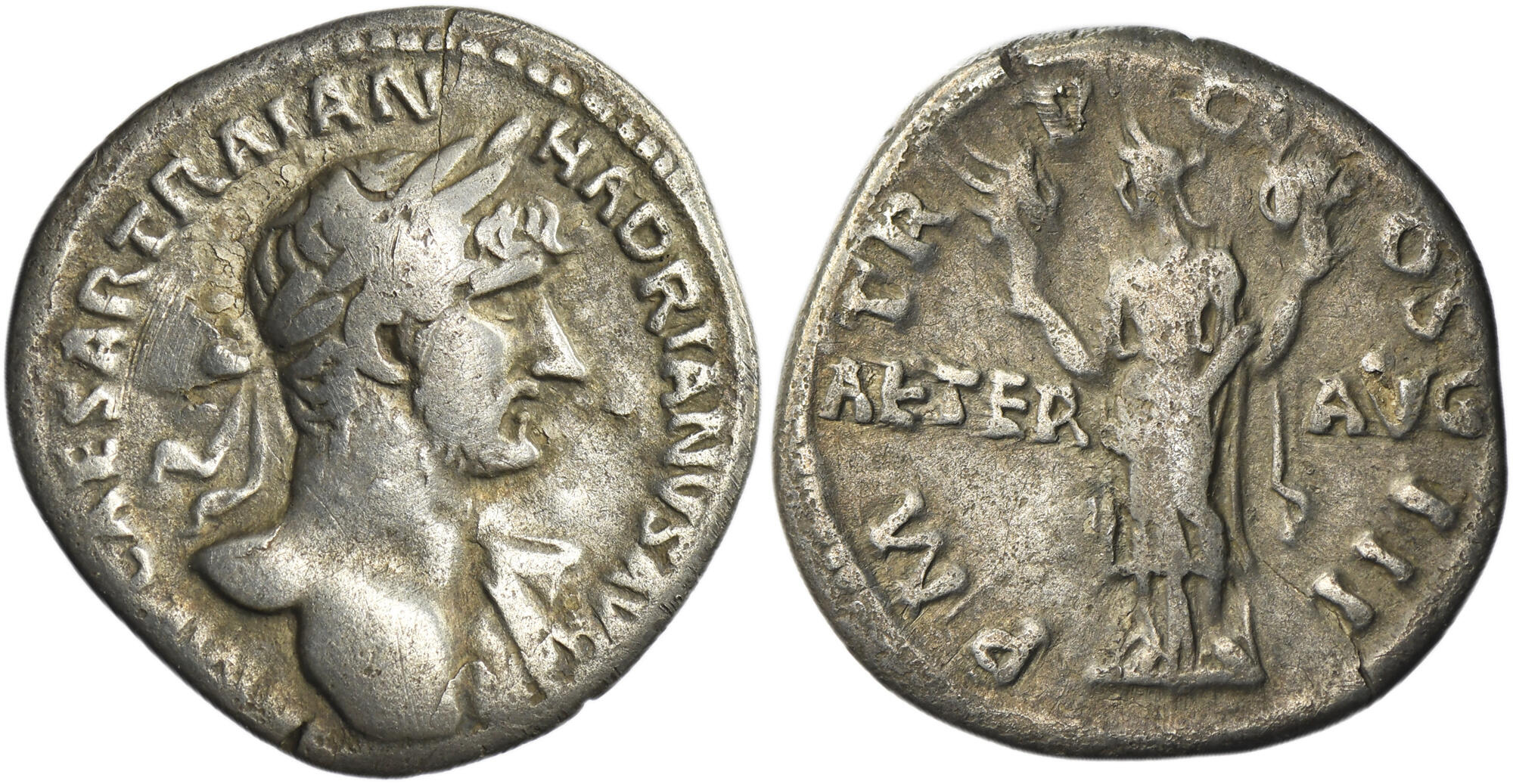 |
Match 5:
| Wojcicki Polish Auction House > Lech Kokociński Collection | Auction date: 22 April 2026 |
| Lot number: 345 Price realized: 53 EUR (Approx. 62 USD) Note: Prices do not include buyer's fees. | |
| Lot description: Roman Imperial, Trajan, Denarius Silver denarius of Trajan (AD 98–117), struck at the Rome mint in AD 108–109, belongs to issues from the height of his reign, following the conclusion of the Dacian Wars and during the continued consolidation of his position as one of the most distinguished rulers of the Roman Empire. The obverse shows a bust of the emperor laureate and draped, facing right, with the legend IMP TRAIANO AVG GER DAC P M TR P, presenting his official titulature together with the victory titles Germanicus and Dacicus, adopted after his military successes. Such an expanded titulature is characteristic of issues struck after the Dacian campaigns. The reverse depicts Roma seated left, holding a statuette of Victory and a spear, with the legend COS V P P S P Q R OPTIMO PRINC. The representation of Roma, the personification of the Roman state, combined with Victory, directly alludes to military success and imperial power. The presence of the extended legend, including the title OPTIMO PRINCIPI, officially granted to Trajan by the Senate, emphasizes his exceptional status as the "best ruler." Roman Imperial Trajan (98-117), Denarius 108-109, Rome mint Obverse: laureate and draped bust right IMP TRAIANO AVG GER DAC P M TR P Reverse: Roma seated left, holding Victory and spear COS V P P S P Q R OPTIMO PRINC Diameter 18 mm, weight 3.11 g Srebrny denar Trajana (98–117 n.e.), wybity w mennicy rzymskiej w latach 108–109 n.e., należący do emisji z okresu pełni jego panowania, przypadającego po zakończeniu wojen dackich i w czasie dalszego umacniania pozycji cesarza jako jednego z najwybitniejszych władców epoki. Na awersie przedstawiono popiersie cesarza w wieńcu laurowym i płaszczu, zwrócone w prawo, z legendą IMP TRAIANO AVG GER DAC P M TR P, zawierającą jego oficjalną tytulaturę wraz z przydomkami zwycięskimi Germanicus i Dacicus, przyjętymi po sukcesach militarnych. Tego rodzaju rozbudowana tytulatura jest charakterystyczna dla emisji po zakończeniu kampanii dackich. Rewers ukazuje Romę siedzącą w lewo, trzymającą figurkę Wiktorii oraz włócznię, z legendą COS V P P S P Q R OPTIMO PRINC. Przedstawienie Romy, personifikacji państwa rzymskiego, w połączeniu z Wiktorią stanowi bezpośrednie odniesienie do zwycięstw militarnych i potęgi imperium. Obecność rozbudowanej legendy, w tym tytułu OPTIMO PRINCIPI, przyznanego Trajanowi oficjalnie przez senat, podkreśla jego wyjątkową pozycję jako „najlepszego władcy". Cesarstwo Rzymskie Trajan (98-117), Denar 108-109, mennica Rzym Awers: popiersie w wieńcu laurowym i płaszczu w prawo IMP TRAIANO AVG GER DAC P M TR P Rewers: Roma siedząca w lewo, trzymająca Wiktorię i włócznię COS V P P S P Q R OPTIMO PRINC Średnica 18 mm, waga 3.11 gReference: RIC 116 Grade: VF Roman Imperial Trajan Denarius Starting price: 25 EUR | 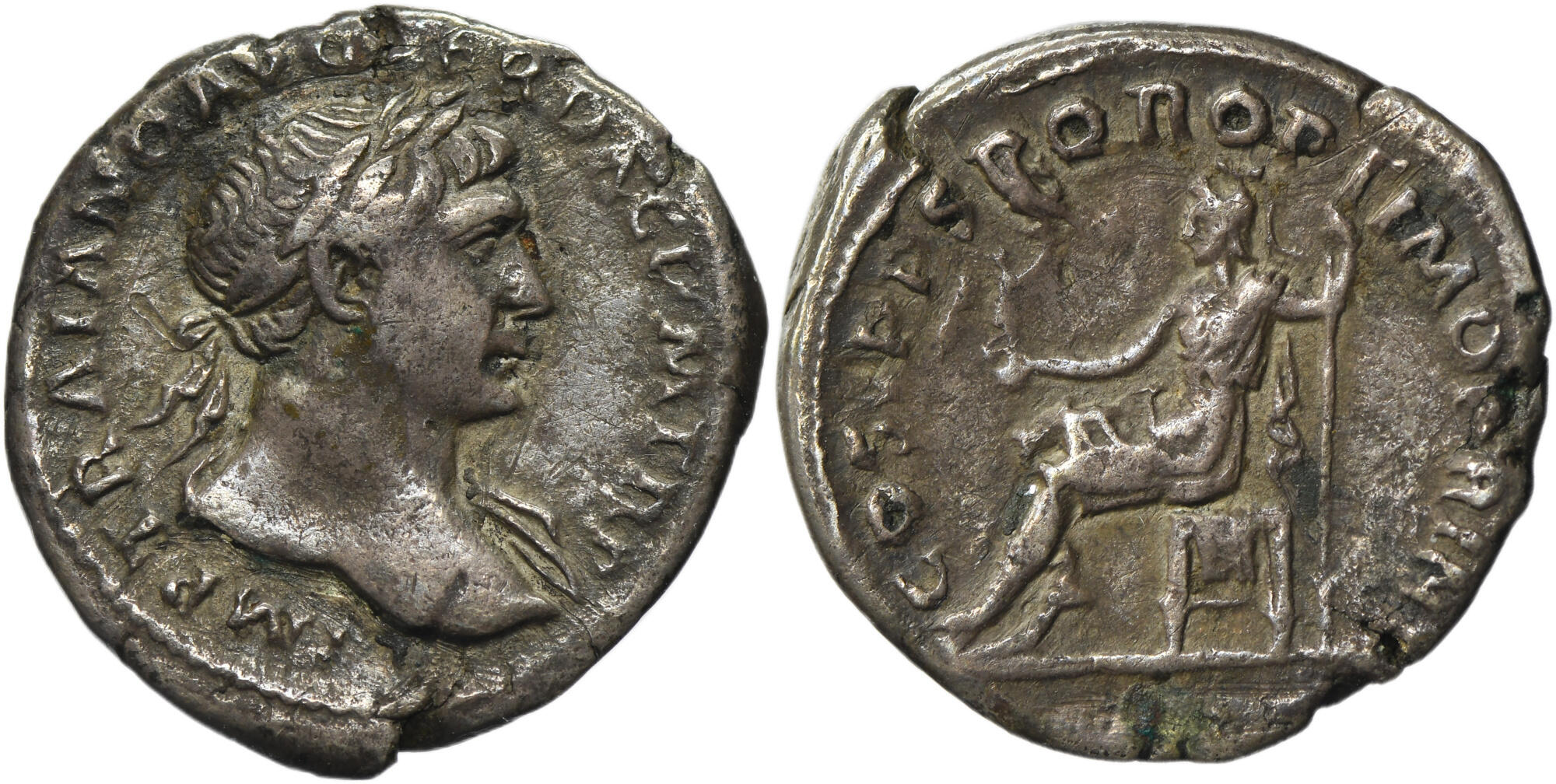 |
