

Our partner for world banknotes research

| Nomos AG > obolos 42 | Auction date: 3 May 2026 |
| Lot number: 280 Price realized: 80 CHF (Approx. 102 USD / 87 EUR) Note: Prices do not include buyer's fees. | |
| Lot description: TROAS. Skamandria. Circa 350-300 BC. (Bronze, 9 mm, 0.85 g, 6 h). ΙΔΗ Head of the mountain-nymph Ide to right; before, uncertain symbol; at neck section, crescent (?). Rev. Σ-Κ Pine-cone. Asia Minor Coins (online) 10802. BMC 79.4 var (array of legend). Klein -. SNG Cop -. Very rare; dark-green patina. Somewhat rough surfaces, otherwise, very fine. Coins of Skamandria are all quite rare and this type with the nymph Ide on the obverse and a pine cone, flanked by only two letters, on the reverse is particularly scarce (types with three letters on the reverse are slightly more common). The unusual array of the legend makes this coin almost unique - we are only aware of two other coins with the Σ-Κ legend starting on the right side. Starting price: 75 CHF |  |

Match 1:
| Nomos AG > obolos 42 | Auction date: 3 May 2026 |
| Lot number: 279 Price realized: Unsold | |
| Lot description: TROAS. Skamandria. Circa 350-300 BC. (Bronze, 9 mm, 1.06 g, 5 h). Head of the mountain-nymph Ide to righ. Rev. Σ-Κ/A Pine-cone. SNG Copenhagen 466-468. Rare; dark-green patina. Struck on a tight flan, otherwise, very fine. Starting price: 50 CHF |  |
Match 2:
| Leu Numismatik AG > Auction 23 | Auction date: 2 November 2026 |
| Lot number: 36 Price realized: This lot is for sale in an upcoming auction - Bid on this lot  | |
| Lot description: PHILISTIA. Gaza. Circa 420-350 BCE. Rbʾ Šql = Drachm (Silver, 15 mm, 3.78 g, 6 h). Lion to right, attacking a bull collapsing to left; below, uncertain symbol (shrimp to right?); all within guilloche-pattern circular border. Rev. Forepart of a horse right, forelock tied up with a ribbon into an upright tuft; in upper left field, 𐡏𐡆 (ʿZ in Aramaic); all within dotted square border within incuse square. BMC Palestine pl. XIX, 15 (same dies). Gitler & Tal VI.9Db (this coin). Hendin -. Jeselsohn 132 (same obverse die). Shoshana - Sofaer -. Extremely rare, arguably the finest of just five known examples of this wonderful issue. Beautifully toned and with highly interesting iconography. Struck from the usual worn obverse die, otherwise, extremely fine. From the collection of Alan Irvin Casden, privately acquired from him in 2003. Finds such as the famous Asyut Hoard show that large quantities of northern Greek and Thraco-Macedonian silver reached the eastern Mediterranean. This movement of silver should probably be seen, at least in part, in connection with Achaemenid control over Thrace and northern Greece from the reign of Dareios I onward; tribute payments, military requirements, and trade relations are also likely to have played an important role. The gravitational pull of the vast Achaemenid Empire was undoubtedly considerable in this respect. For the present coin, this is significant because the obverse, showing a lion bringing down a bull, clearly draws on Akanthian prototypes, examples of which were also prominently represented in the Asyut Hoard (153-193). This supports a dating to the late 5th century BCE and at the same time points to the close connections of the Philistian coastal cities with the Aegean world. It is more difficult to determine the source of inspiration for the horse protome on the reverse. In Greek coinage, the horse-protome motif is widespread, occurring from Thessaly through Thrace to Asia Minor. At the same time, the rendering of the forelock tied up into a topknot finds particularly close parallels in Achaemenid art, for example on the reliefs of the Apadana at Persepolis and on Achaemenid horse-protome rhyta (see Gitler, Achaemenid, pl. III, 16). The coin thus combines elements from different pictorial traditions in a manner characteristic of early Philistian silver coinage. This lot can be shipped to a US address. When delivered in Switzerland, this item is subjected to margin taxation in accordance with Art. 24a MWSTG (Swiss VAT Act), provided that the buyer is not registered for VAT. Estimate: 3500 CHF | 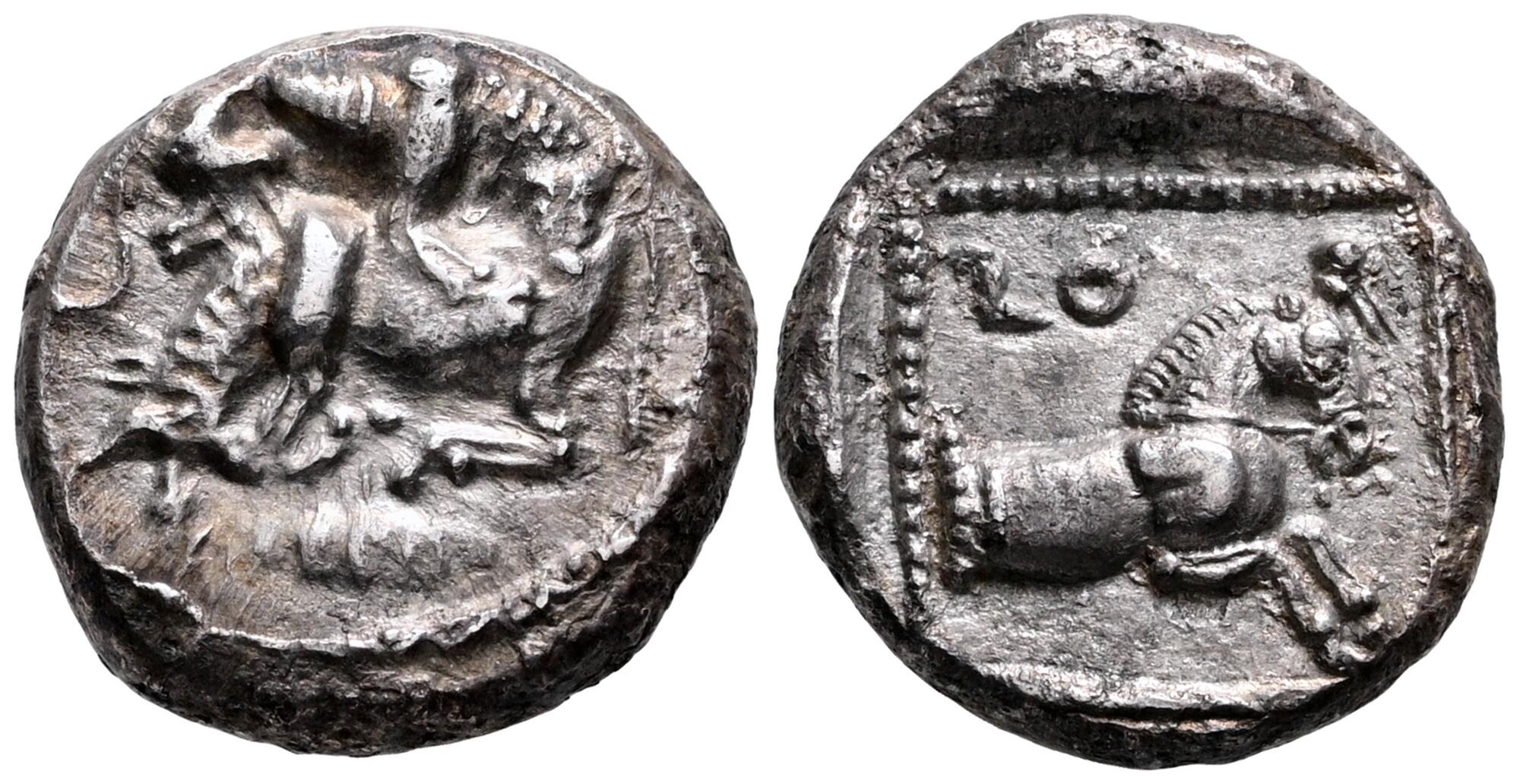 |

Match 3:
| Leu Numismatik AG > Auction 23 | Auction date: 2 November 2026 |
| Lot number: 63 Price realized: This lot is for sale in an upcoming auction - Bid on this lot | |
| Lot description: PHILISTIA. Central Mint. Athenian-styled, circa 420-350 BCE. Half Mʿh = Hemiobol (Silver, 9 mm, 0.34 g, 6 h). Horned head of a griffin to left. Rev. Owl standing right, head facing; to left, olive sprig; to right, AOE; all within incuse square. Gitler & Tal XIV.23HOa corr. (same dies, obverse described as a 'monster'). Hendin -. Jeselsohn -. Kraay, Abu Shusheh, 16 and pl. 29, E = Lambert, Palestine, 16 and pl. I, 16 corr. (same dies, obverse described as an 'elephant's head r. (? or helmet)'). Shoshana -. Sofaer -. Extremely rare and in spectacular condition. A true gem, beautifully toned and sharply struck on excellent silver, with exceptional detail and remarkable iconography. Very minor weakness on the griffin's horn, otherwise, good extremely fine. Ex Leu 75, 25 October 1999, 1315 (with original ticket), and previously from the so-called 'Abu Shusheh hoard' of 1930 (IGCH 1507). This magnificent hemiobol, or half-ma'ah, surely ranks among the most impressive and beautiful Philistian coins known. On tiny dies, the artist has compressed a wealth of detail that stands comparison with the work of the finest Greek die-engravers. The reverse in particular, with its beautifully struck complete incuse square and exceptionally fine owl, immediately evokes the classical Athenian tetradrachms, which exerted such a profound influence on the numismatic iconography of the Levant. The obverse, by contrast, shows a left-facing animal head with horns and beak, which Lambert completely misunderstood and misidentified as an 'elephant's head r. (? or helmet)'. Kraay had already pointed out this error and at the same time offered a new interpretation, identifying the head as that of a griffin. Gitler and Tal were more cautious, describing it as a 'horned monster's head'. In this case, however, Kraay's interpretation should be preferred: comparison with the magnificent gilded Achaemenid rhyton in the British Museum (BM 124081) reveals a striking resemblance. The beak, wide-open eyes, horns, pointed ears, and the suggested plumage above and behind the eye all closely recall the depiction on our coin. Kraay's identification of the head as that of a griffin therefore seems highly plausible. This lot can be shipped to a US address. When delivered in Switzerland, this item is subjected to margin taxation in accordance with Art. 24a MWSTG (Swiss VAT Act), provided that the buyer is not registered for VAT. Estimate: 7500 CHF | 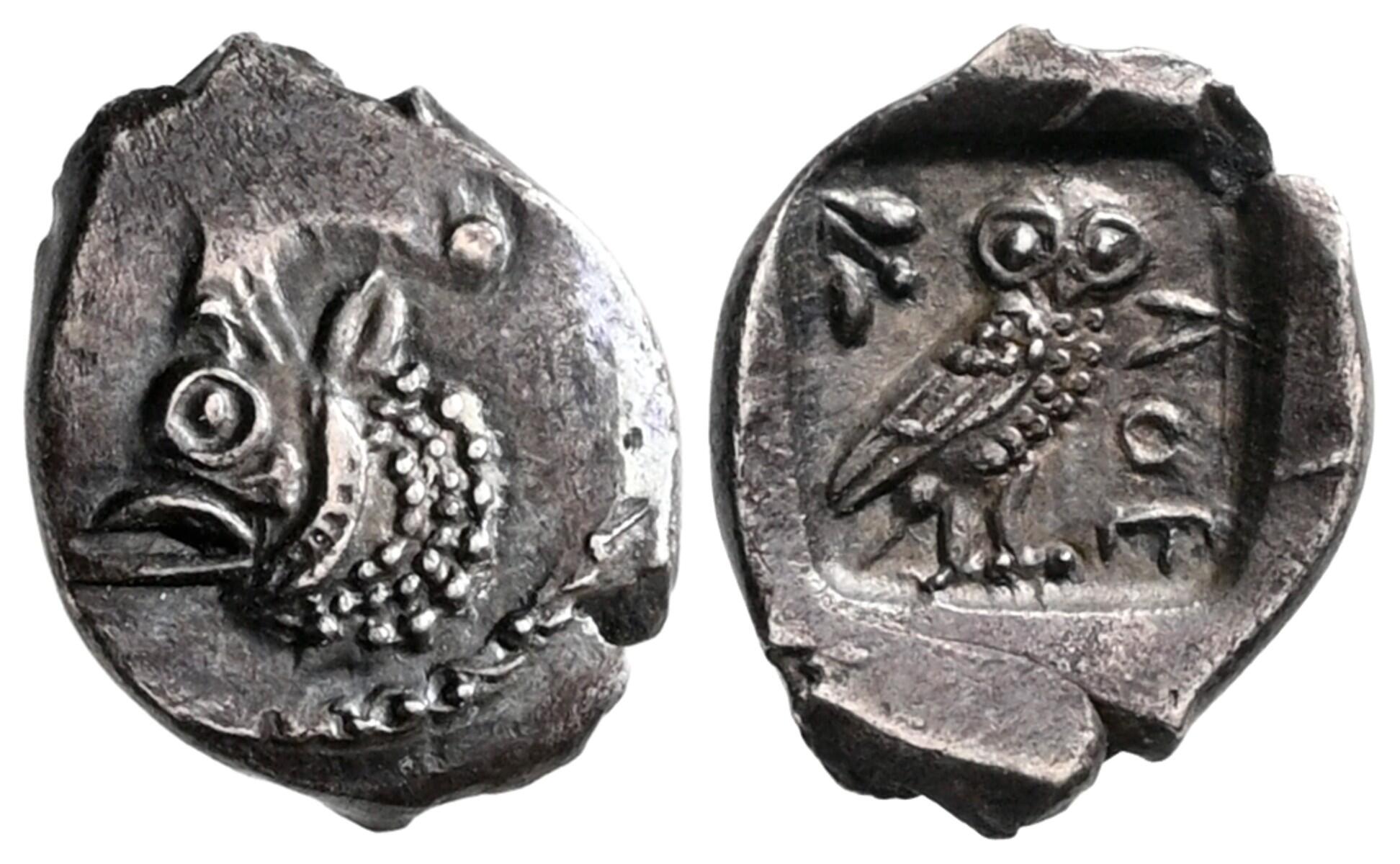 |
Match 4:
| Leu Numismatik AG > Web Auction 44 | Auction date: 5 September 2026 |
| Lot number: 217 Price realized: 600 CHF (Approx. 741 USD / 638 EUR) Note: Prices do not include buyer's fees. | |
| Lot description: WESTERN ASIA MINOR, Uncertain. 2nd-1st centuries BC. AE (Bronze, 18 mm, 6.20 g, 12 h). Facing head of a bull; above, eight-rayed star. Rev. ΣΟΑΤΙ[Σ](?) Owl standing right, head facing and wings spread, on palm frond; ti left, monogram. Classical Numismatic Group E-Auction 461 (2020), 137. SNG Tübingen 2442 ('Pergamon'). Very rare. Light deposits and the obverse struck slightly off center, otherwise, good very fine. Ex Leu Web Auction 36, 6-7 September 2025, 423, and Aquila 3, 2 July 2022, 466. In SNG Tübingen and in Leschhorn (p. 552), the inscription on this very rare and enigmatic type is interpreted as ZΩATIΣ (?). However, our specimen shows the inscription as ΣΟΑΤΙ[.], with the final letter remaining unclear. The meaning of this legend is uncertain. Unless it represents an otherwise unattested ethnic, the most plausible interpretation is that it refers to an unusual magistrate's name, Soati(s) (?). Iconographically, the reverse of the coin closely resembles types from Pergamon (cf. BMC 190), which notably also omit an ethnic. However, these Pergamene issues do not name a magistrate, but instead identify the victorious Athena depicted on the obverse. A frontal bull's head, as seen on our coin, does not appear elsewhere in the known Pergamene coinage, though bull heads in profile are attested. The issuing authority behind this extremely rare coin therefore remains unknown, as does the question of whether it was struck in Pergamon or at another, as yet unidentified, mint. This lot cannot be shipped to a US address. Starting price: 50 CHF | 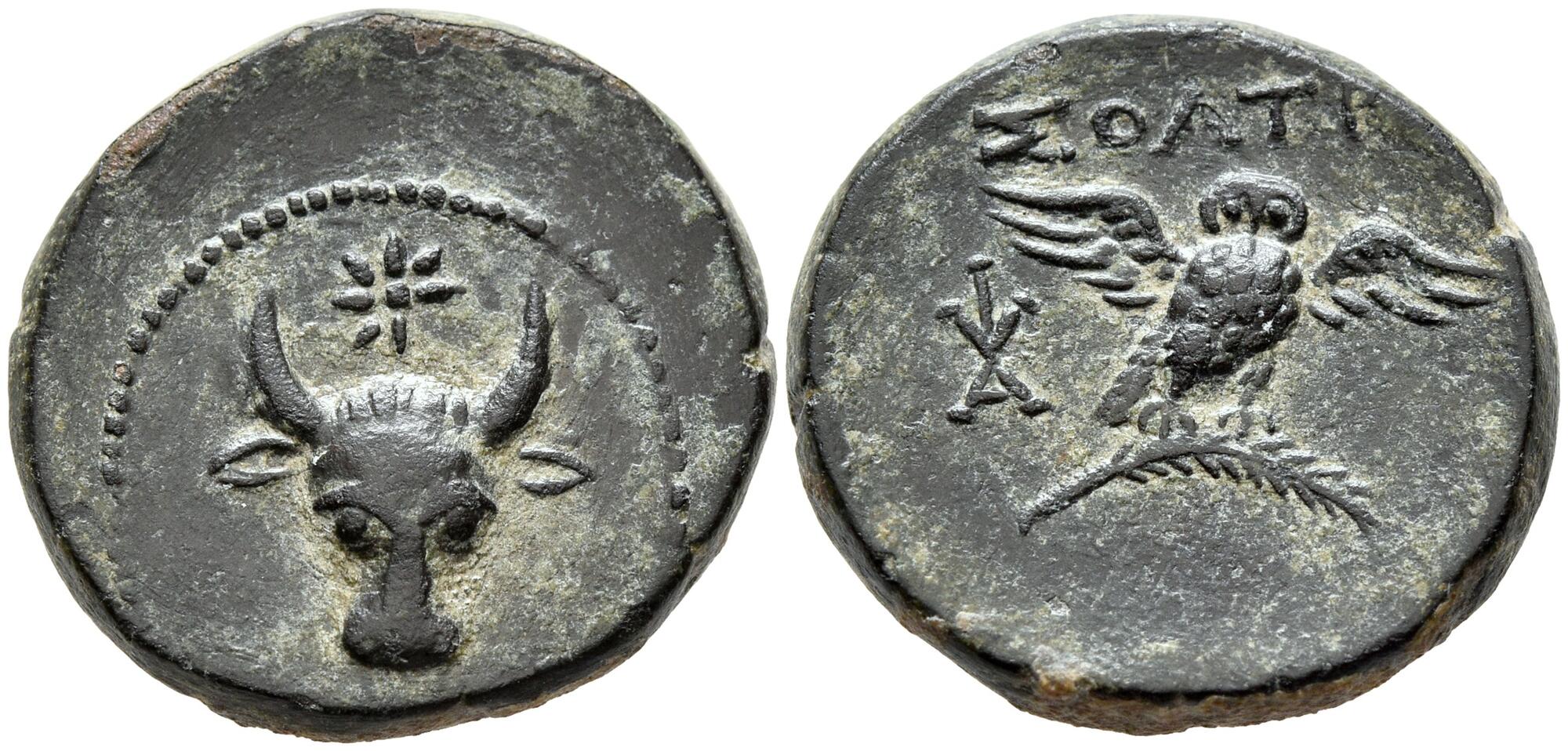 |
Match 5:
| Leu Numismatik AG > Web Auction 44 | Auction date: 5 September 2026 |
| Lot number: 500 Price realized: 50 CHF (Approx. 62 USD / 53 EUR) Note: Prices do not include buyer's fees. | |
| Lot description: LESBOS. Pyrrha. 4th century BC. AE (Bronze, 10 mm, 1.00 g, 1 h). Female head (Aphrodite or nymph Pyrrha?) to left, hair bound in sphendone. Rev. ΠΥ[P] Goat standing left. BMC 1-2. HGC 6, 1060. SNG Copenhagen 428 var. (symbol on reverse). SNG München 805 var. (symbol on reverse). SNG von Aulock 1761 var. (symbol on reverse). Minor traces of corrosion on the reverse, otherwise, very fine. From the collection of G. Plankenhorn, formed since the 1960s. This lot cannot be shipped to a US address. Starting price: 25 CHF | 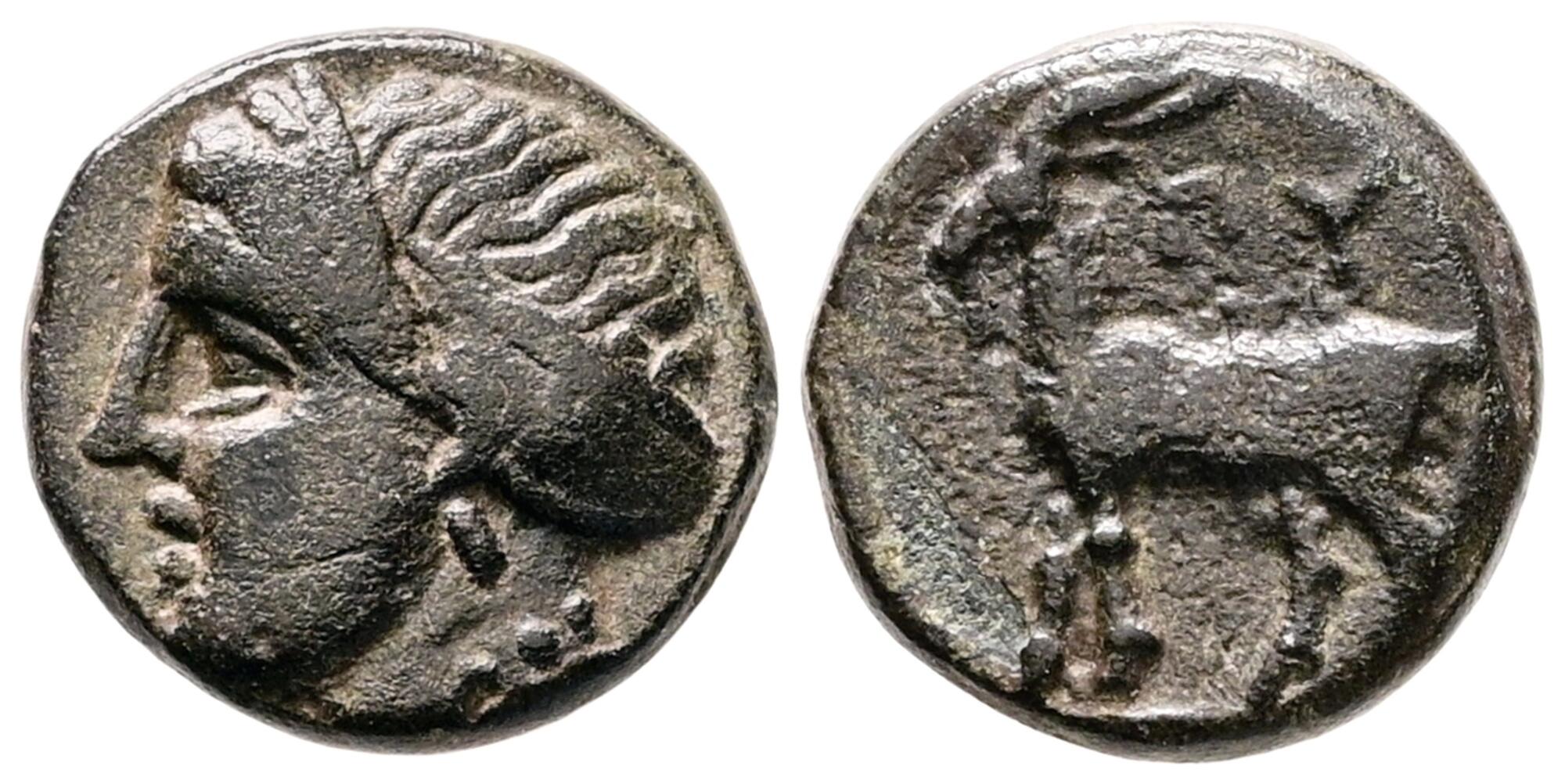 |
