

Our partner for world banknotes research

| Numismatica Ars Classica > Auction 165 | Auction date: 26 May 2026 |
| Lot number: 491 Price realized: 200,000 CHF (Approx. 253,518 USD / 218,684 EUR) Note: Prices do not include buyer's fees. | |
| Lot description: Vespasian augustus, 69 – 79 Sestertius 71, Æ 36 mm, 25.59 g. IMP CAES VESPASIAN AVG P M TR P P P COS III Laureate head r. Rev IVDEA CAPTA Jewess seated r. in attitude of mourning at foot of palm tree; behind, captive standing r. with hands bound behind his back; weapons, shields and helmets l. C 232 var. (IVDAEA). BMC 534. RIC 161. Hendin 1500b. CBN 489 var. (IVDAEA). An extremely rare variety with IVDEA instead of IVDAEA and in exceptional condition for the issue, undoubtedly among the finest sestertii of the Judean series in private hands. A portrait of enchanting beauty, the work of a very skilled master engraver, struck in high relief on a very broad flan and a finely detailed reverse composition. A wonderful Tiber tone with some minor unobtrusive marks on the reverse around the letters, otherwise good extremely fine Ex Heritage sale 3003, 2012 Shoshana 20523. *Not suitable for NGC grading. Vespasian's greatest military triumph was the war he and his son Titus waged in Judaea at the end of Nero's reign. The campaign was so difficult that the Flavians celebrated its conclusion with triumphal processions, games, a triumphal arch and an uncommonly extensive series of coins. This sestertius is one of the most remarkable examples to have survived, with even the smallest details perfectly preserved. Most impressive is the miniature portrait of Vespasian on the reverse, the engraving of which would have tested the skills of even the most gifted artist. With dual sympathies the chronicler Josephus wrote an in-depth narrative of the Roman campaign in Judaea. We are told of great suffering by both Jews and Romans, though in the final analysis the Jews bore the lion's share of the consequences. The Roman dead numbered in the tens of thousands, and Josephus counts the number of Jewish dead in the millions, with most having succumbed to famine or pestilence. Josephus describes what the Romans encountered when they breached the walls of Jerusalem and began to search the subterranean portion of the city: "So horrible was the stench from the bodies which met the intruders, that many instantly withdrew, but others penetrated further through avarice, trampling over heaps of corpses; for many precious objects were found in these passages" In the aftermath, Josephus reports that the Romans "selected the tallest and most handsome of the youth and reserved each of them for the triumph; of the rest, those over seventeen years of age he sent in chains to the mines in Egypt, while multitudes were presented to Titus in the various provinces, to be destroyed in the theatres by the sword or by wild beasts; those under seventeen were sold." Our colleagues at NGC felt that the surface on the reverse of this sestertius had been altered and that the coin was therefore not gradable. We do not agree with this analysis and would like to explain our reasons. This variety with the legend IVDEA is extremely rare, much rarer than reported in standard reference works. From our research, we have identified fewer than ten specimens of this variety. Among these, we were able to match the obverse of the present piece with that of another specimen of the same variety sold in Auctiones Basel, sale 17 (1988), lot 557. Despite our best efforts, we were not able to match this obverse with any otherreverse. Despite extensive research, we were unable to find this reverse die and more importantly not even one close enough to allow the supposed alteration to which NGC is referring to. While we can see that there are a few minor scratches around the letters of the reverse's legend, duly described in our grading, this cannot be considered an alteration of the surface, as the letters are certainly not re-engraved or enhanced. The same applies to the two small cuts on one of the palm branches. At NGC, there were particular concerns about the style of the captive, his headdress, and a "ditch" surrounding the head of the captive and the palm. We examined these stylistic elements in detail and found several examples displaying similar characteristics. The captive is shown wearing a soft, pileus-like cap, typical of the eastern provinces and of Jews in the first century AD, a feature that is not uncommon on other specimens of the same issue, and particularly evident on a specimen acquired by the British Museum in 1872. The face of the captive, unusually depicted unshaven, is not inconsistent with other portraits of the series. The same can be noted for the palm, which is rendered in a wide variety of styles, often differing significantly from one example to another. In particular, NGC were particularly concerned by the number and fullness of the branches, but if the coin had been altered it would have been easier to delete details rather than adding additional branches. Other elements of the reverse are entirely typical of the issue. We studied the "ditches" referred to by NGC and found several examples where some of the details appear to have a small area of depression around them. This is quite common on coins coming from rivers, such as the one offered here. This characteristic seems to be caused by water flow on the surface of the coin interacting with certain elements of the design. Finally, the total absence of patina would make any alteration extremely difficult, if not impossible. Any such re-engraving would necessarily have been carried out on bare metal, and any attempt of this kind would leave evidentand unequivocal trace In our experience, we have never encountered a bronze coin lacking patina re-engraved or enhanced where the tooling was not clearly visible and in our modest opinion this is not the case of the present coin. Estimate: 200000 CHF |  |

Match 1:
| The Coin Cabinet > Ancients Auction 36 | Auction date: 30 July 2026 |
| Lot number: 291 Price realized: Unsold | |
| Lot description: ROMAN EMPIRE. Vespasian. Bronze Sestertius, AD 71. Rome. Obv: IMP CAES VESPASIAN AVG P M TR P P P COS III, laureate head right. Rev: ROMA, Roma standing left, holding Victory and spear; S-C across fields. Very Fine. From the Kent Rondeau Collection. Reference: RIC II.1-190; BMCRE-560. Die Axis: 6h. Diameter: 32 mm. Weight: 23.78 g. PLEASE NOTE: A 20.00% buyer's premium will be charged separately. VAT on the buyer's premium may apply in accordance with UK regulations. Payment can be made in EUR, CHF, or USD for an exchange fee. Please contact us to find out more. Starting price: 50 GBP |  |
Match 2:
| Tauler & Fau > Auction 172 | Auction date: 30 June 2026 |
| Lot number: 37 Price realized: 2,900 EUR (Approx. 3,315 USD) Note: Prices do not include buyer's fees. | |
| Lot description: Vespasian. Sestertius. 72 AD. Lugdunum. (Ric-II 2 1186). (Bmcre-814 note). Anv.: IMP CAES VESPASIAN AVG P M TR P P P COS IIII, laureate head to right, globe at point of bust. Rev.: T IMP AVG F COS II CAESAR DOMITIANVS AVG F COS DESIG II, Titus and Domitian standing facing, each holding spear and parazonium; S-C across fields. Ae. 26,12 g. A fine example of this rare type. Probably the best we've seen in its natural state and without restoration. It will undoubtedly be highly valued by collectors. Choice VF. Est...6000,00. Spanish description: Vespasiano. Sestercio. 72 d.C. Lugdunum. (Ric-II 2 1186). (Bmcre-814 note). Anv.: IMP CAES VESPASIAN AVG P M TR P P P COS IIII. Cabeza laureada a la derecha, globo en la punta del busto. Rev.: T IMP AVG F COS II CAESAR DOMITIANVS AVG F COS DESIG II. Tito y Domiciano en pie uno frente al otro, cada uno sosteniendo una lanza y un parazonium; S-C a través de los campos. Ae. 26,12 g. Buen ejemplar para este raro tipo. Probablemente uno de los mejores en su estado natural y sin restauraciones. Sin duda, será altamente valorado por los coleccionistas. MBC+. Est...6000,00. |  |
Match 3:
| Tauler & Fau > Auction 173 | Auction date: 28 September 2026 |
| Lot number: 1077 Price realized: 750 EUR (Approx. 852 USD) Note: Prices do not include buyer's fees. | |
| Lot description: Vespasian. Sestertius. 77-78 AD. Lugdunum. (Ric-II 1 1208). (Bmcre-827). Anv.: IMP CAES VESPASIAN AVG P M TR P P P COS VIII. Laureate head to right; globe at point of neck. Rev.: SALVS AVGVSTA. Salus seated to left, holding patera and sceptre; S C in exergue. Ae. 25,50 g. Rare. VF. Est...500,00. Spanish description: Vespasiano. Sestercio. 77-78 d.C. Lugdunum. (Ric-II 1 1208). (Bmcre-827). Anv.: IMP CAES VESPASIAN AVG P M TR P P P COS VIII. Cabeza laureada a la derecha; globo en la punta del cuello. Rev.: SALVS AVGVSTA. Salus sedente a la izquierda, sosteniendo pátera y un cetro; S C en el exergo. Ae. 25,50 g. Rara. MBC. Est...500,00. | 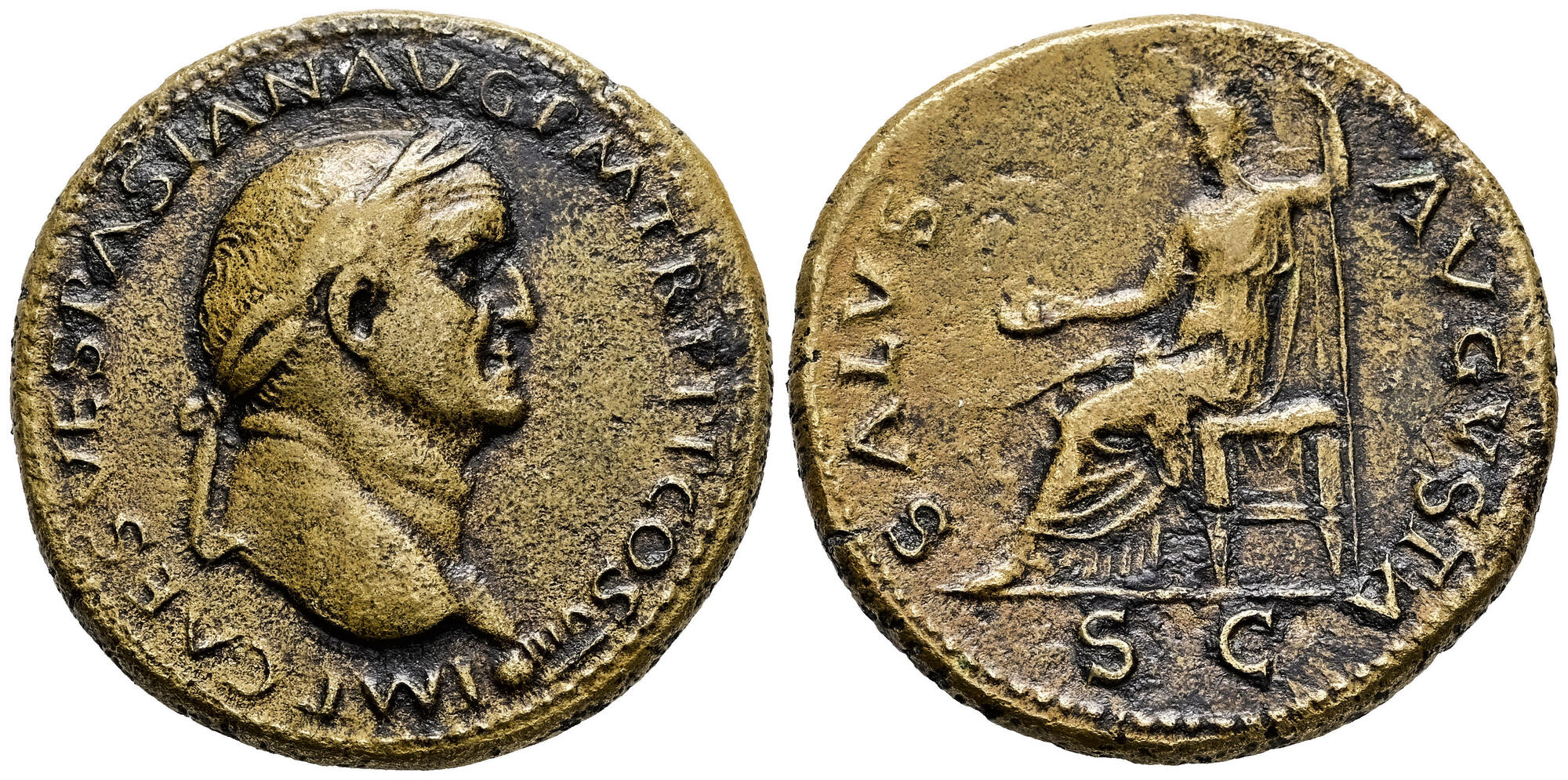 |
Match 4:
| Leu Numismatik AG > Auction 23 | Auction date: 2 November 2026 |
| Lot number: 389 Price realized: This lot is for sale in an upcoming auction - Bid on this lot  | |
| Lot description: Titus, 79-81. Sestertius (Orichalcum, 37 mm, 25.60 g, 6 h), Rome, 80. IMP T CAES VESP AVG P M TR P P P COS VIII Laureate head of Titus to left. Rev. IVD - CAP / S C Palm tree with two bunches of dates; to left, Judaea, draped and veiled, seated left on cuirass in attitude of mourning, resting her head on her right hand; to right, male captive standing right, head to left, with his hands bound behind his back; in front of him, shield and helmet. BMC 164. Bromberg I 311. CBN 158. Cohen 110. Hendin 6622a. RIC 149. Samel 2341. Shoshana I 20538. Rare and in exceptional condition for the issue. Beautifully struck, with a perfectly centered reverse of almost medallic appearance; surely among the finest known examples. Slightly rough, otherwise, nearly extremely fine. Ex Stack's, 5 December 2000, 306 (with original ticket). With the accession of Titus in 79 CE, the victory over Judaea remained one of the central themes of Flavian imperial representation. This was especially appropriate for the new emperor, who had personally commanded the final campaign and captured Jerusalem in 70 CE. The continued issue of explicit IVDAEA CAPTA types in 80 CE therefore linked Titus' own military achievement with the dynastic victory programme established under Vespasian. The familiar composition of the mourning Judaea and standing captive beneath the palm tree made that continuity immediately recognizable, while at the same time giving the type a particularly personal relevance for the conqueror of Jerusalem himself. The present sestertius is exceptionally well preserved for the issue and undoubtedly ranks among the finest known examples. The reverse in particular is perfectly centered and boldly struck, with the full dotted border giving it an almost medallic appearance. Beyond its exceptional quality, the coin is also an important reminder that the Judaean victory remained a powerful element of Flavian dynastic identity under Titus. This lot can be shipped to a US address. When delivered in Switzerland, this item is subjected to margin taxation in accordance with Art. 24a MWSTG (Swiss VAT Act), provided that the buyer is not registered for VAT. Estimate: 10000 CHF | 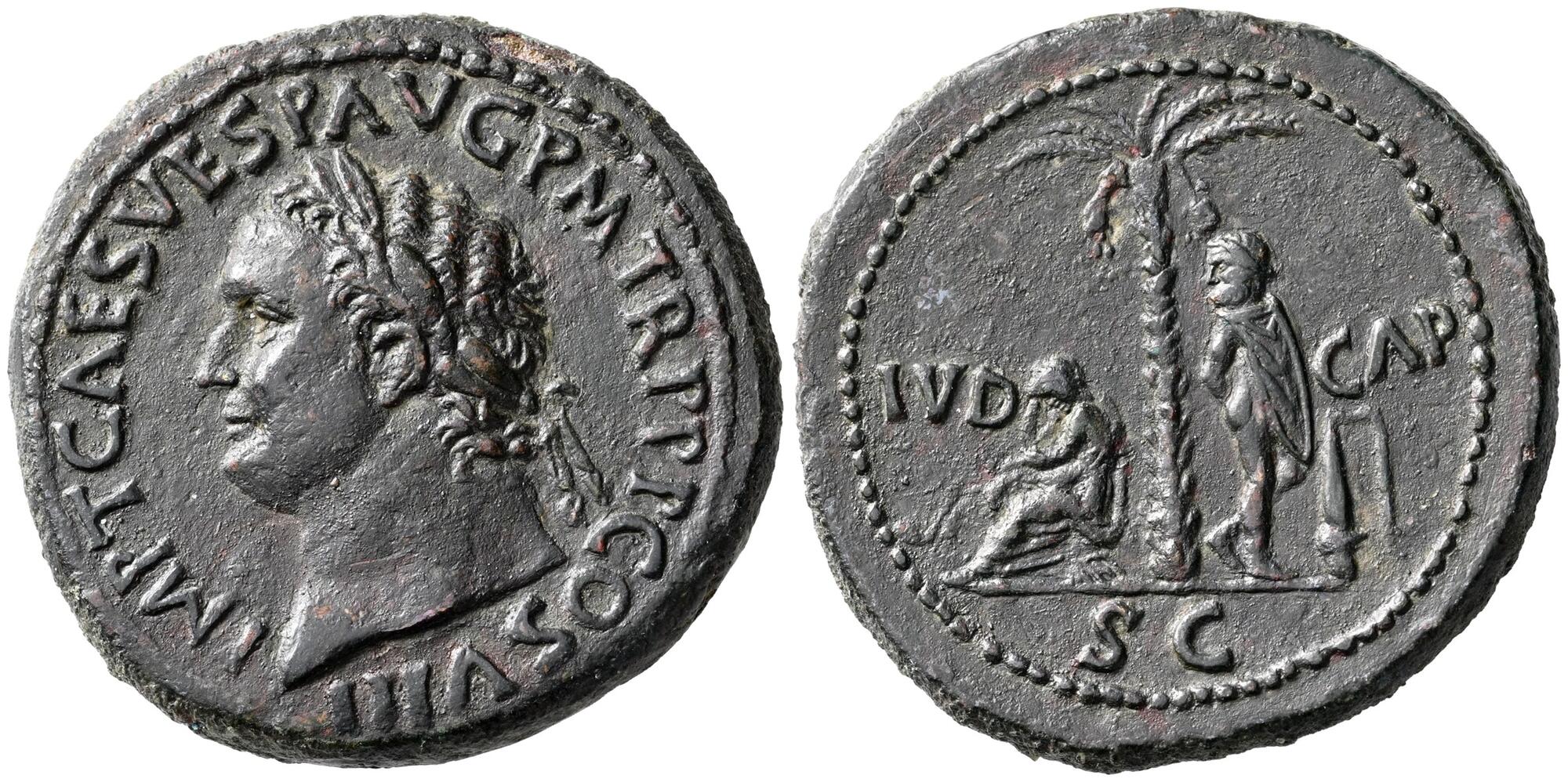 |

Match 5:
| Leu Numismatik AG > Auction 23 | Auction date: 2 November 2026 |
| Lot number: 390 Price realized: This lot is for sale in an upcoming auction - Bid on this lot | |
| Lot description: Titus, 79-81. Sestertius (Orichalcum, 35 mm, 23.53 g, 6 h), Rome, 80. IMP T CAES VESP AVG P M TR P P P COS VIII Laureate head of Titus to left. Rev. IVD - CA[P] / S C Palm tree with two bunches of dates; to left, Judaea, draped and veiled, seated left on shields in attitude of mourning, resting her head on her right hand; to right, male captive standing right with his hands bound behind his back; in front of him, two spears and shield. BMC 170. Bromberg I 311 var. (captive looking left not right). CBN 156. Cohen 109. Hendin 6624a. RIC 151. Samel -. Shoshana -. Rare. Two minor flan cracks and with light deposits, otherwise, very fine. Privately acquired from UBS, inv. no. 205823/Z (with original ticket). This lot can be shipped to a US address. When delivered in Switzerland, this item is subjected to margin taxation in accordance with Art. 24a MWSTG (Swiss VAT Act), provided that the buyer is not registered for VAT. Estimate: 2000 CHF | 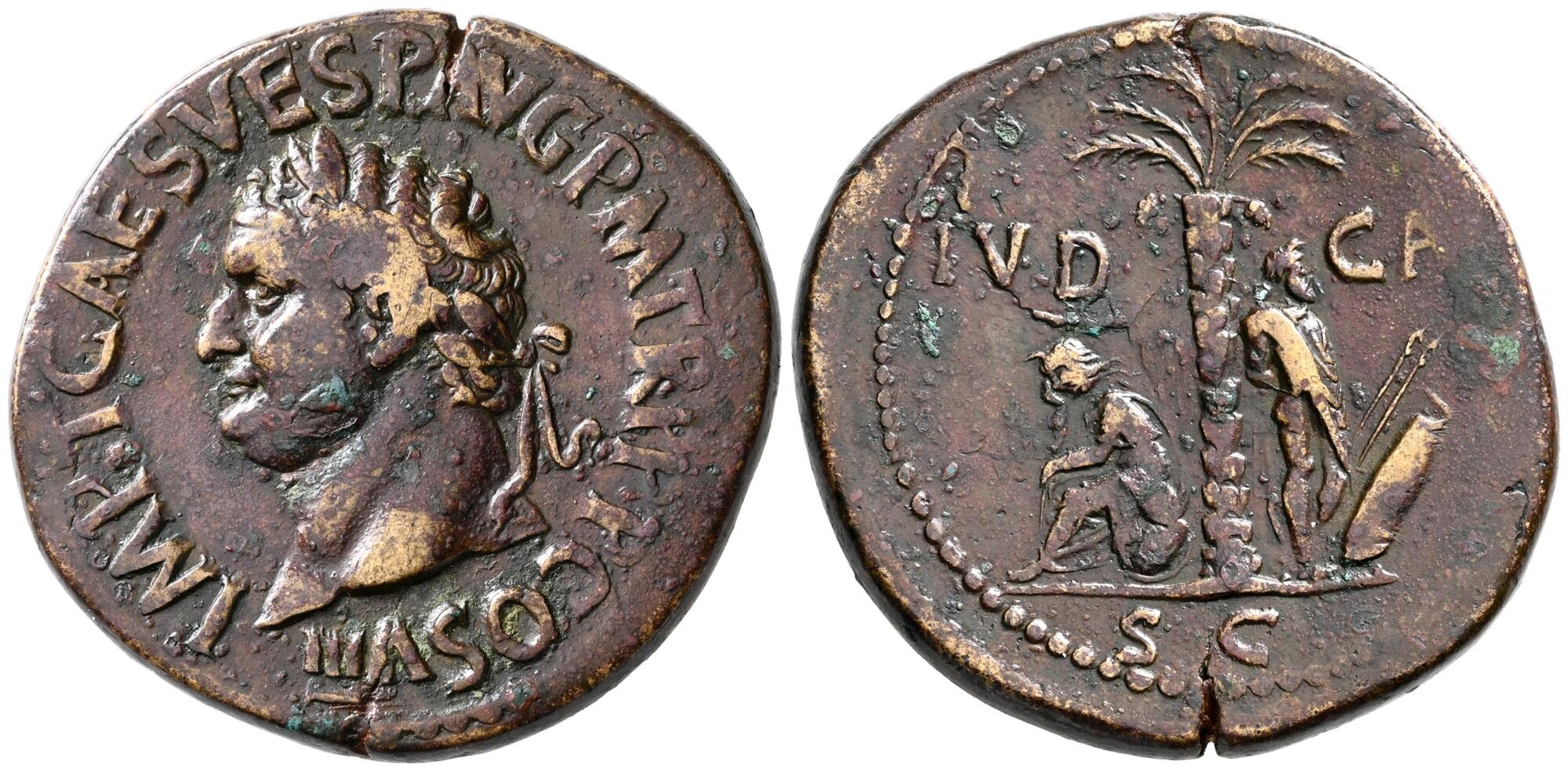 |
