

Our partner for world banknotes research

| Classical Numismatic Group > Auction 132 | Auction date: 18 May 2026 |
| Lot number: 40 Price realized: 27,500 USD (Approx. 23,623 EUR) Note: Prices do not include buyer's fees. | |
| Lot description: Vespasian. AD 69-79. AV Aureus (19mm, 7.35 g, 6h). Rome mint. Struck July-December AD 71. IMP CAES VESP AVG P M, laureate head right / NEP RED, Neptune, naked, standing left, right foot set on globe, holding acrostolium in right hand and vertical scepter in left. RIC II.1 44; Calicó 653a (this coin illustrated); BMCRE 54; BN 37; Adda 56; Biaggi 328. Minor marks, edge marks. EF. Well struck and in high relief. From the PLZ Collection. Ex Numismatica Ars Classica 51 (5 March 2009), lot 218; Numismatica Genevensis SA IV (11 December 2006), lot 165; Rev. W. L. Gantz Collection (Part 1, Glendining, 27 May 1941), lot 465; D. Anderson Collection (Glendining, 3 December 1929), lot 104; Hirsch XXXIV (5 May 1914), lot 1006; Hirsch XXXI (6 May 1912), lot 1194. An atypical reverse with Neptune's foot on a globe drew me to this attractive aureus, plus a provenance that is over a century old! (PLZ) Titus Flavius Vespasianus (Vespasian) would today be described as coming from a family of "new money." He was born outside Rome and raised in the countryside by his grandmother. He served as quaestor and then as aedile and he would be the first of his family to rise to senatorial rank. He made his reputation in the Roman army, serving in Thrace and the Claudian invasion of Britain in AD 43, where he was the legate of Legio II Augusta. His achievements in Britain are well recorded. In AD 51 he was elected consul, after which service he retired. Nero coaxed him out of retirement to govern Africa, but his most important military posting would come when Nero asked him to put down the Jewish rebellion in AD 66. While in Judaea the stage would be set for his rise to the throne where he would become the last man standing in AD 69, the Year of the Four Emperors. Vespasian's Judaean legions and those of neighboring Syria proclaimed him emperor on July 1, AD 69, and he quickly set sail for Egypt to secure the rest of the east. Unexpectedly, the Danube legions also declared for him and launched a lightning invasion of Italy that caught the forces of Vitellius flat-footed. Their victory, and the subsequent death of Vitellius, saw Vespasian confirmed as emperor by the Senate in absentia. He would not enter Rome until the late summer of AD 70. He immediately set about consolidating his support after the most tumultuous year in Rome's history. A relative unknown to the general populace, the mint set upon a propaganda campaign related to his defeat of the Jews with the massive outpouring of "Judaea Capta" coinage for both Vespasian and his elder son and coleader in the Jewish war, Titus. Upon the destruction of Jerusalem, Titus returned to Rome with the spoils of war, including a great number of enslaved Jewish combatants. Father and son celebrated with a terrific triumph and a substantial issue of Judaea Capta coinage (see lots 41 and 42). Vespasian used the wealth captured from the Jews to start construction on the Flavian Amphitheater (Colosseum). Sadly, it would not be completed during his lifetime. Besides the Colosseum, he also invested heavily in restoration projects throughout Rome. Vespasian was a stern ruler but was widely perceived as fair-minded and generous to people in need. He was well known for his wit and pleasant manner. Even his image on coins seem to portray these jovial qualities. As he lay on his deathbed, he is reported to have uttered the famous phrase "dear me, I think I am becoming a God!" The Flavian dynasty he founded would rule the empire for a combined 27 years. The coin offered here is one of only three examples to appear in Coin Archives. This is the finest of the three, and the Calico plate coin. Struck in high relief with a superb portrait. Estimate: 15000 USD |  |

Match 1:
| Classical Numismatic Group > Auction 132 | Auction date: 18 May 2026 |
| Lot number: 815 Price realized: Withdrawn | |
| Lot description: Elagabalus. AD 218-222. AV Aureus (20mm, 6.39 g, 6h). Rome mint. Struck end of AD 219. IMP ANTONINVS PIVS AVG, laureate and cuirassed bust right / P M T R P II COS II P P, distribution scene: Elagabalus, togate, seated left on curule chair on platform; to left, Liberalitas, holding abacus and cornucopia, standing left; at base of platform, citizen mounting steps, raising hand; LIB AVG II in exergue. RIC IV 9c; Thirion 142; BMCRE pp. 545-6 and pl. 87, 3 var. (bust type; same rev. die); Calicó 3000 (same dies); Biaggi 1286 var. (same; same rev. die); Mazzini –; Don Manuel Vidal Quadras Collection (Part 2, E. Bourgey, 16 December 1913), lot 416 (same dies). Toned. Good VF. Extremely rare. R.3 in Calicó. One of four known to this cataloger. Struck on the occasion of the marriage of Elagabalus and Julia Paula coinciding with the arrival of the sacred stone of Emesa in Rome. Estimate: 10000 USD |  |
Match 2:
| Classical Numismatic Group > Electronic Auction 609 | Auction date: 13 May 2026 |
| Lot number: 597 Price realized: 3,750 USD (Approx. 3,195 EUR) Note: Prices do not include buyer's fees. | |
| Lot description: Titus. As Caesar, AD 69-79. AV Aureus (19mm, 6.26 g, 6h). Rome mint. Struck under Vespasian, AD 74. T CAESAR IMP VESP, laureate head right / PONTIF TR POT, Fortuna standing left on cippus, holding rudder and cornucopia. RIC II.1 696 (Vespasian); Calicó 751. Fine. Estimate: 2000 USD | 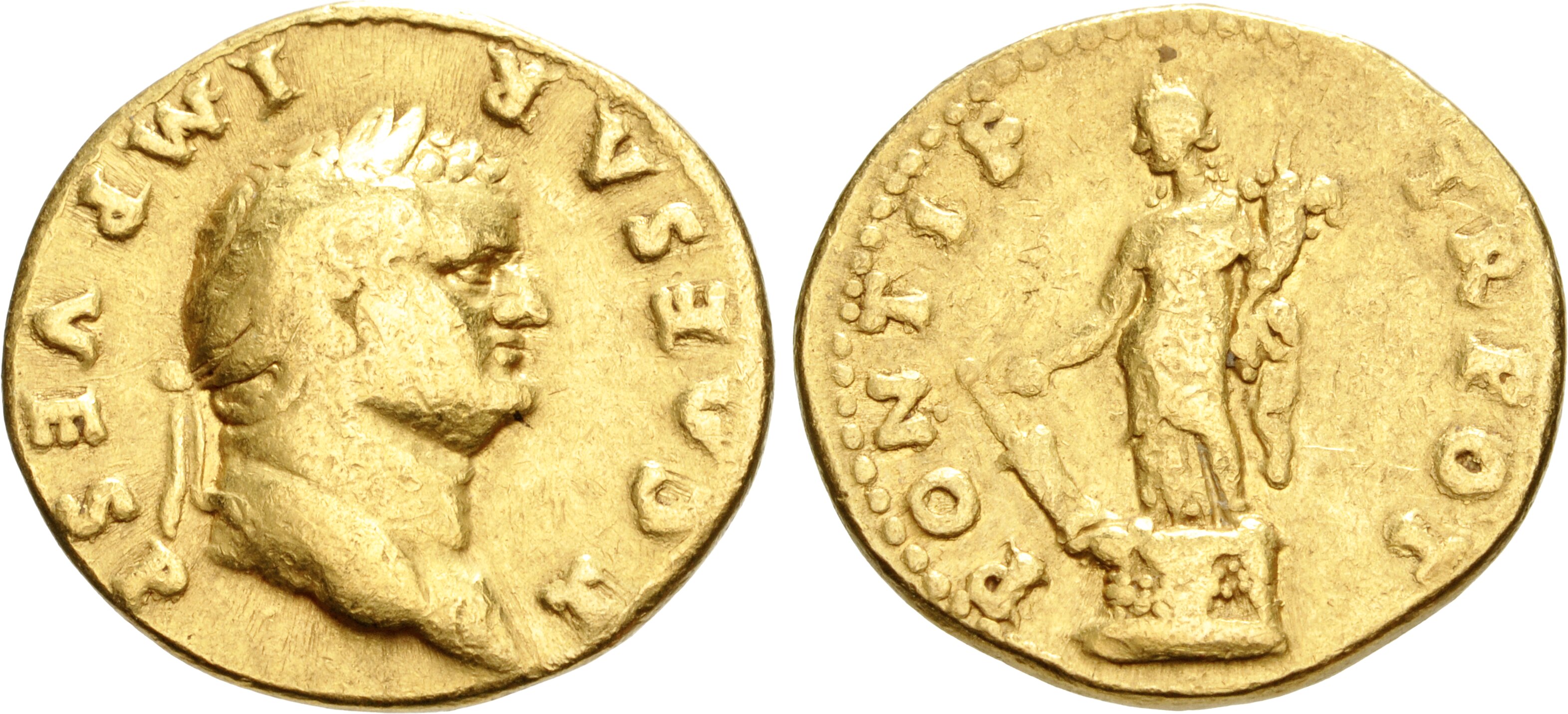 |
Match 3:
| Classical Numismatic Group > Electronic Auction 609 | Auction date: 13 May 2026 |
| Lot number: 593 Price realized: 3,750 USD (Approx. 3,195 EUR) Note: Prices do not include buyer's fees. | |
| Lot description: Vespasian. AD 69-79. AV Aureus (18mm, 7.05 g, 6h). Rome mint. Struck January-June AD 70. Laureate head right / Pax seated left, holding olive branch and winged caduceus. RIC II.1 28; Calicó 607a. Small banker's mark on reverse. Good Fine. Estimate: 2000 USD | 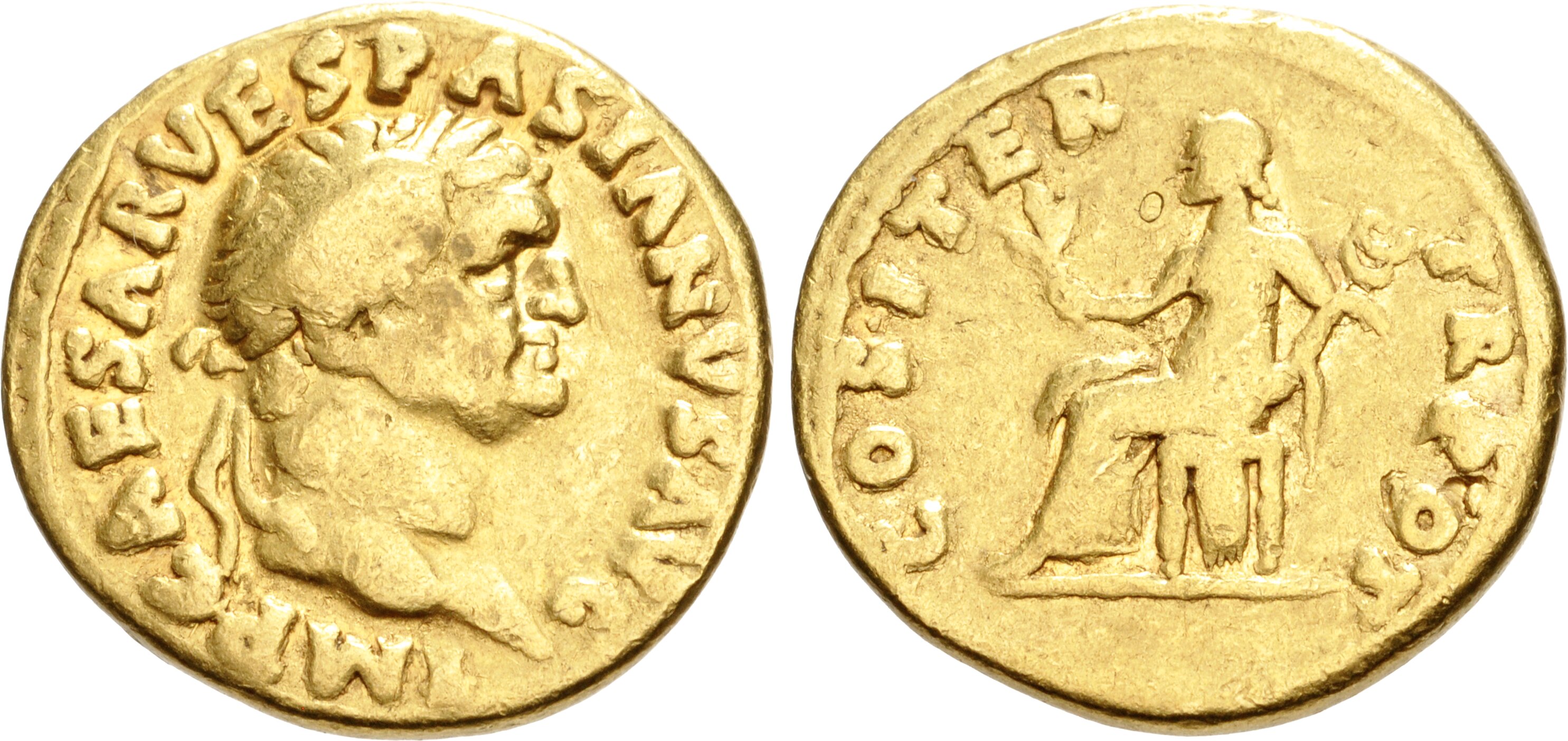 |
Match 4:
| Classical Numismatic Group > Auction 132 | Auction date: 18 May 2026 |
| Lot number: 44 Price realized: 27,500 USD (Approx. 23,623 EUR) Note: Prices do not include buyer's fees. | |
| Lot description: Titus. As Caesar, AD 69-79. AV Aureus (20mm, 7.39 g, 6h). Rome mint. Struck under Vespasian, AD 76. T CAESAR IMP VESPASIAN, laureate head right / COS V, heifer of Myron standing right. RIC II.1 857 (Vespasian); Calicó 733a; BMCRE 185 (Vespasian); BN 162 (Vespasian); Adda 64; Biaggi 363 (this coin); Jameson 71 (this coin); Mazzini 51. Minor scratch on obverse, minor marks on reverse. EF. A magnificent portrait. From the PLZ Collection. Ex Leo Biaggi de Blasys Collection (Numismatica Ars Classica 49, 21 October 2008), lot 162; Robert Jameson Collection (publ. 1913); M. Fellot Collection (Bourgey, 13 April 1904), lot 79. Another great provenance with an iconic reverse. (PLZ) Titus Flavius Vespasianus was the elder son of the emperor Vespasian. Like his father, he made his reputation in the Roman army, holding ever-more important positions in Germania and Britannia. Later, he led the 15th Legion to Judaea to join his father in the suppression of the Jewish rebellion known as the First Jewish War. In AD 69, "the Year of the Four Emperors," Vespasian broke off the Judean campaign to make his own attempt to seize the purple. Titus remained behind in Judaea to finish the campaign against the Jewish rebels. Vespasian would already be emperor when Titus finally besieged the city of Jerusalem in AD 70. When Jerusalem fell, the city and its centerpiece, the Second Temple, suffered almost total destruction. Titus returned to Rome in AD 71 and was given a grand triumph. Details of this event are still to be seen on the arch of Titus in the Roman Forum. Titus and Domitian were both declared Caesars by the Roman Senate, but Titus was clearly preferred and, as Praetorian Prefect, was virtually co-emperor with his father, holding seven consulships in total. Upon Vespasian's death in June of AD 79, Titus succeeded to the throne without opposition. He proceeded to rule with moderation, intelligence and compassion. Vespasian used the spoils of the Jewish war to build Rome's most recognizable and enduring monuments, the great Flavian Amphitheater (Colosseum). Although begun and largely constructed under his father, it would be Titus who officially opened the Amphitheater in AD 80. The inaugural games to open the Colosseum lasted for 100 days and included gladiatorial contests, naval battles, chariot and horse racing, and a wide variety of exotic animal events. To this day, even in ruins, it remains one of the most visited sites in Rome. Unfortunately, Titus' brief reign also included more than its fair share of tragedy. The eruption of Mount Vesuvius destroyed the cities of Pompeii and Herculaneum, likely in October AD 79, shortly after he assumed office. His relief efforts, which included large personal donations, are widely admired, and Titus is known to have visited the area on two occasions. In AD 80, another major fire broke out in Rome, and many buildings were destroyed, including the Pantheon, Temple of Jupiter, and Theater of Pompey. Again, Titus provided money from his personal fortune to aid in the relief and repair efforts. Unfortunately for Rome, his time was destined to be short. Titus was observed to weep at the games opening the Colosseum and took seriously ill shortly thereafter. He seems to have sensed his doom and lamented that he was going to an early grave with only one serious regret, the nature of which has been the subject of speculation ever since. He died on September 1, AD 81 at the age of 40, in the same house where his father had succumbed two years before. This impressive aureus of Titus was struck while he was Caesar to Vespasian, in AD 73. Although the Flavian dynasty was on firm footing by the time of issue, the reverse design of a standing sacrificial cow reprises an issue of Augustus and is intended to further legitimize Flavian rule. Hailing from the prestigious Biaggi Collection, this piece has an exceptionally detailed portrait of Titus, depicting him as a "chip off the old block" of his father. Estimate: 10000 USD |  |
Match 5:
| Classical Numismatic Group > Electronic Auction 610 | Auction date: 3 June 2026 |
| Lot number: 1058 Price realized: 4,000 USD (Approx. 3,435 EUR) Note: Prices do not include buyer's fees. | |
| Lot description: Titus. AD 79-81. AV Aureus (19mm, 7.17 g, 6h). Rome mint. Struck after 1 July AD 79. Laureate head right / Venus, seen half from behind, naked to the hips, standing right, right knee bent, resting left elbow on column, holding helmet up in right hand and transverse spear in left; shield resting against column to left. RIC II.2 13; Calicó 756a. Near VF. Estimate: 2000 USD |  |
